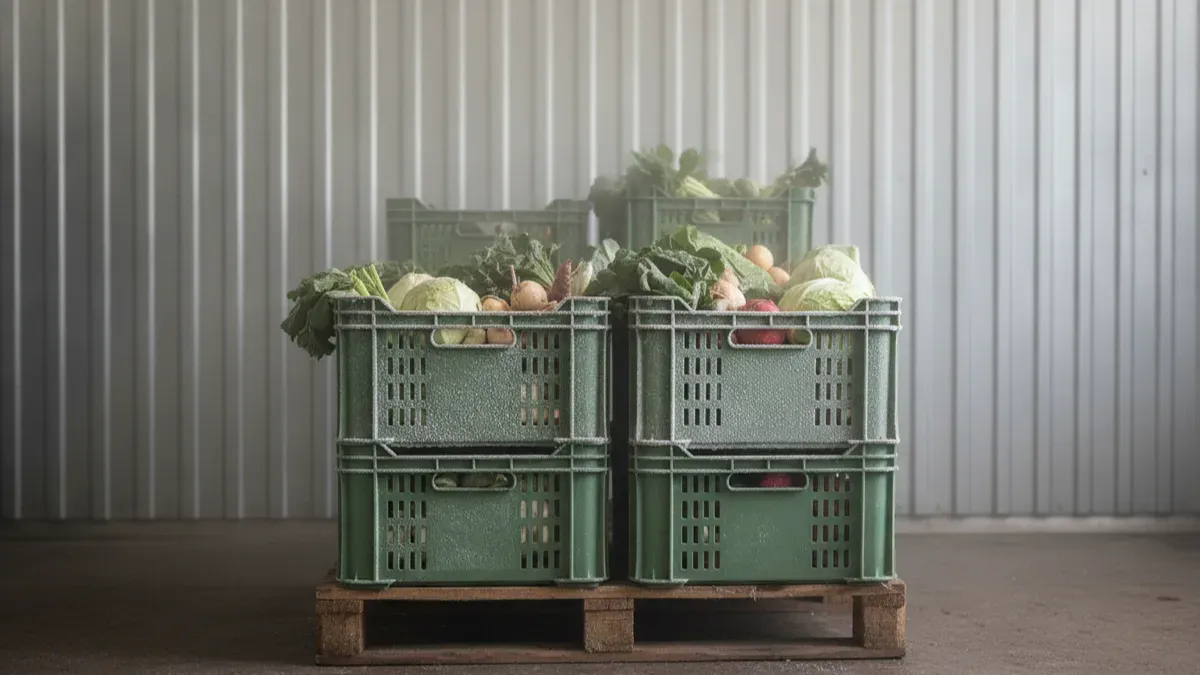
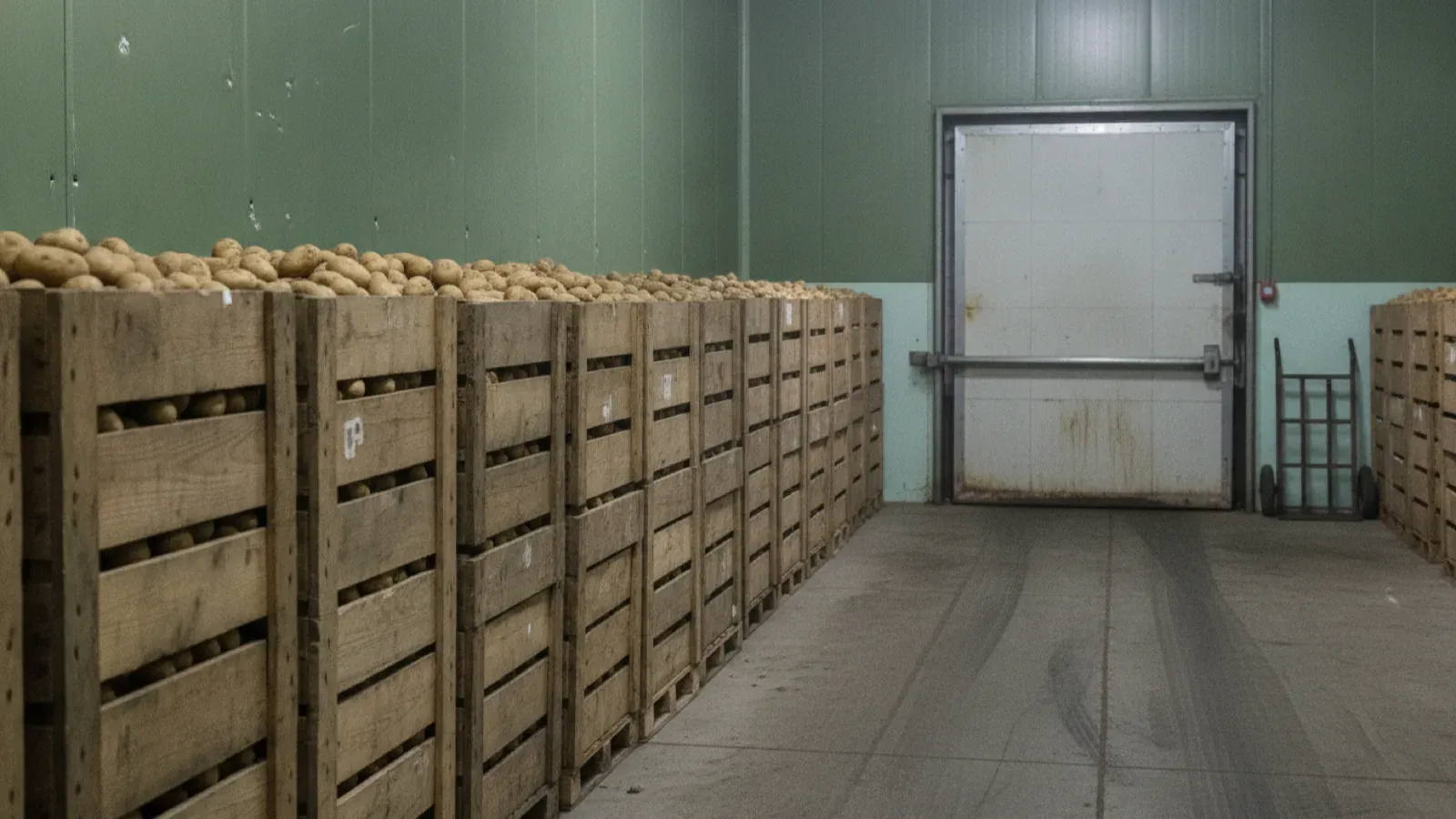
As of the April 2025 MIDH cost norms, a 5,000 MT cold storage costs ₹9,600 per MT in civil construction and ₹12,000 per MT with a pre-engineered building: roughly ₹4.8 crore to ₹6 crore before land. Back-ended subsidy is 35% in general areas and 50% in special ones, and the government's own schedule allows 24 months to build.
Build cost is the part that barely varies. Rent per bag, how many months your chambers stay full, the tariff category your discom puts you in and how much capacity already sits in your catchment change from district to district, and they are what decide whether the project works.
What does a cold storage business actually earn from?
A cold storage is a landlord business, not a trading business: you rent out chilled space by the bag, the quintal or the season, and occupancy is the single number that decides whether you make money. The rent per bag barely moves from year to year. The share of chambers that stay full does move, and it moves the profit with it.
Your paying customers are rarely farmers. They are traders and commission agents who buy at harvest and sell through the year, along with food processors, dairy and poultry suppliers, ice cream and frozen food distributors, and increasingly the dark-store operators who need chilled space near a city. Some of that demand is contractual and year-round. Some of it is one intense stocking season and then eight quiet months.
The demand backdrop is real. India produced 367.72 million tonnes of horticulture in 2024-25 (second advance estimates), of which fruits were 114.51 million tonnes and vegetables 219.67 million tonnes, and horticulture now accounts for about 33% of agricultural gross value added, according to the Economic Survey 2025-26. Post-harvest losses, measured by the NABCONS 2022 all-India study published in MoFPI's Annual Report 2024-25, run 6.02% to 15.05% for fruits and 4.87% to 11.61% for vegetables. Those are lower than the older CIPHET numbers people still quote, so the "20% of everything rots" line you will see on other pages is not what the government's own current study says.
What types of cold storage are there, and which one should you build?
Forget the old five-way split into potato, dairy, meat, processed food and multi-commodity units. The classification banks and subsidy officers actually work with, set out in the MIDH Operational Guidelines of April 2025, is CS-1 (bulk single-commodity, civil or civil plus pre-engineered building), CS-1-Onion, CS-2 (multi-chamber multi-product), CS-2-CA (controlled atmosphere), CS-3 (ripening chamber) and CS-4 (dry spices and raisins), with frozen storage and deep freezers sitting under the MoFPI cold chain scheme.
This matters for one blunt reason. Under MIDH, assistance for a new cold storage is available only for multiple-chamber, energy-efficient units. A single-chamber potato-only store can still be built, but it is effectively off the subsidy map, which changes its economics before the first brick is laid.
Multi-chamber units also spread the seasonality risk that kills single-commodity operators. A potato-only store in a potato belt fills in March and empties by November, and there is no second act. A CS-2 unit with separate chambers at different temperatures can hold apples, chillies, dry fruit, seed and frozen product in different months. Controlled atmosphere carries the highest capital cost and the highest power bill of the lot, so it belongs to operators who already have committed long-term contracts, not to first-timers.
How do you choose the site and location?
Pick either the growing belt or the consumption market and commit to it, because a plot that is halfway between the two serves neither. Land near the mandi buys you trader footfall and short haulage for outbound stock. Land in the growing belt buys you first call on the crop and cheaper inbound freight.
The land requirement follows from a volumetric norm rather than any official land rule. MIDH fixes chamber volume at 3.4 cubic metres per MT, so 5,000 MT needs about 17,000 cubic metres of chamber, roughly a 1,700 square metre footprint at 10 metre stacking height, before you add the yard, docks, ramp and admin block. One to one and a half acres remains a sane planning figure for that size, and it should be a plot a loaded truck can enter, turn and leave without reversing onto a highway.
Three-phase power decides more than location does. Check the sanctioned load your discom will actually give at that address, the tariff category it will fall under, and the cost of the transformer and the DG set. MIDH's cost norm bundles the DG set, transformers, electrical panels, automation and firefighting into the capital cost, which tells you how large a share of the project those items are. Water for the condensers, and a written survey of every competing store within your catchment (their capacity, their occupancy last season, the rate they charged), is the last box before you pay for land.
How much does a cold storage cost to build in 2026?
The government publishes per-MT cost norms and both the bank and the subsidy officer will appraise your project against them, so build your budget on these rather than on a builder's lump-sum quote. All figures below are the MIDH Operational Guidelines, April 2025.
| Capacity | Civil (₹ per MT) | Civil + PEB (₹ per MT) | Indicative build cost, land excluded |
|---|---|---|---|
| Up to 5,000 MT | 9,600 | 12,000 | ₹4.8 cr to ₹6.0 cr at 5,000 MT |
| 5,001 to 6,500 MT | 9,120 | 11,400 | ₹4.6 cr to ₹7.4 cr |
| 6,501 to 8,000 MT | 8,640 | 10,800 | ₹5.6 cr to ₹8.6 cr |
| 8,001 to 10,000 MT | 8,160 | 10,200 | ₹6.5 cr to ₹10.2 cr |
| 10,001 to 20,000 MT | 4,080 to 5,100 | 4,080 to 5,100 | ₹4.1 cr to ₹10.2 cr |
Controlled atmosphere is costed on top of this, with CA add-on components going up to ₹9.40 crore and the subsidy on them capped near ₹9 crore.
Two corrections to the figures still floating around. The often-repeated "₹10 crore for 5,000 MT" is only reachable once expensive land is stacked on top of the build cost, and "₹20 crore to ₹25 crore for 10,000 MT" is roughly double the government's own norm unless you are building controlled atmosphere or buying land at urban rates. Quote land as its own line in your project report and let the reviewer see it separately.
On the recurring side, the standing monthly heads are electricity, diesel for the DG set, refrigeration AMC, insurance, labour and marketing. There is no official per-month benchmark for these, and anyone quoting you a neat all-India figure has invented it. Get written quotes locally, and budget working capital for one full idle season plus the first stocking cycle, because rent usually lands at the end of a storage season while the power bill lands every month.

What subsidy and loan can you get for a cold storage?
The honest 2026 answer is 35% of eligible project cost in general areas and 50% in difficult areas, not the 50% to 75% that half the internet still repeats. The MoFPI revision dated 22 May 2025 collapsed the older split into a single 35% / 50% pattern, capped at ₹10 crore per project. MoFPI's own web page for pattern of assistance still displays the pre-2025 numbers because it was last updated in 2020, so work from the 2025 PDF, not the web page.
There is a second trap in the same scheme. Under clause 4.3 of those revised guidelines, standalone facilities are not considered: an eligible project must include farm-level infrastructure and a processing centre, plus at least one of a distribution hub or reefer vehicles. A plain potato store, however well built, no longer qualifies for the PMKSY cold chain grant. The application fee is ₹20,000 (₹15,000 for SC/ST applicants), and 408 cold chain projects had been approved under the scheme as on 31 March 2026, which tells you how selective it is.
For a standalone store the live route is MIDH plus NHB. Assistance is credit-linked and back-ended at 35% in general areas and 50% in North Eastern, Himalayan, scheduled and vibrant-village areas. Where you apply depends on size: up to 5,000 MT goes through your state horticulture mission (NHM or HMNEH), and 5,001 to 20,000 MT goes through NHB. That is what the 5,000 MT figure actually means, and it is not a viability floor.
Financing now runs mostly through the Agriculture Infrastructure Fund. AIF had mobilised ₹1,23,002 crore and supported over 2,700 cold storage projects as on 27 November 2025, per the Economic Survey 2025-26. Its terms: a minimum 10% promoter contribution, with any capital subsidy counting towards that contribution, 3% interest subvention on up to ₹2 crore of loan for seven years, and credit guarantee cover extended from 2+5 to 2+8 years. Forget the old "banks lend 80% at concessional interest" line; there is no such fixed rule, and your term loan share will be whatever your appraisal and collateral support. If you are preparing for that appraisal, tidy up your CIBIL score and read how business loan applications are assessed before you approach a branch.
One thing to check on the day you start your DPR. A Department of Expenditure office memorandum of March 2026 continues the DA&FW schemes, including AIF and Krishonnati Yojana (which now carries MIDH), only till 30 September 2026 or until they are approved for the 16th Finance Commission cycle, on the same scope and cost norms. The schemes are running, but the extension is temporary, so confirm current status on the portal before you build a financial model around a subsidy percentage. Applications and scheme documents sit on agriinfra.dac.gov.in, nhb.gov.in and the converged krishinivesh.gov.in portal. It is worth reading how government schemes for small businesses are structured generally, since the sequencing is the same across most of them.
No scheme pays before construction. MIDH and NHB assistance is released after the unit is built and physically inspected. MoFPI releases its grant in three tranches of 25%, 40% and 35% against verified expenditure and a project management agency's evaluation, and AIF requires assets to be geo-tagged through the Krishi Mapper app. The promoter funds first and claims later, every time.
Which licences, registrations and NOCs do you need?
Start with the deletions, because the standard licence lists circulating online contain approvals that do not exist. There is no central "industry department permission" for a cold storage. There is no MoFPI licence (MoFPI gives grants, not licences). There is no "food chemical department" clearance anywhere in Indian law, and there is no separate "environment NOC"; what exists is a consent from the State Pollution Control Board.
| Approval | Issued by | Level |
|---|---|---|
| Udyam registration | Ministry of MSME, udyamregistration.gov.in | Central |
| GST registration | GSTN / CBIC | Central |
| FSSAI licence, kind of business "Storage / Warehouse / Cold Storage" | FSSAI, through FoSCoS | Central or state, per eligibility |
| WDRA registration | Warehousing Development and Regulatory Authority | Central |
| Factory licence | State factories / labour department | State, via single window |
| Fire NOC | State fire service | State |
| Consent to Establish and Consent to Operate | State Pollution Control Board | State |
| Shops and establishments or labour registration | State labour department | State |
| EPF and ESI registration | EPFO and ESIC, online only | Central |
Two of these have changed recently and are worth knowing before a consultant charges you for the news. First, CPCB's list of sectors classified as on 24 August 2026 places cold storage (entry 34.2) in the Green category with a pollution index of 30, notified on 12 February 2025. That is the lightest consent track, so the pollution clearance is not the ordeal readers often fear. Second, a MoFPI letter dated 13 July 2026 makes WDRA registration compulsory for cold storage facilities created under its cold chain projects, with the certificate to be emailed to the ministry. WDRA registration is online only, Category-V covers controlled-temperature commodities such as table, seed and processing potatoes, apples in CA, carrots and citrus, and the agri-warehouse registration fee on WDRA's schedule as of 2026 is ₹20,000 for a 5,000 to 10,000 tonne store (₹500 for FPOs, PACS and SHGs). Even if you are not taking a MoFPI grant, registration is worth doing: it lets your store issue electronic negotiable warehouse receipts, which lets your depositors raise pledge finance against stock lying in your chambers. That is a reason for a trader to choose you over the store down the road.
Whether the FSSAI licence is a state or central one depends on eligibility rules you should check on FoSCoS rather than on any number printed in an article. On the entity side, note that MSME limits were raised from 1 April 2025: micro is now investment up to ₹2.5 crore and turnover up to ₹10 crore, small is ₹25 crore and ₹100 crore, medium is ₹125 crore and ₹500 crore. A ₹5 crore to ₹10 crore cold storage sits comfortably inside "small enterprise", so Udyam registration and the MSME credit and payment-protection benefits are available to you. If you already registered, you can check your MSME registration by name on the Udyam portal. Licence positions differ by state and change; verify each with the authority or your CA before you file.
What goes into the project report (DPR)?
The DPR is the only document the bank's appraisal officer and the subsidy department actually read, and a weak one is the most common reason a viable project stalls. AIF publishes document checklists and a DPR template on agriinfra.dac.gov.in, which is the cheapest way to see the expected structure before you pay anyone.
It needs the promoter profile and entity documents, the site details with land ownership or lease papers, capacity and chamber configuration against the MIDH volumetric norm, technical specifications of the refrigeration plant and insulation, and the cost estimate line by line against the published norms. Then the assumptions that decide everything: occupancy year by year rather than a flat number, tariff per bag or per quintal benchmarked to what stores in your catchment actually charge, and power consumption at that occupancy.
The finance section states means of finance (promoter contribution of at least 10% under AIF, term loan, and back-ended subsidy shown as a receivable rather than as day-one cash), followed by projected profit and loss, cash flow, DSCR and the break-even year. CA-certified financials remain part of the document set for both bank appraisal and subsidy claim. Professional fees for DPR preparation vary widely and there is no official schedule, so take two or three written quotes and ask each preparer for a project of your size that was actually sanctioned.
How long does it take to build, and when does the money start coming?
Plan for 24 months from the approval letter to a commissioned plant, or 30 months in difficult areas, which is what the MoFPI cold chain guidelines of 22 May 2025 allow before the grant lapses (validity and performance security run to 32 months). The "about one year" you will see quoted is optimistic against the government's own schedule, and it ignores that your opening season is fixed by the harvest calendar, not by your completion certificate. Finish in April in a potato belt and your plant sits empty for eleven months.
Sequence the last stage carefully. Layout and equipment must follow NCCD technical standards, which MIDH makes binding for every subsidised cold storage component, and it is the NCCD spec that the inspecting engineer will hold your builder to. Before commercial operation you need the SPCB consent to operate and the fire NOC in hand, and grant-funded projects get a separate project management agency inspection before final release. Run the refrigeration plant on trial with a partial load first, so that pull-down time, humidity control and panel faults surface in an empty chamber rather than on a chamber holding someone else's crop.
There is no official payback benchmark for this business, and any article giving you a confident "three to four years" is guessing. The one hard anchor is the financing structure: an AIF-backed term loan runs a maximum of seven years including a moratorium of up to two years. So the realistic frame is the moratorium plus a ramp-up period during which occupancy climbs, and your DPR should state the occupancy percentage at which rent covers EMI plus the power bill. That percentage, not a year number, is the target you manage against every season.
How do you staff and run the plant day to day?
The one hire that cannot be substituted is a refrigeration operator who knows your plant, and experienced hands are hard to find in most districts. Around that role you need an electrician, a store keeper who can maintain lot-wise records, loaders on seasonal engagement, and security. Operators solve the technician problem the same way everywhere: they hire away from an existing cold storage, pay above the local rate, and keep a second person trained enough to cover a shift.
Daily operations are mostly documentation. Chamber-wise temperature and humidity logs, lot-wise stacking records showing whose bags sit where, gate records for inward and outward movement, and a standby protocol for a power cut, meaning who starts the DG set and how quickly. When stock is damaged, the log is the only thing standing between you and a full-value claim. Insure the building, the plant and, separately, the stored goods, and be explicit in your storage receipt about what liability you carry and what the depositor carries.
How do you market a cold storage so the chambers fill up?
Occupancy is locked months before the season starts, so the selling happens before the harvest, not during it. By the time trucks are moving, every trader has already decided where his stock is going. Advance booking, with a token amount against a chamber allocation, is how an established store walks into a season with most of its space already committed.
The channel is relationships, not advertising. Commission agents and aadhatiyas in your nearest mandi place other people's stock and are the closest thing this business has to a sales force. Beyond them, FPOs looking for storage near their collection centre, dairy and poultry suppliers wanting year-round chambers, food processors buying seasonal raw material, and quick-commerce dark-store operators needing chilled space near a city all bring steadier, less seasonal demand than the traditional trade. Keep the local basics running too: presence at farmer meetings, hoardings on the mandi road, a WhatsApp group where you post available space and rates before each season.
What are the biggest risks?
Power is the first one. Electricity plus diesel is the largest recurring cost in this business, a tariff revision or a category change hits you directly, and a district with frequent outages turns your DG set from a backup into a co-primary power source with a fuel bill to match.
Oversupply is the second. In established potato belts, new capacity has kept arriving in the same catchments, and when stores compete on rate the whole district's tariff falls together. This is why the competitor survey belongs before the land purchase, not after. The national picture supports the point, with the caveat that the last official assessment is a decade old: NCCD's all-India capacity study of August 2015, reproduced in MoFPI's Annual Report 2024-25, put bulk cold store capacity at 32 million MT against a requirement of 35 million MT, while the real gaps sat elsewhere, with 250 integrated pack houses against a need for 70,000, under 10,000 reefer trucks against 62,000, and 800 ripening chambers against 9,000. Bulk storage was already close to assessed national requirement then, and no newer official census has replaced that reading; the missing links are pack houses, reefer transport and ripening. That should influence what you build.
Third, recovery. Traders who cannot sell leave stock in your chambers and delay rent, and a commodity price crash can wipe out both your customer's margin and your season's collections at once. Season rent is often collected after the stock moves out, which makes you a lender in practice; keep a running balance for every depositor from day one rather than reconstructing it in June. A free digital khata app like OkCredit records each entry with an SMS to the customer and sends automatic payment reminders on outstanding balances (Android app).
Finally, be honest with yourself about scale. This is a capital-heavy, long-gestation project with a back-ended subsidy you fund first and claim later, and a scheme framework currently running on a temporary extension. If ₹5 crore of committed capital plus a two-year build is not something you can carry, the answer is not a smaller cold store. It is a different entry point.

What are the low-budget ways into cold chain?
Every small component has its own published cost norm and the same 35% general / 50% special-area back-ended subsidy, which makes these real projects rather than consolation prizes. Figures are from the MIDH guidelines of April 2025.
| Component | Official cost norm (2025) | Notes |
|---|---|---|
| Staging cold room | Up to ₹52 lakh | Suited to a single mandi or a retail cluster |
| Solar-powered cold room | Allowed on a standalone basis | Useful where power supply is weak |
| Mobile pre-cooling unit | ₹30 lakh | Goes to the farm instead of the crop coming to you |
| Pre-cooling unit | ₹5 lakh per MT | Pack house adjunct |
| Ripening chamber | ₹1.00 lakh to ₹1.20 lakh per MT | 800 exist nationally against a need for 9,000 |
| Refrigerated vehicle, 4 to 14 MT | ₹3.45 lakh per MT, NHB cap ₹80 lakh per project | Also an eligible AIF project type |
Reefer transport as a service is the most instructive of these. You learn cold chain handling, temperature discipline and the customer set at a fraction of the capital, and you find out whether the demand in your area is real before you commit to a plant. Renting chamber space inside an existing facility and sub-letting it is the other low-capital route, though it works only where you can lock a rate for the full season. If someone offers you a cold storage franchise, verify the operator's existing units, their registrations and their audited numbers before any payment; there is no scheme approval that vouches for a private franchisor. For other options at this capital level, browse more small business ideas.
FAQ
How much does it cost to start a cold storage business in India?
Build cost follows the MIDH cost norms of April 2025: ₹9,600 per MT for civil construction and ₹12,000 per MT with a pre-engineered building for units up to 5,000 MT, which is about ₹4.8 crore to ₹6 crore for a 5,000 MT plant, excluding land. Larger slabs cost less per MT, down to ₹8,160 to ₹10,200 per MT in the 8,001 to 10,000 MT band. Controlled atmosphere components are costed separately, up to ₹9.40 crore.
How much subsidy is available on a cold storage in 2026?
35% of eligible project cost in general areas and 50% in difficult areas, for SC/ST applicants, FPOs and SHGs, under the MoFPI cold chain scheme guidelines of 22 May 2025, capped at ₹10 crore per project. MIDH and NHB give credit-linked back-ended assistance at the same 35% and 50% rates. The older 50% to 75% figure no longer applies. All assistance is released after construction and inspection, never before.
Which licences do I need for a cold storage?
Centrally: Udyam registration, GST, an FSSAI licence under the kind of business "Storage / Warehouse / Cold Storage" applied for on FoSCoS, plus WDRA registration, which MoFPI made compulsory for its cold chain projects by letter dated 13 July 2026. From the state: factory licence, fire NOC, State Pollution Control Board consent (cold storage is a Green-category activity with a pollution index of 30 in CPCB's list as on 24 August 2026), labour registration, and EPF and ESI once thresholds are crossed. Verify each with your own state's single-window portal.
How long does it take to build a cold storage, and when does it turn profitable?
The MoFPI cold chain guidelines allow 24 months from the approval letter to operationalise a project, and 30 months in difficult areas. There is no official payback benchmark. The usable anchor is the financing: AIF term loans run a maximum of seven years including a moratorium of up to two years, so plan for the moratorium plus a ramp-up season or two, and manage against the occupancy percentage at which rent covers EMI plus the power bill.
Can I enter the cold chain business with a small budget?
Yes, through costed components rather than a full plant. As of the April 2025 MIDH norms, a staging cold room is funded up to ₹52 lakh, a mobile pre-cooling unit at ₹30 lakh, a ripening chamber at ₹1.00 lakh to ₹1.20 lakh per MT, and a refrigerated vehicle of 4 to 14 MT at ₹3.45 lakh per MT with NHB capping refrigerated transport at ₹80 lakh per project. All carry the same 35% or 50% back-ended subsidy, and reefer vehicles are an eligible AIF project type.