A paper bag unit in 2026 starts at roughly Rs 4.5-7 lakh for an entry roll-fed automatic machine, plus shed, power and your first paper lot. Licences are light: Udyam, a municipal trade licence, GST once turnover crosses Rs 40 lakh, and a written intimation to the pollution board. BIS certification is not mandatory.
Two things decide whether the unit makes money, and neither is the machine. One is the price you actually realise per bag, which is set by the compliant plastic bag next to yours on the shelf. The other is a tax quirk introduced on 22 September 2025: you now buy kraft paper at 18% GST and sell bags at 5%. Both are covered below with the numbers.
What does a paper bag business actually sell, and who buys it?
There are three product tiers, and the tier you pick decides the machine you buy, so decide this before you look at a single quotation.
The first tier is the plain kraft V-bottom carry bag with no handle: the brown grocery and sweet-shop bag, made on a roll-fed machine at very high speed, sold on price alone. The second is the printed bag with flat or twisted handles, the one a garment shop or a bakery puts its name on. That needs either an inline 2-colour or 4-colour print unit or a separate square-bottom handle-bag line. The third is premium: board-based tote, gift and jewellery bags, heavier GSM, often laminated or with lace and eyelet finishing, made in short runs at prices several times the plain bag.
Your buyer list is longer than most people assume. Kirana and grocery shops, bakeries and sweet shops, garment and footwear retail, pharmacies, jewellers, restaurants and cloud kitchens, and D2C brands buying branded packaging. If you plan to sell to a kirana store crowd, expect price-shopping and monthly cycles. If you sell to garment retail and D2C, expect artwork files, sampling and better margins.
One split matters more than the rest: bags that touch food are a different compliance track from bags that do not. A bakery or sweet-shop buyer is a food business operator and is bound by the FSSAI packaging rules, so it will ask you for food-grade paper and compliant ink. A footwear shop will not ask you anything except the rate.
Finally, decide whether you are a job-worker or a brand. Job-work means converting paper for a bigger converter or a packaging trader on their reel, their artwork, their customer, at a conversion rate per thousand. Lower margin, near-zero selling effort, no receivables risk. Owning your own stock-bag brand means you carry the inventory, the credit and the sales work, and you keep the whole spread. Most small units start with a mix and drift toward whichever one their orders come from.
How much does it cost to start a paper bag business in 2026?
The machine is the biggest single cheque, and prices on live 2026 supplier listings split cleanly by machine family.
| Tier | What it makes | Nameplate output | Machine price on 2026 listings |
|---|---|---|---|
| Hand tools | small plain bags, sampling, home scale | a few hundred a day by hand | bought as separate tools: paper punching machine, creasing machine, eyelet press, gum. There is no single Rs 50,000 machine |
| Roll-fed automatic, V-bottom (small "baby" and standard classes) | plain or 2/4-colour printed grocery and carry bags, no handle | 200-500 bags/min on the small model, up to 300 bags/min on the standard model | Rs 4.2 lakh to Rs 13.5 lakh, common entry point Rs 4.5-7 lakh |
| Sheet-fed and semi-automatic pasting | square-bottom and handle bags in shorter runs | operator paced | roughly Rs 3 lakh to Rs 8 lakh (sheet-feeding square-bottom machine around Rs 5.5 lakh, pasting machine around Rs 8 lakh) |
| Square-bottom handle-bag line | shopping bags with flat or twisted handles, fully automatic | 80-200 pieces/min, roughly 4,800-12,000 an hour | Rs 45 lakh to Rs 1.4 crore |
Machine prices are ranges from live IndiaMART supplier listings as of 2026, not a manufacturer price list. Indian machine builders publish full spec sheets but quote price only on enquiry, so treat these as the band to negotiate inside, and get three written quotations. Output figures are from the builder's own spec pages (Mohindra Mechanical Works, small and standard roll-fed models) and are nameplate speeds before changeover, reject and downtime losses. That builder is named here only because its spec sheets are published and citable, not as a supplier recommendation. Every machine on your shortlist publishes the same sheet, and comparing those sheets side by side is the point.
Two figures that circulate widely deserve correcting. There is no Rs 50,000 manual paper bag machine on the market in 2026: the cheapest thing listed as manual in the category is about Rs 2.9 lakh and rated at 50 pieces an hour, which is a worse buy than the same money spent on hand tools plus labour. And the old pairing of "Rs 50 lakh investment for 60 lakh bags a year" does not survive arithmetic. Sixty lakh pieces a year is about 20,000 a day over 300 working days, roughly 2,500 an hour on a single shift, which an entry roll-fed automatic at Rs 4.5-7 lakh covers several times over. Rs 50 lakh in 2026 buys you an entry square-bottom handle-bag line, which is a different product, not a bigger volume of plain bags.
Then there is everything that is not the machine, and it usually adds up to more than first-timers budget:
Shed rent plus a security deposit, typically several months of rent held. A three-phase power connection with the sanctioned load matched to the machine's connected load on the spec sheet, plus the deposit the discom charges for it. Ancillary equipment: cutting, creasing, punching, eyelet and lace fitting, a motorised roll slitter and a weighing scale. Your first raw material lot, which for one tonne of bag-grade kraft at 2026 rates of Rs 35-65/kg is Rs 35,000 to Rs 65,000. A compressor, pallets and racking. And the item that sinks more paper bag units than any machine fault: working capital for the credit period. If you build to Rs 3 lakh of monthly sales on 60-day terms, you are permanently carrying about Rs 6 lakh of receivables before you have earned a rupee of profit. Budget that, or finance it. If you are looking at term finance for the machine, read up on how a business loan in India is actually assessed before you sign an order.
Which licences and registrations does a paper bag unit need?
The paperwork for a converting unit is genuinely light, and the single most repeated claim about it online is wrong: BIS certification is not mandatory for paper bags.
BIS's own list of products under compulsory certification (Scheme I, the ISI mark) contains exactly one paper entry as of 2 September 2026: plain copier paper, under the Plain Copier Paper (Quality Control) Order, 2020. No Quality Control Order covers kraft paper, paper sacks or paper carry bags, and none appears on BIS's list of upcoming QCOs. ISI marking on a paper bag is voluntary. A large buyer may still ask you to conform to a specific IS number, but that is a contract term you agree to, not a licence you apply for.
Here is the list that does apply.
Udyam (MSME) registration. SSI registration no longer exists. Udyam replaced it, and the portal requires holders of EM-II, UAM or any other Ministry of MSME registration to re-register. It is free, online and self-declared. Classification limits were raised with effect from 1 April 2025: micro is investment up to Rs 2.5 crore and turnover up to Rs 10 crore, small up to Rs 25 crore and Rs 100 crore, medium up to Rs 125 crore and Rs 500 crore. The MSMED (Amendment) Bill, 2026, passed by the Rajya Sabha on 3 August 2026 and the Lok Sabha on 7 August 2026, makes filing the Udyam memorandum voluntary. File it anyway: scheme benefits, priority-sector credit and the delayed-payment machinery all key off it. If you have registered before and lost the number, here is how to check MSME registration by name.
Trade licence from the local municipal body, or shop-and-establishment registration, depending on your urban local body. This is the one licence a home-scale unit genuinely cannot skip, and the fee, form and renewal cycle are ULB-specific. An industrial shed in a notified area brings the estate authority's allotment conditions along with it.
GST, PAN and a current account. GST registration is compulsory once aggregate turnover crosses Rs 40 lakh for a person supplying goods only, or Rs 20 lakh in the listed special-category states (Arunachal Pradesh, Manipur, Meghalaya, Mizoram, Nagaland, Puducherry, Sikkim, Telangana, Tripura, Uttarakhand), per Notification 10/2019-Central Tax. Inter-state supply and the other section 24 cases mean registration from day one regardless of turnover. Those thresholds were not changed by the September 2025 rate reform. Staying under the threshold to avoid compliance has a specific cost in this business, covered in the margin section below.
Entity choice. A proprietorship needs no ROC registration at all. ROC comes into it only if you choose a private limited company or an LLP, which is a tax and liability decision, not a licensing requirement.
Pollution control: intimation, not consent. CPCB classifies "cardboard or corrugated box and paper products (excluding paper or pulp manufacturing and without using boilers)" as White category with a pollution index of 20, entry 31.0 of the list of sectors as on 24 August 2026. White category units are exempt from Consent under section 21(1) of the Air Act and section 25(1) of the Water Act, subject only to informing the State Pollution Control Board or Pollution Control Committee in writing. The exemption notifications, G.S.R. 702(E) and 703(E) of 12 November 2024, were substituted as recently as 8 July 2026, so this is current. One caveat with teeth: a standalone gravure or printing press is a separate Orange-category sector (entry 127.0). Bolt a full printing press onto your unit and your category changes.
Food-contact bags. Under the Food Safety and Standards (Packaging) Regulations, 2018, paper and board in direct contact with food must be food grade, free from contaminants and conform to a Schedule-I standard: IS 6615 for general-purpose packing and wrapping paper, IS 6622 for greaseproof, IS 7161, IS 1776 for folding box board, IS 2771 for corrugated boxes, IS 8970. Printing inks used on food packages must conform to IS 15495, and newspaper or similar material must not be used for storing or wrapping food. The legal obligation sits on the food business operator, not on you, which is precisely why bakery and cloud-kitchen buyers will ask for your paper grade and ink in writing. Keep the mill's test certificate and your ink supplier's declaration on file.
Licence rules vary by state and municipality and they move. Confirm your list with your local authority and a CA before you spend.

Which paper bag making machine should you buy, and what raw material?
Match the machine family to the bag you have already found a buyer for, because the two families do not overlap.
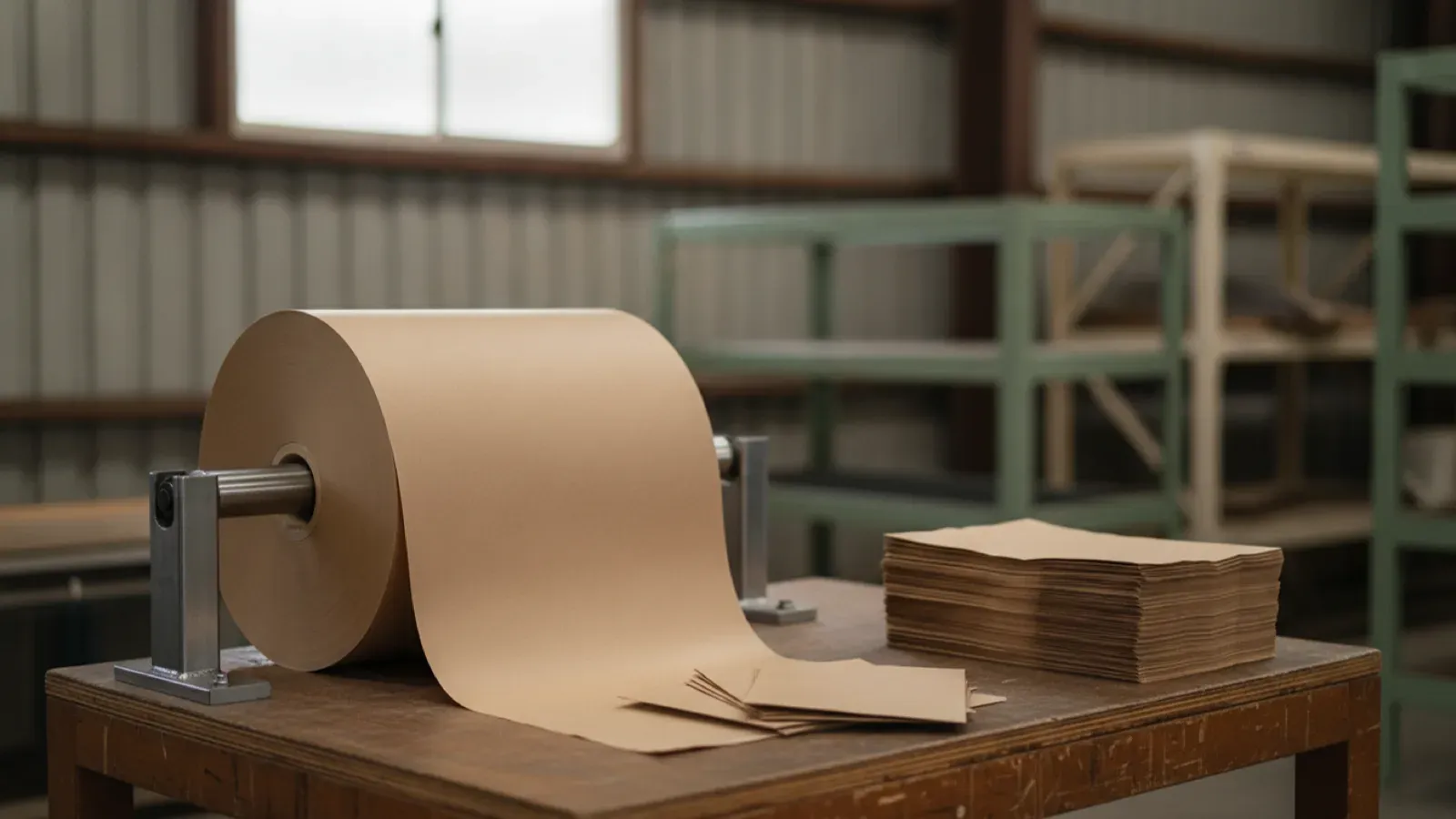
A roll-fed automatic makes V-bottom bags from a reel at 200-500 bags a minute on the small model and up to 300 a minute on the standard model. That is 12,000 to 30,000 pieces an hour on paper, on small plain bags, before changeovers and rejects. It cannot make a bag with a handle. A square-bottom line makes the handle bag retail actually wants, at 80-200 pieces a minute, and costs ten times as much. Sheet-fed and semi-automatic pasting machines sit between them for shorter runs, but note that they now overlap entry-level automatics on price, so "semi-auto to save money" is no longer automatically true.
Print capability is a variant of each size class rather than a separate tier. The same builder offers every model in three configurations: no printing, 2-colour and 4-colour. Buy print only when you have repeat branded orders in hand. A 2-colour inline unit pays for itself quickly on branded work and sits idle on plain stock bags, and plate charges are recovered from the customer anyway.
Around the main machine, budget for the ancillary line: bag cutting, creasing, punching, cut-handle and eyelet fitting, lace fitting, a motorised roll slitter and a testing scale. All of these are live, separately listed categories, so you can start with the two you need and add the rest.
On paper, the GSM you can run is capped by the machine, and that is the practical point most buying advice misses. The small roll-fed model is specced for 35-105 GSM; the standard model for 50-150 GSM. Bag-grade kraft on live listings runs 60-250 GSM. In practice, 80-120 GSM is the common band for plain kraft carry bags, while handle bags and premium board bags need 140-250 GSM, which the small machine simply will not take. Decide the GSM band first, then the machine.
Consumables are short and boring: kraft reels and sheets in brown, white and colours, adhesive, printing ink, handles, laces, eyelets and tags. One piece of dated vocabulary worth dropping when you talk to suppliers is "polyester stereo"; the trade has largely moved to photopolymer flexo plates.
Buy reels from a mill or a mill-authorised stockist once your monthly consumption justifies a full-truck lot, and from a trader before that, accepting the premium for small lots. Compare recycled and virgin grades on burst factor and consistency, not just on price per kg, because a cheap reel that breaks on the machine costs you a shift. The wholesale markets in your region are where most first-time units find their first trader.
On second-hand machines, be careful and specific. Ask to see the machine running on your GSM and your bag size, not on the seller's sample. Check spares availability and who services it locally. A cheap import with no service backup is the most common way a small unit loses two months of production in its first year.
How much space, power and staff does the unit need?
The machine footprint is small; the storage is not. The builder publishes 6x10 ft to 6x18 ft (60 to 108 sq ft) for the small roll-fed model, and 8x18 ft to 10x24 ft (144 to 240 sq ft) for the standard model. So a machine occupies well under 250 sq ft.
Everything else is what fills a shed. Reels standing on end need floor and clear access for a trolley. Finished bags are bulky and low value per cubic foot, so a month of stock takes serious room. Add packing, a bundling table and a walkway. Build it up for yourself: machine footprint, plus reel storage, plus finished-goods godown, plus packing and movement. A single-machine unit generally works in the several-hundred-square-foot range if it ships quickly and holds little stock, and needs closer to a couple of thousand square feet the moment it starts carrying inventory for two or three retail accounts. Treat 2,000 sq ft as a description of a stocking unit, not as a minimum entry requirement.
Power is a three-phase connection sized to the connected load on the machine's spec sheet. Get the sanctioned load right at the application stage; retrospective load enhancement is slow and the penalty for running over sanctioned load is not worth it.
On staffing, be honest about what nobody can tell you: there is no current published manning norm for a paper bag unit, because the government project profiles that used to carry one are offline. What exists is a set of roles. One machine operator who actually understands reel tension, glue and registration is the person the unit lives or dies on. A helper loads reels and clears the output. Handle, eyelet and lace fitting is finishing labour, scaled to whatever handle work you take. Someone bundles, counts and packs. And someone sells and, more importantly, collects. In a small unit two or three of those roles sit on the same person, including the owner.
Location gets chosen for boring reasons. One old reason is now gone: GST rates are uniform nationwide and the current rates took effect on 22 September 2025 everywhere, so there is no tax arbitrage between districts. What does still vary is rent, wage rates, the state electricity tariff and freight distance to your buyers. Paper bags are bulky and low value per kg, so freight matters more here than in most small manufacturing. Run that trade-off on your own route before signing a lease: a cheaper shed sitting well outside your delivery cluster can hand back the rent it saves in vehicle running and driver time.
Store paper off the floor on pallets and away from wall damp. Moisture ruins reels and warps finished bags, and moisture-damaged stock is a total write-off, not a discount sale.
What is the real profit margin per paper bag?
Build it from the paper up, because paper is more than half the cost and it is the only input with a published, dated price.
Indian Printer & Publisher's monthly Indian paper and paperboard price survey put finished kraft liner (12 BF) at Rs 36-38 a kg in the New Delhi market on 24 August 2026, unchanged from its 21 July 2026 update. The same survey has corrugated paperboard at Rs 59-82 a kg and SBS board at Rs 86-96 a kg. Bag-grade kraft on live supplier listings runs roughly Rs 35-65 a kg for 80-150 GSM, with specialty and bleached grades going to Rs 100-250 a kg.
Take one plain V-bottom bag, 18 x 25 cm, 100 GSM. At that size and grammage the blank uses roughly 12 g of paper.
| Cost line | Per bag | Where the number comes from |
|---|---|---|
| Kraft paper, 12 g at Rs 45/kg | Rs 0.54 | Rs 45/kg is a midpoint chosen from the Rs 35-65 bag-grade band for this worked example, not the quoted Rs 36-38 liner rate; the 12 g is arithmetic from bag size and GSM |
| Wastage and rejects at 7% of paper | Rs 0.04 | your machine and your operator, measure it |
| Adhesive | Rs 0.05 | your supplier's quote |
| Power | Rs 0.03 | your state tariff and connected load |
| Direct labour | Rs 0.20 | your wage bill divided by actual shift output |
| Bundling and packing | Rs 0.03 | your input |
| Cost per bag | about Rs 0.89 |
Only the paper band in that table comes from a dated 2026 source, and even the Rs 45 is a midpoint picked for illustration. Everything else is a placeholder for your own quotation, and the table is built that way on purpose so you can substitute. A 2-colour printed version of the same bag costs more by whatever your ink consumption and your amortised plate charge work out to; get both figures in writing from your ink supplier and your plate maker and add them as two more rows.
Now the selling side, which is where the old razor-thin margin story came from. Live B2B listings show plain kraft carry bags at roughly Rs 3-12 a piece by size and printed or premium board bags at Rs 8-40 a piece. Read those carefully: listing prices skew toward larger and printed bags, and what you actually realise on a repeat plain-bag account for a small size sits at the bottom of that band or below it, before freight and before the credit period. So do not model your margin on a listing. Model it on the price you can win, and test three of them.
| Realised price, ex-works | Contribution per bag | At 3 lakh bags a month |
|---|---|---|
| Rs 1.50 | Rs 0.61 | Rs 1.83 lakh |
| Rs 2.50 | Rs 1.61 | Rs 4.83 lakh |
| Rs 3.50 | Rs 2.61 | Rs 7.83 lakh |
That is contribution, not profit. Against it sit shed rent, salaries, fixed power and admin, and the machine EMI. Put your own numbers in; a small single-machine unit that models these at around Rs 1.5 lakh a month breaks even at about 2.5 lakh bags a month if it realises Rs 1.50 a bag, and at about 93,000 bags a month if it realises Rs 2.50. The entire difference is pricing and product mix, not machine capacity. Your entry roll-fed automatic can physically make 2.5 lakh bags in under two weeks of single-shift running. Capacity was never the constraint. Orders and price are.
This is also why printed and branded work is worth chasing. Ink and an amortised plate do add cost, and you will have to price that from your own quotes, but look at what printing does to the other side of the equation: live listings put printed and premium board bags at Rs 8-40 a piece against Rs 3-12 for plain. Plain stock bags are a commodity you win on rate; branded bags are a job you win on artwork, consistency and delivery date, and the customer switches suppliers far less often.
Two 2026-specific items now sit inside this calculation, and no competing page models them.
The GST inversion. From 22 September 2025, uncoated kraft paper and paperboard (HSN 4804) moved from 12% to 18% GST, while paper bags, sacks and cartons under heading 4819 moved from 12% to 5%. You buy your main input at 18% and sell your output at 5%. If you are registered, credit accumulates and you claim a refund under the inverted duty structure; the GST Council also recommended starting 90% provisional refunds on such claims on a risk-assessed basis, which helps the cash cycle but does not remove it. If you are not registered, that 18% on paper is simply a cost you cannot recover: on the example above it adds about 10 paise to every bag. Staying under the threshold to dodge filing is not free in this business, which is worth weighing alongside what happens when you don't pay GST.
Pass-through. Kraft moves. The August 2026 survey happened to show it flat since July, but a unit that quotes a fixed annual rate to a retail chain and then eats a mid-year paper rise has given away its whole margin. Quote with a validity period, in writing, and revise when the reel invoice moves.
How do you get your first regular orders?
Field selling still wins the first ten accounts, and the kit is small: a sample of each size you make, in the GSM you actually run, and a printed rate card.
Your rate card should carry, for each size, the flat and gusset dimensions in cm, the GSM, the price per piece, the minimum order quantity, the plate or block charge for printed work (usually one-time, recovered on the first order), delivery terms and the credit period you are willing to give. Walk into a bakery with that and you are a supplier. Walk in without it and you are a person asking for a chance.
Price discovery now happens before you arrive. B2B marketplaces such as IndiaMART and TradeIndia carry live per-piece prices for exactly these bags with size, GSM and MOQ attached, typically in the Rs 3.50 to Rs 25 range across the whole product spread, so buyers have already anchored on a number. Use that both ways: list your own products there for inbound leads, and check where your quote sits before you send it. For repeat local accounts, a WhatsApp Business catalogue with your sizes and rates saves a lot of phone calls.
Offline, the packaging and stationery wholesale lines in your city, plus paper traders, are the fastest route to volume, though they will squeeze the rate hard. Job-work for a larger converter is the least glamorous and most reliable way to keep a new machine running while you build direct accounts.
Then there is the part that ruins otherwise good units. Paper bag buyers pay on cycles, commonly 30 to 90 days, and small manufacturers routinely have more money sitting in the market than in the bank. Fix a credit limit per buyer, put every dispatch and every payment on a ledger the buyer can see, and stop supply when someone crosses the limit. To track customer credit, a free khata app like OkCredit keeps every entry backed up and sends automatic payment reminders. If a buyer still will not pay, a Udyam-registered micro unit now has a real recovery route: the MSMED amendment passed in August 2026 sets fixed timelines for delayed-payment disputes (mediation within 90 days, arbitration referral within 30 days after that, and an award within 90 days of pleadings), requires central public sector buyers to settle MSME invoices through TReDS, and lets a court order at least 50% interim payment after six months.
Plan for seasonality. Festival and wedding months pull branded and gift-bag orders forward, and your paper needs to be bought before the rush, not during it.
Is demand growing, and do the plastic rules actually help?
The regulatory tailwind is real but smaller than the internet claims, and getting this right protects you from over-investing.
India has not banned plastic carry bags. The Plastic Waste Management (Amendment) Rules, 2021 raised the minimum carry-bag thickness to 75 microns from 30 September 2021 and to 120 microns from 31 December 2022, and set a 60 GSM floor for non-woven plastic carry bags from 30 September 2021. The 1 July 2022 prohibition covers a named list of single-use items (straws, cutlery, plates, cups, stirrers, wrapping film around sweet boxes, PVC banners under 100 microns and so on), not carry bags. Several states run their own stricter bans, which is why the picture varies by state.
What those thickness floors do is raise the cost of the plastic alternative. What they do not do is remove it. Your real price ceiling is the compliant 120-micron plastic bag and the 60 GSM non-woven bag sitting next to yours in the same wholesale market. Compostable plastic is the third competitor, and it carries its own compliance load: compostable products must conform to IS 17088 and the maker or seller must obtain a certificate from CPCB before marketing.
A quieter demand driver is the FSSAI prohibition on using newspaper or similar material for storing or wrapping food, which pushes small food sellers toward proper food-grade paper bags.
On recycled content, there is a claim worth killing: no Indian rule sets a minimum post-consumer recycled content for paper. The recycled-content mandates in the Plastic Waste Management (Amendment) Rules, 2026 apply to plastic packaging only. Large retail and D2C buyers may still ask you for recycled-content declarations or FSC-type documentation, but that is a purchase specification you negotiate, not a law you comply with.
You will find plenty of global market-size numbers for kraft paper quoted around. None of the widely repeated figures traces to a live primary source, so this post does not use one. The evidence that matters for your decision is closer to home anyway: a dated domestic paper price series, a GST rate on your finished goods that fell to 5%, and thickness rules that keep making the plastic bag more expensive.

What usually goes wrong in a paper bag business?
Underpricing is the first and worst mistake. Organised converters buy paper by the truckload and run bigger machines, so their cost per bag is structurally below yours on plain stock. Chasing them down on rate is how a new unit runs a full shift and still loses money. Compete on sizes they will not run small, on delivery in two days, and on branded work.
Buying too much machine is the second. A square-bottom handle-bag line at Rs 45 lakh and up is the right buy only when handle-bag orders already exist on paper. Until then the EMI runs whether the machine does or not.
Late pass-through of paper prices is the third, and it is quiet. Kraft moves, your annual rate card does not, and the margin bleeds for months before anyone notices.
Wastage from an untrained operator is the fourth. Reject rate on a paper bag line is a direct percentage off the top of a thin margin, and it is entirely a training and setup problem. Measure rejects per shift from day one.
Moisture and dead stock is the fifth. Bags absorb damp, warp and become unsellable. Store on pallets, keep stock moving, and do not build inventory against orders you only hope will come.
And know the objections your buyer will raise, because they are legitimate: paper bags are bulkier to store, heavier to transport, cost more than the plastic equivalent and are not waterproof. The answers are honest ones, not spin. Right GSM for the load, a laminated or greaseproof grade where moisture is the issue, and a supply schedule that stops the shop from having to warehouse a month of bags.
If you are still comparing this against other manufacturing options, it is worth scanning a broader list of business ideas before you commit capital.
FAQ
Can I start a paper bag business from home?
Yes, at hand-tool scale. You will need a municipal trade licence, and a written intimation to the State Pollution Control Board since the sector is White category. You do not need GST until turnover crosses Rs 40 lakh for goods (Rs 20 lakh in listed special-category states), unless you supply inter-state. What you will not find is a Rs 50,000 machine: the cheap home route in 2026 is separate tools (punching, creasing, eyelet press and gum) plus labour, and output is a few hundred bags a day.
Which paper bag making machine should a beginner buy?
Buy for the bag you have an order for. If it is plain V-bottom grocery bags, an entry roll-fed automatic at Rs 4.5-7 lakh (2026 listings) running 200-500 bags a minute is enough for several times most first-year order books. If your buyers want handles, no roll-fed machine will do it, and you are looking at a square-bottom line from about Rs 45 lakh. Add a 2-colour print unit only when you have repeat branded orders.
Do I need an FSSAI licence to sell paper bags to a bakery?
No. The obligation under the Food Safety and Standards (Packaging) Regulations, 2018 sits on the food business operator, not on the bag maker. But your bakery and sweet-shop buyers will ask you for food-grade paper conforming to a Schedule-I standard such as IS 6615 or IS 6622, and for inks conforming to IS 15495. Keep the mill's test certificate and your ink supplier's declaration on file.
What minimum order quantity should I quote?
Set MOQ by size and by whether the job is printed. Plain stock bags in a size you already run can go out in small lots because there is no setup cost. Printed work carries plate making and a machine changeover, so the MOQ has to cover both, and the plate or block charge is billed once on the first order and recovered from the customer. Put the MOQ on the rate card next to the price so it is never an argument later.
How many bags do I have to sell every month to break even?
It depends almost entirely on your realised price, not your machine. Using the worked example above (cost about Rs 0.89 a bag on an 18 x 25 cm, 100 GSM plain bag at 2026 paper rates) and roughly Rs 1.5 lakh of monthly fixed costs, break-even is about 2.5 lakh bags a month at a realised Rs 1.50 a bag, and about 93,000 bags a month at Rs 2.50. Substitute your own rent, salaries and EMI before you rely on it.