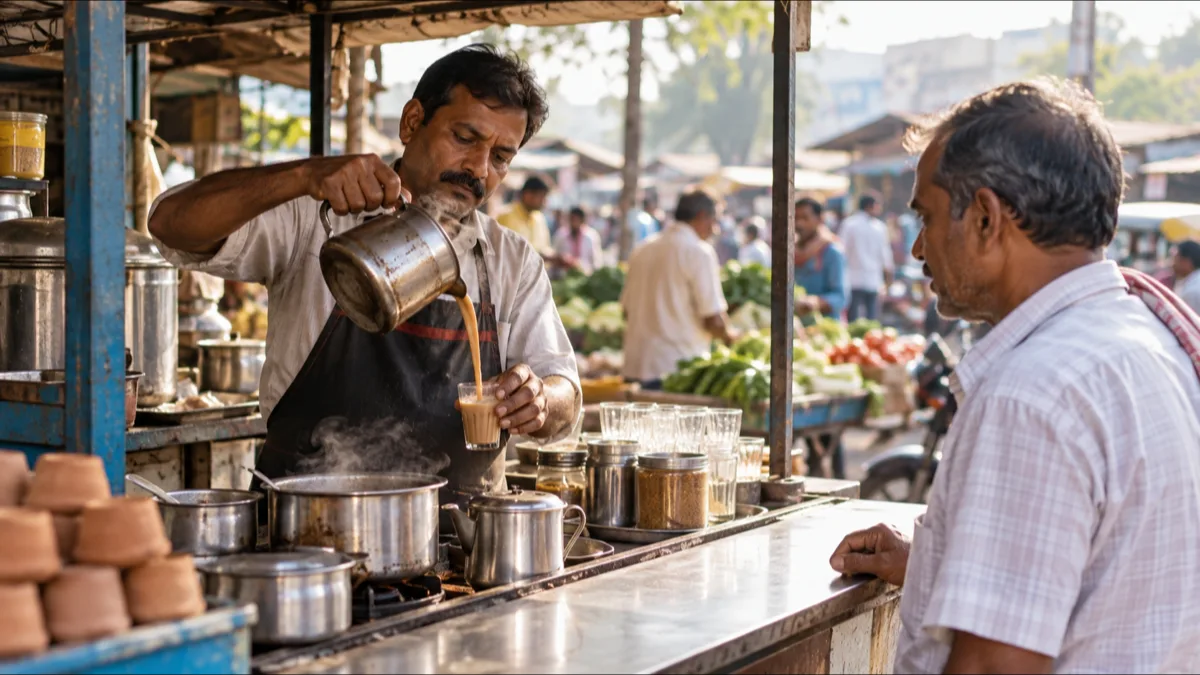
A tea stall can start as a cart, a counter inside a private shop, or a small takeaway outlet. The right first move is to test a location and one repeatable recipe, then size the equipment to the cups people actually buy. Use the setup figures below as planning ranges, then replace them with local supplier quotes before spending. A current per-cup worksheet using October input prices works out to about ₹6.60 in variable cost for a 100 ml cup sold at ₹15. That leaves ₹8.40 toward rent, wages, repairs and your own pay. It is a worked planning case, not a profit promise.
The numbers are useful only when you replace them with your city’s rates, your recipe and the number of cups sold. In 2026 those inputs have moved quickly: a national daily price dashboard on 30 October listed average retail milk at ₹61.61 per litre, loose tea at ₹276.54 per kg and sugar at ₹59.16 per kg. IndianOil’s commercial 19 kg LPG price in Delhi was ₹2,810 on 1 October. Other cities and suppliers differ.
What kind of tea stall should you start?
Choose the service shape before buying a cart. A pushcart costs less to fit out, but it needs a legal vending spot and a plan for water, waste, storage and bad weather. A counter inside a private building may solve some of those problems, but brings rent or revenue share and a landlord’s conditions. A small shop can add snacks and seating, but the monthly break-even rises with rent, electricity and staff.
Watch your preferred location at the hours you would be open. For three ordinary days, count people who can stop, not just people walking past. Note the gap between rushes, competing tea prices, bus or parking access, shade, drainage and the nearest water point. Ask the owner, municipality or Town Vending Committee about permission before paying a deposit. A busy footpath is not automatically a lawful vending site.
Keep the opening menu short. Regular chai, one spiced or ginger option, and one snack that turns over quickly are easier to cost than ten slow-moving choices. Add a second menu item only if customers ask for it often and the ingredient can be stored safely. Long menus look generous on a board and quietly tie cash up in packets that expire.
How much does a basic tea stall cost to set up?
The following are planning ranges for a budget stall, not supplier quotations. A better equipped takeaway unit can cost more, and the table leaves out a large property deposit, plumbing, construction and seating.
| Item | Basic planning range | What changes the price |
|---|---|---|
| Boiler or tea urn | ₹2,000 to ₹5,000 | Capacity, heating type, new or used |
| Stove and cylinder setup | ₹2,500 to ₹4,000 | Commercial connection and burner size |
| Vessels and serving tools | ₹3,000 to ₹8,000 | Stainless steel grade and number of cups |
| Cart or stall structure | ₹8,000 to ₹25,000 | Size, wheel quality, storage and fabrication |
| Signboard and initial stock | ₹9,500 to ₹20,000 | Material, menu and first order quantity |
| Registration and local permissions | ₹100 plus local fees | FSSAI category and municipal process |
The table shows the listed basic setup items as a planning estimate. A larger setup with refrigeration or more stock will need a separate quote. Get written quotes for the cart, stove, utensils and first stock. A low cart quote may exclude the canopy, lockable storage, delivery or food-safe work surface.
The ₹100 FSSAI registration certificate fee still applies, but the turnover bands in many older tea-stall guides are out of date. Since 1 April 2026, FSSAI’s revised categorisation provides registration up to ₹1.5 crore annual turnover, a State Licence above ₹1.5 crore up to ₹50 crore, and a Central Licence above ₹50 crore. Confirm the food-business category on FoSCoS for your setup and activities. A tea stall selling snacks or packaged food may need its activity details added.
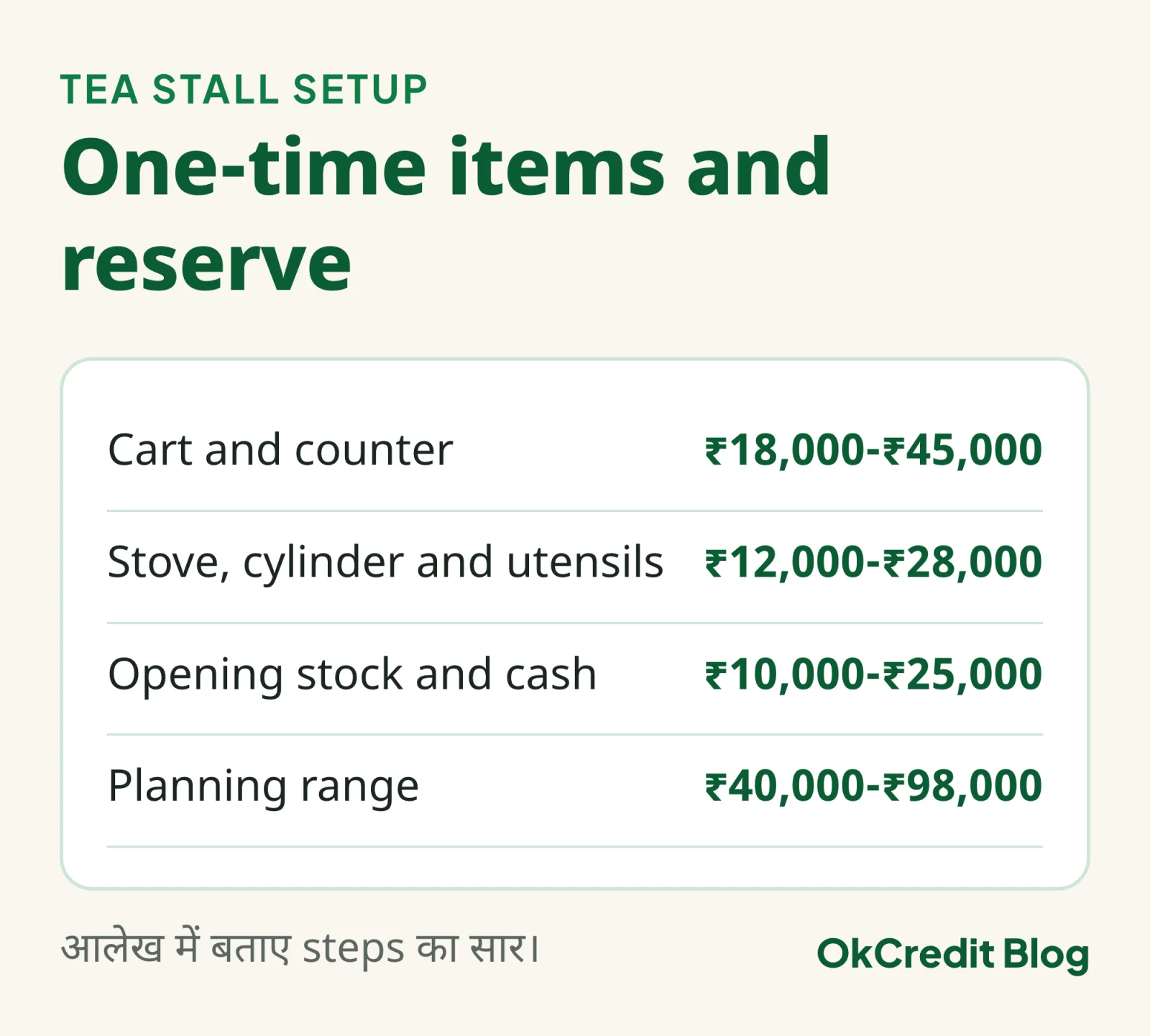
Price the cart and equipment separately from deposit, working cash and monthly bills.
Which permissions should you check before opening?
Every food business must hold the registration or licence that fits its activity. Apply through FoSCoS, the Food Safety Compliance System, and keep the certificate where customers can see it. Basic FSSAI registration is not a substitute for permission to occupy a pavement or a local trade permission.
For a street cart, ask the local municipal body or Town Vending Committee how vending certificates, site allocation and fees work in that area. The Street Vendors Act provides for local vending plans and committees; it does not mean every road or station forecourt is open for a new stall. If you rent a counter, get written permission for food preparation, LPG use, water and signage.
Check whether your city requires a trade licence, Shops and Establishments registration, commercial electricity or a fire clearance for your premises and equipment. These requirements vary by state and building. Udyam registration is free on the Government of India portal, but it is an MSME registration, not a food or vending permission. GST registration is a separate check based on turnover, state and the way you sell.
Buy and use commercial LPG equipment correctly. IndianOil lists 19 kg cylinders for commercial or industrial use. The cylinder price changes monthly and varies by city. Do not plan the business around a domestic cylinder meant for household use.
What will a cup of tea cost you in 2026?
Cost a batch, then divide by the cups customers paid for. Do not divide the packet price by how many cups you hoped to serve. Some tea stays in the pan, gets spilled, is given away or is discarded at closing. That unsold quantity is still part of your cost.
For a transparent 100 ml example, assume each cup uses 60 ml milk, 3 g tea, 8 g sugar, one ₹0.60 disposable cup and ₹1.00 for water and fuel. Using the Department of Consumer Affairs’ all-India average retail prices on 30 October 2026, milk contributes about ₹3.70, tea ₹0.83 and sugar ₹0.47. The rest are explicit example inputs that you should replace with your receipts.
| Per-cup line | Example cost | How to adjust it |
|---|---|---|
| Milk, 60 ml | ₹3.70 | Use your local invoice per litre |
| Tea, 3 g | ₹0.83 | Weigh the dose from your chosen blend |
| Sugar, 8 g | ₹0.47 | Use your local invoice per kg |
| Paper cup | ₹0.60 | TradeIndia supplier listing, October 2026 |
| Water, fuel and small wastage allowance | ₹1.00 | Replace with batch and fuel records |
| Total variable cost | ₹6.60 | Recipe and yield will change this |
At a ₹15 selling price, the contribution is ₹8.40 per sold cup, or 56% of the selling price, before rent, labour and other fixed expenses. That figure is contribution, not net margin. Use a steel glass? Replace the cup cost with washing water, detergent and breakage. Add ginger or cardamom? Weigh it into the batch instead of treating it as free.
Tea prices in Kolhapur and other cities vary by stall and date. Check current menu boards and local input costs on the route where you plan to sell rather than treating a reported price as a national rate.
What are the monthly running costs?
Separate costs that change with each cup from costs that arrive even on a slow day. Ingredients and cups are variable. Rent, helper wages, mobile data, cleaning supplies, equipment repair and your own working time are fixed or semi-fixed. Keep a line for each rather than calling whatever remains “profit.”
Here is a small rented-stall example. The ₹10,000 rent, ₹10,000 helper cost and ₹5,000 for fuel top-ups, water, cleaning and phone are planning assumptions, not a national price list. Replace them with a landlord quote, the local wage you will pay and your last bills. The ₹19,800 variable expense uses 3,000 cups at ₹6.60 each.
| Monthly line | Example at 100 cups a day | Basis |
|---|---|---|
| Rent, helper and other overhead | ₹25,000 | Owner’s planning assumptions |
| Ingredients and cups | ₹19,800 | 3,000 cups × ₹6.60 |
| Total cash cost before owner pay | ₹44,800 | Fixed plus variable costs |
Do not forget the owner’s hours. If you work twelve hours a day, the cash left after bills is not all return on investment. It includes payment for your own labour. Also set aside money for a replacement burner, fridge repair or a day when the stall cannot open.
How many cups do you need to break even?
Break-even cups per month = monthly fixed costs ÷ contribution per cup. With ₹25,000 fixed costs and ₹8.40 contribution, the stall needs about 2,977 cups in a month to cover those costs. Across 30 open days, that is roughly 100 cups a day. The calculation excludes loan instalments, depreciation, tax and a salary for the owner.
At 100 cups a day, sales are ₹45,000 a month. Variable cost is ₹19,800. After the example’s ₹25,000 fixed costs, about ₹200 remains before owner pay and equipment replacement. At 130 cups a day, sales rise to ₹58,500 and contribution to ₹32,760; after the same fixed costs, ₹7,760 remains. Those are scenario calculations, not expected earnings.
If you need ₹20,000 a month for your own pay as well as the example’s fixed costs, the stall needs to contribute ₹45,000. Divide by ₹8.40 and the target becomes about 5,358 cups per month, or 179 cups daily over 30 days. A single worker may not serve that volume at peak times. You may need a second burner, faster handoff, a helper or longer hours, which changes costs again.
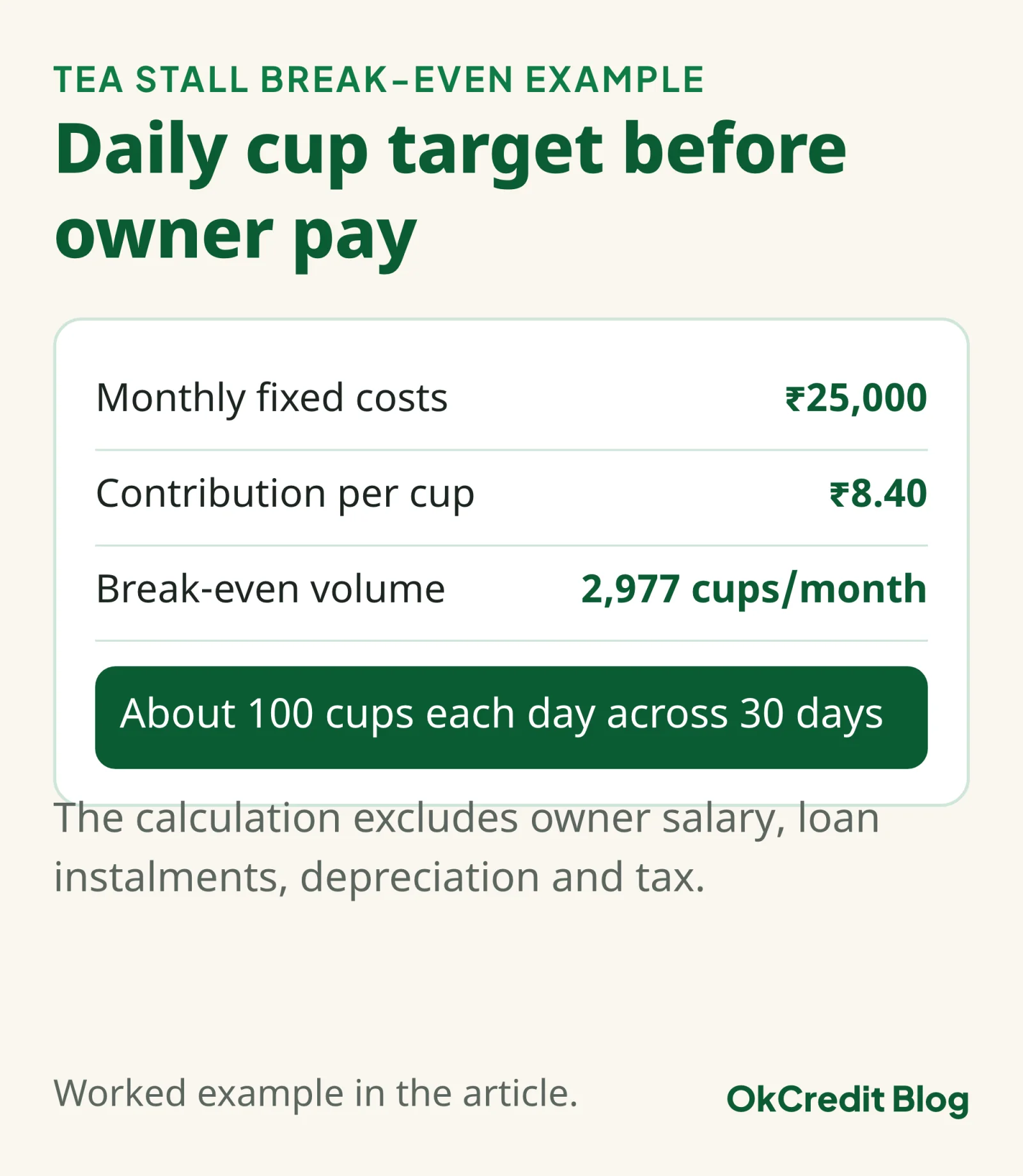
At the example prices, about 100 cups a day cover ₹25,000 fixed costs before paying the owner.
Count cups by hour during a trial, not just by day. If 70% of sales arrive in a two-hour morning rush, your equipment and staffing must handle that rush without over-brewing the slow afternoon batch. The aim is not to chase a big daily total. It is to make enough saleable cups at a quality people return for.
How do you keep tea safe and consistent?
Buy milk and other perishables from a supplier who can deliver on the days you need them. Keep chilled ingredients at safe temperatures and avoid topping a fresh batch into yesterday’s pan. Mark opening dates on packets, rotate older stock first and clean vessels between batches. FSSAI’s catering hygiene guidance is useful even for a small counter; it covers storage, personal hygiene and cleaning routines.
Write a recipe by weight and volume: milk, water, tea, sugar and any flavouring. Train whoever covers the counter to use the same cup and measure. Taste the first batch, but also measure the yield. If you change from a 90 ml cup to 120 ml without changing the price, ingredient cost rises while the number of servings per pan falls.
Keep drinking water and handwashing arrangements separate from the area where dirty utensils are stacked. Store cups covered. Put waste in a bin with a lid and agree who removes it. If there is no sink, decide how washing will work before the cart is built.
How should you choose a location and get repeat buyers?
A good spot is one where customers can stop without blocking a doorway, traffic lane or emergency route. Visit at opening time, lunch, school release and evening if those match your hours. Watch whether customers stand for two minutes or linger for twenty. That choice affects counter depth, seating and rent.
Ask neighbouring shopkeepers which weekdays are quiet and when wages or deliveries usually happen. A stall near a college can be busy during term and slow during holidays. A bus-stop stall may see short peaks linked to route timings. Your own observation is more useful than a generic promise that “high footfall means high profit.”
Make service easy to repeat: same cup size, clear price, quick change, clean counter and no surprise charge for a small cup. Keep the menu visible but short. If customers often buy on credit, agree the limit and payment date at the start. A simple daily sales and dues record helps you see whether a regular has paid rather than relying on memory. A guide to starting a kirana store has more on tracking repeat customers, while business-loan preparation covers cash-flow planning before borrowing.
What should you check after the first month?
Review the stall at the same time each week. Write down cups sold by size and recipe, milk and tea issued, unsold tea discarded, daily cash and digital payments, and any customer credit. Compare what the notebook says with stock on hand. If the cost per cup is rising, identify whether the cause is a larger pour, ingredient price, low batch yield or waste.
Ask customers what they come back for, but compare the answer with what sells. If ginger chai gets praise but only sells twice a day, keep it as a small batch rather than preparing a full pan. If customers ask for breakfast, test one item on a few mornings before buying a griddle and changing your licence category.
Frequently asked questions
What is the minimum investment for a tea stall?
Use the table as a planning range for a basic cart-based setup. Rent deposit, local permissions, refrigeration, construction and working cash can raise that total. Get current quotes in your own city. Rent deposit, local permissions, refrigeration, construction and working cash can raise that total. Get current quotes in your own city.
What is the FSSAI turnover limit for registration in 2026?
From 1 April 2026, FSSAI’s revised turnover categorisation places registration up to ₹1.5 crore annual turnover, a State Licence above that up to ₹50 crore, and a Central Licence above ₹50 crore. Check FoSCoS for the category that fits your activities.
How much does one cup of chai cost to make?
There is no national cost per cup. In the example above, a 100 ml cup costs about ₹6.60 in variable inputs at 30 October average ingredient prices plus stated cup and fuel assumptions. Your recipe, city and wastage will alter it.
How many cups should a stall sell each day?
In the illustrated case, about 100 cups a day cover ₹25,000 monthly fixed costs over 30 days, before the owner’s pay. Use your actual rent and batch costs to calculate your own target.
Can I set up on any footpath?
No. Ask the local municipal body or Town Vending Committee about vending permissions and site allocation. A busy public space is not automatically available for a new cart.