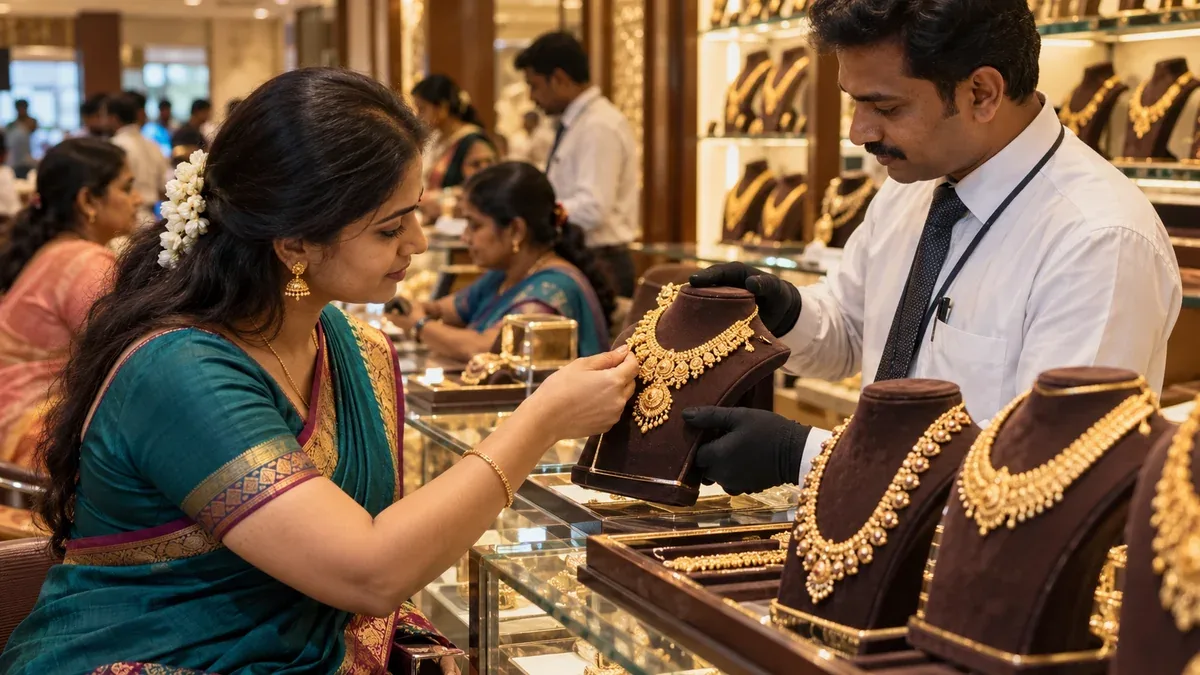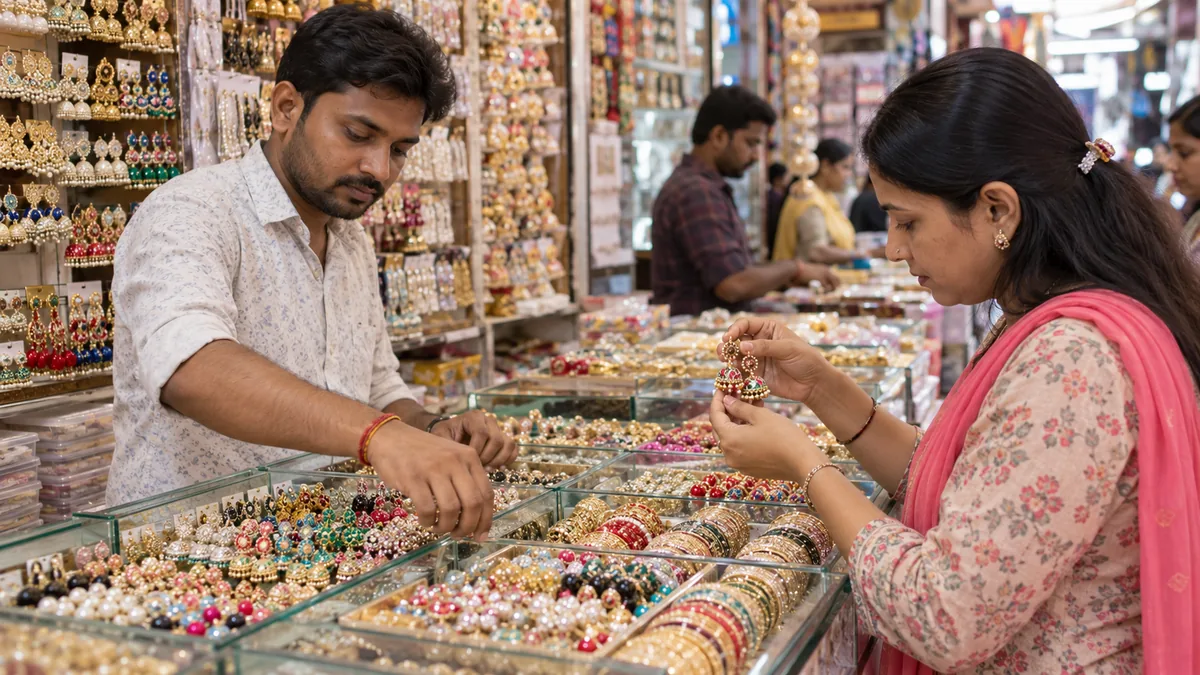
The best imitation jewellery market depends on the style you plan to sell and the quantity you can test, not on a single nationwide ranking. Delhi’s Sadar Bazaar and Chandni Chowk lanes suit a broad accessory and fashion range; Jaipur is known for traditional-look and kundan-meenakari styles; Mumbai’s Bhuleshwar and Zaveri Bazaar area has wholesalers and bridal-look options; Rajkot has manufacturers and plated-jewellery suppliers; Hyderabad’s Laad Bazaar is associated with bangles and wedding accessories. These are sourcing leads, not guarantees of the lowest price or quality. In 2026, compare invoice cost, finish, defect policy, minimum order and delivery before choosing a supplier.
Imitation jewellery is generally classified under HSN heading 7117, and CBIC’s published rate guidance lists a 3% GST rate for imitation jewellery, with specific exceptions such as lac or shellac bangles. Confirm the current HSN and treatment for your exact product and transaction with a tax professional. Imitation jewellery is not precious metal jewellery, and it must not be sold or advertised as gold or silver jewellery unless the product actually meets the relevant material and legal description.
Which market should you visit first?
Choose a city based on the category you want to trial. If you want daily earrings, clips, lightweight necklaces and mixed fashion accessories, a large trading market such as Delhi’s Sadar Bazaar can make it easier to compare many sellers in one trip. Buyers looking for wedding-style sets or traditional designs may compare Jaipur’s Johari Bazaar and market lanes around it. For large variety, Mumbai’s Bhuleshwar and Zaveri Bazaar areas are common sourcing references, though parts of Zaveri Bazaar specialise in precious jewellery, so ask sellers directly whether they handle imitation lines. Hyderabad’s Laad Bazaar is associated with bangles and wedding shopping, while Kolkata’s Burrabazar and Chennai’s Sowcarpet are additional wholesale areas to research.
There is no government-issued national list that ranks these markets by price, authenticity or retailer profit. A market name can cover many lanes and product types. One shop might sell finished sets, another components, and another only wholesale lots. Call ahead through a verified business number, ask for the exact shop lane and confirm whether retail buyers can purchase at the stated minimum quantity. Market opening days and hours may change around festivals and local events; check current details before travelling.
| Sourcing hub | Commonly reported product strengths | Good first question to ask |
|---|---|---|
| Delhi: Sadar Bazaar, Chandni Chowk | Fashion earrings, accessories, bridal-look sets and mixed lots | What is the minimum per design and defect replacement window? |
| Jaipur: Johari Bazaar | Traditional-look, kundan and meenakari-style jewellery | Is this imitation jewellery, silver, or a precious-metal item? |
| Mumbai: Bhuleshwar and Zaveri Bazaar area | Mixed fashion, plated and occasion collections | Which lane and seller handle imitation wholesale specifically? |
| Rajkot | Plated products and manufacturer-linked sourcing | Can the maker provide repeat designs and a written finish specification? |
| Hyderabad: Laad Bazaar | Bangles and wedding-related accessories | Can sizes and colours be replenished as a matched lot? |
| Kolkata: Burrabazar and nearby lanes | Broad wholesale accessories and fashion lines | Is the quoted price for a set, a dozen or a mixed carton? |
| Chennai: Sowcarpet | Trading and accessory wholesalers | What are the shipping and replacement terms for an outstation buyer? |
| Bengaluru: Chickpet | Fashion accessories and city retail sourcing | Which products are stocked regularly rather than festival-only? |
Use the table as a starting route. It does not certify any individual seller, and a cluster’s reputation is not proof that a particular lot is well finished. Product quality changes by supplier, coating, base metal, storage and batch. Confirm all claims with a sample and invoice.
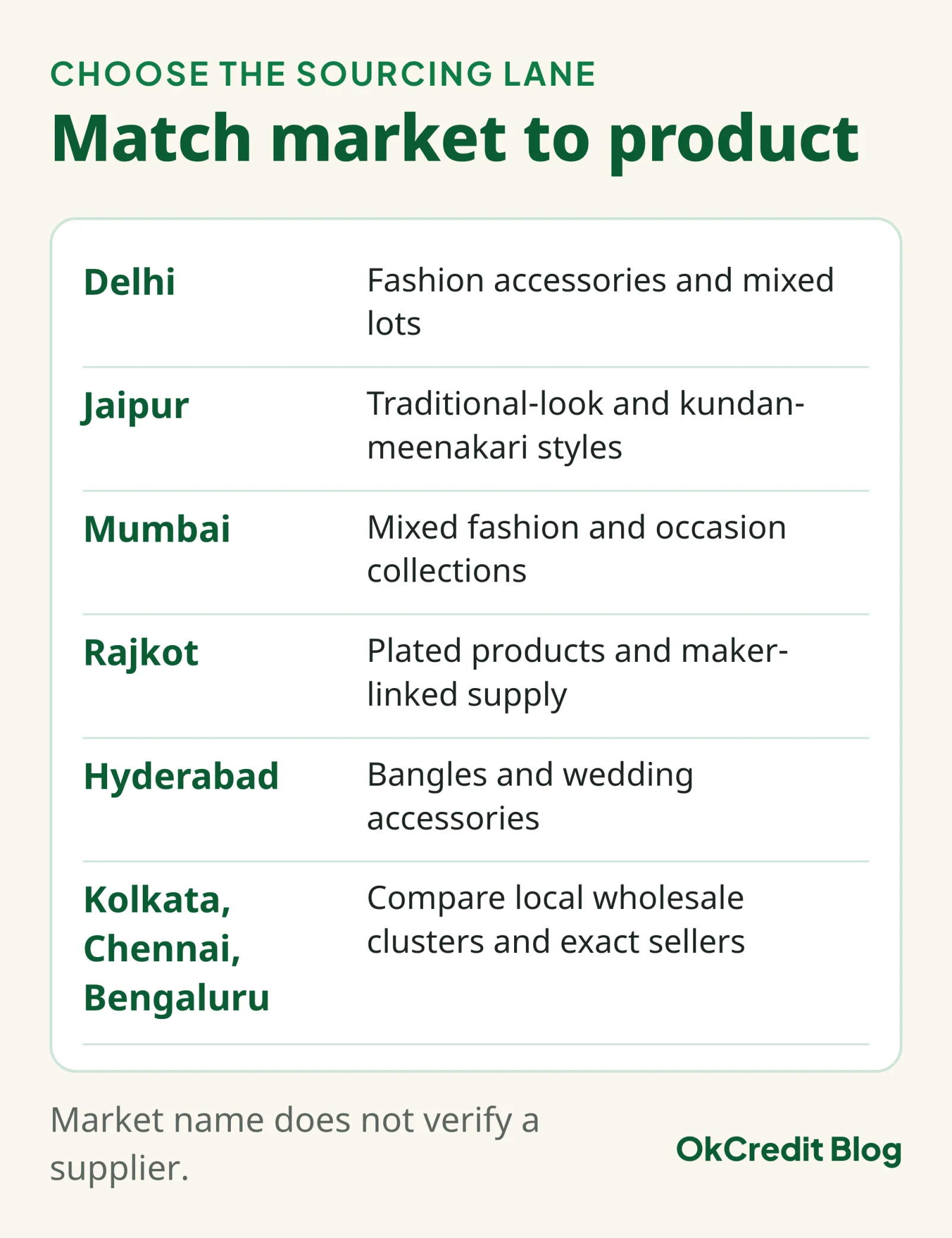
Choose a cluster by product type, then verify each seller.
How do you compare the actual cost of a purchase?
Do not compare only the sticker price. Add travel or courier, packing, GST where charged, payment fee, sample cost, defect allowance, repair or repacking, and the cost of keeping unsold designs. A set quoted at ₹180 with ₹20 allocated for freight and ₹10 for expected defects has a landed planning cost of ₹210 before shop rent and sales effort. If the retail price is ₹350, the gross difference is ₹140, not net profit. This is an example to show the arithmetic, not a market-price claim.
Ask the supplier to write the unit definition on the invoice: one piece, one pair, one set, one dozen or one assorted lot. Photograph the sample next to its bill. Confirm whether stones, hooks, clasps and plating are included in the quoted specification. If you need a matched pair, check both earrings. For a necklace set, open the clasp and inspect every joint. Small defects can turn a seemingly high margin into returns and customer complaints.
A first order should be small enough that you can inspect each design.
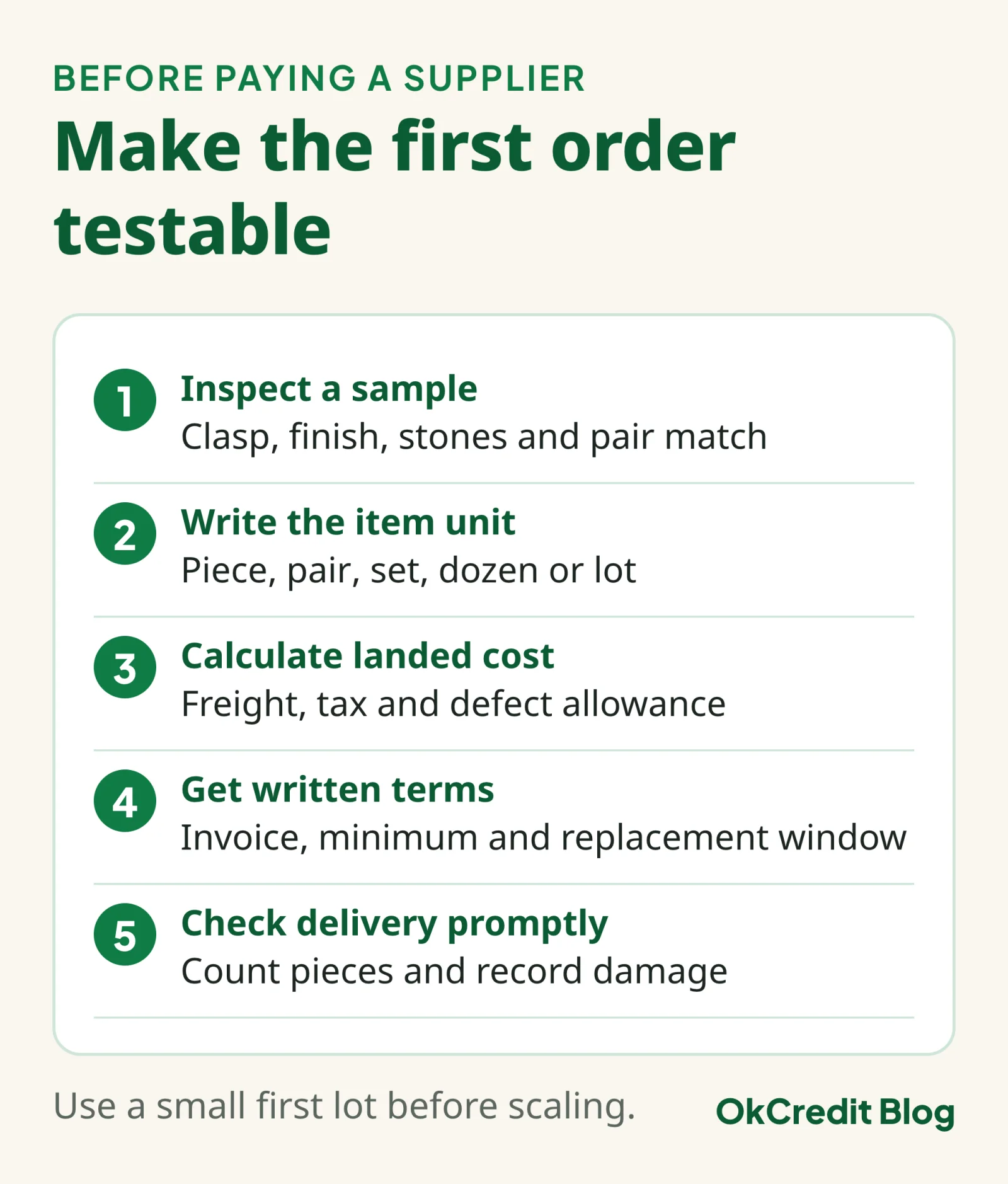
The sample and invoice should describe the same item.
Record the supplier name, shop address, invoice number, item code, colour, quantity, rate and defect count. Do not rely on an informal chat catalogue as the only product record. Before sending an advance to a new supplier, confirm the business name and payment beneficiary. Avoid a deal that asks you to pay an unrelated account or purchase a large lot before you have checked a sample.
What should you inspect on imitation jewellery?
Look at the finish under neutral daylight and indoor light. Check plating consistency, sharp edges, clasp strength, stone setting, loose links, missing stones and colour mismatch across a pair. Rub a sample gently with a clean cloth to see if visible colour transfers. Ask how the product should be stored and whether the finish has a stated care instruction. Never promise “anti-tarnish,” “hypoallergenic,” “nickel-free,” “waterproof” or “skin-safe” unless the supplier provides reliable product-specific evidence and you can support the claim.
For earrings, inspect the post and back. For bangles, check size and shape across the lot. For necklaces, check chain joints and clasp movement. For hair accessories, test the spring or pin. If you sell bridal sets, confirm that the full set is present and that the colour of the components matches. Keep a photo of the approved sample so a repeat shipment can be compared against it.
What do GST and product claims mean for a small retailer?
CBIC’s GST rate information lists imitation jewellery under heading 7117 at 3% in the published schedule, with distinct treatment for certain products. The GST Council rate table shows 1.5% CGST and 1.5% SGST for the applicable intra-state entry. HSN classification depends on what the item is made of and how it is described, so do not put a precious-metal code on an imitation item or assume all “fashion jewellery” is identical for tax purposes. Retain purchase invoices and show the tax details required on your sales bill when registered.
BIS hallmarking applies to specified gold and silver jewellery and artefacts, not ordinary imitation pieces. Never place a BIS hallmark, HUID, “gold,” “silver,” “925” or purity claim on an imitation product to make it look more valuable. If you sell a piece that contains precious metal, the compliance obligations may change. Keep categories and product descriptions separate in your stock records.
For packaged goods, check the applicable Legal Metrology declarations and the seller’s purchase documentation. If you create a brand label, do not hide the actual manufacturer or origin details that must be declared. A product photo should represent the item customers receive. Mention colour variation or stone differences clearly where they are material to the purchase.
Can you source without travelling to a market?
A verified manufacturer, wholesale website or B2B marketplace can help compare catalogues and request samples. It can also hide important details: the actual finish, packed quantity, shipping protection, replacement policy and whether the seller is the manufacturer or a reseller. Ask for a current stock video with the date or a paid sample before ordering a full carton. Use a business invoice and a payment channel tied to the same seller identity.
For online sourcing, compare the exact SKU across sellers, not just similar photos. Ask how long the price is valid, whether colour and design can be repeated, what happens if transit damages the stones, and who pays return freight. Save the terms with the purchase order. If the website lists a market address, verify that the store exists and the person who takes payment is connected to it. A marketplace seller rating is a signal, not a quality certificate.
How should a retailer build a first collection?
Start with a narrow collection that matches the buyers who already visit your shop. For a general accessories counter, use a small range of lightweight earrings, hair clips, everyday chains and a few occasion sets. If the neighbourhood has wedding stores or ethnic clothing retailers, test traditional styles in limited quantities. Avoid buying dozens of slow designs because one catalogue photograph looks popular online.
Set a maximum first-order budget and split it across categories. Record how many customers ask about each style, how many buy, and which designs return due to colour or clasp problems. Reorder only the products with repeat demand. A supplier who offers consistent design codes and replacement stock can be more valuable than a slightly lower one-time quote.
A small buyer can negotiate by reducing mixed-design quantities, paying for samples, or agreeing a repeat-order plan rather than demanding a large discount on the first visit. Ask for an itemised rate instead of one total for a mixed lot. If you sell on credit to a boutique or reseller, set a written due date and maintain a separate customer balance. For a shop-level cash-flow plan, see how to prepare a business loan estimate and how to manage a small retail store.
What should you do on a wholesale market visit?
Carry a written list of target designs, quantities and maximum landed cost. Visit more than one seller for the same style, inspect samples in daylight, and note the exact shop location. Ask whether the quoted amount includes GST and transport. Request a tax invoice with product description and quantity. Photograph the approved sample and label each photo with the seller and date. Do not block a crowded lane while inspecting every item; ask the seller to show samples at the counter.
For outstation orders, start with a sample shipment, confirm packaging and delivery timeline, and retain the courier receipt. When a carton arrives, record the unboxing and count pieces against the invoice. Report damage promptly and within the seller’s written claim window. If a market visit costs travel and one day of work, include that cost when comparing local wholesale with online supply.
Frequently asked questions
Which is the biggest imitation jewellery market in India?
There is no official national ranking. Delhi, Mumbai, Jaipur, Rajkot, Hyderabad, Kolkata, Chennai and Bengaluru each have sourcing clusters with different product strengths and seller types.
Is imitation jewellery GST 3% in 2026?
CBIC’s published rate information lists imitation jewellery under HSN 7117 at 3% for the relevant entry, with exceptions and classification details. Verify the exact item and current notification before invoicing.
Does imitation jewellery need a BIS hallmark?
Ordinary imitation jewellery is not the same as hallmarked gold or silver jewellery. Do not use a BIS mark, HUID or precious-metal purity claim on an imitation product.
How much should I order on my first visit?
There is no universal minimum. Buy a small sample lot you can inspect, write down the landed cost and test customer demand before placing a larger repeat order.
How can I avoid defective wholesale stock?
Inspect samples, define the product specification, request an invoice, agree on replacement terms, and check the full shipment as soon as it arrives. Keep the supplier and batch details with your sales record.