
There is no single best ghee brand for every household. Compare the product type, ingredient and nutrition label, pack size, traceable manufacturer, price per 100 ml or 100 g, and whether the flavour suits your cooking. Cow ghee, buffalo ghee, blended or regional products may have different taste and price points. In October 2026, Amul’s official shop listed its 1-litre cow ghee at ₹705 and pure ghee at ₹660; online price and availability can change by location. This guide gives a label-first way to compare brands such as Amul, Mother Dairy, Nandini, Aavin, Verka and regional dairies, without claiming an unsupported laboratory ranking.
What should “best ghee” mean for your use?
For everyday cooking, a familiar flavour and consistent supply may matter more than a premium pack. For festive sweets, aroma and grain structure can influence preference. For a small food business, invoice availability, batch consistency, wholesale price and delivery reliability matter because one pack is not the whole procurement cost. A higher-priced cow ghee is not automatically better for every recipe, and lower price alone does not prove lower quality.
First compare like with like: cow ghee with cow ghee, buffalo with buffalo, and same pack size where possible. A 500 ml jar may appear cheaper than a 1-litre tin, so calculate unit price. For a shop, include freight, breakage, retailer margin, payment terms and stock rotation. For home use, consider how quickly your household finishes a pack after opening and whether the container can be stored cleanly.
Which brands can you compare in India?
National dairy sellers include Amul and Mother Dairy. State dairy cooperatives such as Nandini, Aavin, Verka, Saras and Sudha may have strong regional distribution. These names are starting points for checking locally available products, not a ranked top list. Each may sell more than one ghee variant, package size or formulation, and SKU details can change.
Look for the exact product name on the brand’s current official product page or package. Do not transfer a claim from one variant to another. “Cow ghee,” “buffalo ghee,” “high aroma,” and “pure ghee” describe different products or positioning. Check whether the pack says ghee, its milk source, net quantity, FSSAI details, batch information, date marking, MRP and customer-care contact.
How can you compare price fairly?
Use current official store or pack MRP and compute the same unit. A listing snapshot from Amul’s official online shop in October 2026 showed Amul Cow Ghee 1 L at ₹705, Amul Pure Ghee 1 L at ₹660, and Amul High Aroma Cow Ghee 1 L at ₹765. The same listing showed a 500 ml Gir Cow Ghee pack at ₹700, which is a very different price per litre. These are snapshot prices from one channel, not a guarantee for every shop or a claim that a product is worth more.
| Comparison check | What to record | Why it matters |
|---|---|---|
| Product identity | Cow, buffalo or other exact variant | Keeps like-for-like comparison |
| Net quantity | g or ml printed on pack | Needed for unit price |
| Price per unit | Price ÷ quantity × 100 | Reveals pack-size difference |
| Label and batch | FSSAI, batch, date and maker | Supports traceability |
| Storage and use | Pack instructions and seal | Helps prevent quality loss |
For price per 100 ml, divide the pack price by the volume in ml and multiply by 100. At ₹705 for 1,000 ml, the simple listing price is ₹70.50 per 100 ml. Do not compare that with a 500 g pack as if grams and millilitres were identical; ghee density means weight and volume are not interchangeable units. If a store has a discount, compare the amount actually paid and make sure the pack is sealed and within date.
What food standard does ghee have to meet?
FSSAI’s food standards define ghee as a milk-fat product and set a maximum moisture level of 0.5% (Food Safety and Standards Regulations, Chapter 2.1). A front label or taste test alone cannot independently establish laboratory compliance. If you have a genuine safety or adulteration concern, retain the package and bill and contact the food safety authority or an FSSAI-notified laboratory.
Read the product’s full label. Check ingredient declaration, allergen or storage instructions where applicable, nutrition information, net quantity, batch/lot, date marking, FSSAI licence details, manufacturer/marketer address and consumer-care channel. Packaging rules require specified declarations on pre-packaged goods, and food labelling rules add food-specific information. The exact label requirements may vary by product category and current amendment, so use current FSSAI regulations rather than an old blog checklist.
Can colour, aroma or home tests identify the best brand?
No simple kitchen check can rank brands or reliably certify purity. Colour and aroma can differ by milk source, feed, processing and regional preference. FSSAI’s testing materials describe analytical methods for detecting selected adulterants; those methods are not replaced by a viral social-media test. Do not put a food sample through an unsafe chemical test at home. If a product smells rancid, has a damaged seal, unusual leakage or incorrect labelling, stop using it and report through the seller or food authority channel.
FSSAI’s ghee adulteration method for laboratories has described tests for specific vegetable oils. This does not mean that every possible adulterant is covered by one consumer trick. A proper result depends on sample handling, method and laboratory capability. Keep the invoice, pack, batch code and photos if you need to make a complaint. Do not make public claims about a brand based only on a home observation.
Which pack size and storage method make sense?
Choose the pack size your household or kitchen can finish while following the label’s storage advice. Larger packs may reduce price per unit but increase exposure after opening and lock more money in stock. A retailer should track units sold per week, expiry date, leakage, customer preference and wholesale replenishment interval. For business inventory, rotate oldest suitable stock first and keep packs away from heat, moisture and strong odours.
Compare container formats on practical handling. A tin can protect from light but may need a clean dry spoon and careful closure. A jar can be easy to use, but should not sit near a hot stove. Do not transfer ghee into an unclean container. If using a product for sweets or catering, test the exact lot and recipe before committing to a large order; aroma variation may affect the finished dish.
How should a shop or food business choose a supplier?
Buy through an authorised distributor or a seller that gives a proper invoice. Verify FSSAI details and product traceability for the business activity. Ask for wholesale price, case quantity, delivery schedule, damaged pack replacement, payment terms and whether promotional discounts appear as a credit note. Retailer economics should include landed price and likely sell-through, not only printed MRP.
Worked shop example: if your landed cost for a 1-litre pack is ₹620 and your selling price is ₹680, gross difference is ₹60. If transport, payment cost and expected damage average ₹12 per unit, contribution before rent, staff, tax and other overhead is ₹48. These are illustrative figures, not current wholesale prices. Test contribution using your actual invoice and local competitor MRP. A slow premium pack can earn more per unit but less per month if it sits on the shelf.
For restaurants, sweet shops or caterers, ask for batch consistency and supply continuity. A sudden change of variant can change aroma, recipe yield or customer expectation. Document the approved product and keep purchase invoices by batch. For packaged foods used in a business, confirm the appropriate FSSAI licence and recordkeeping requirements in FoSCoS.
When should you switch brands?
Switch if the product no longer fits your price, taste, supply or label requirements, but try a small pack before changing a regular recipe. Compare two products under the same cooking method and record household preference without assuming the label claim predicts taste. In a food business, conduct a controlled test batch and check customer feedback before replacing the main ingredient.
If a pack is damaged or possibly unsafe, keep it separate from good stock. Record supplier, invoice, batch, quantity and complaint date. For customer returns, follow the manufacturer or seller process. Avoid selling an opened, leaking or untraceable pack just to recover inventory cost. Good stock rotation and documented supplier communication protect both customer trust and cash.
For a fair taste comparison, use two small sealed packs of the same product type and prepare the same recipe with the same quantity. Note aroma, texture, aftertaste and how the food turns out. Keep the comparison about preference, not purity claims. A sensory test can tell you what your household likes, but it cannot replace laboratory analysis or establish that a product meets every legal standard.
If you buy online, check the seller name, delivery condition, package seal and return or complaint policy at checkout. Save the order confirmation with the batch label. If the delivered price differs from the listing or a pack is damaged, raise it with the seller before discarding the packaging. For business procurement, keep invoice and batch records for every replenishment.
For related shop operations, see our guide to opening a kirana store.
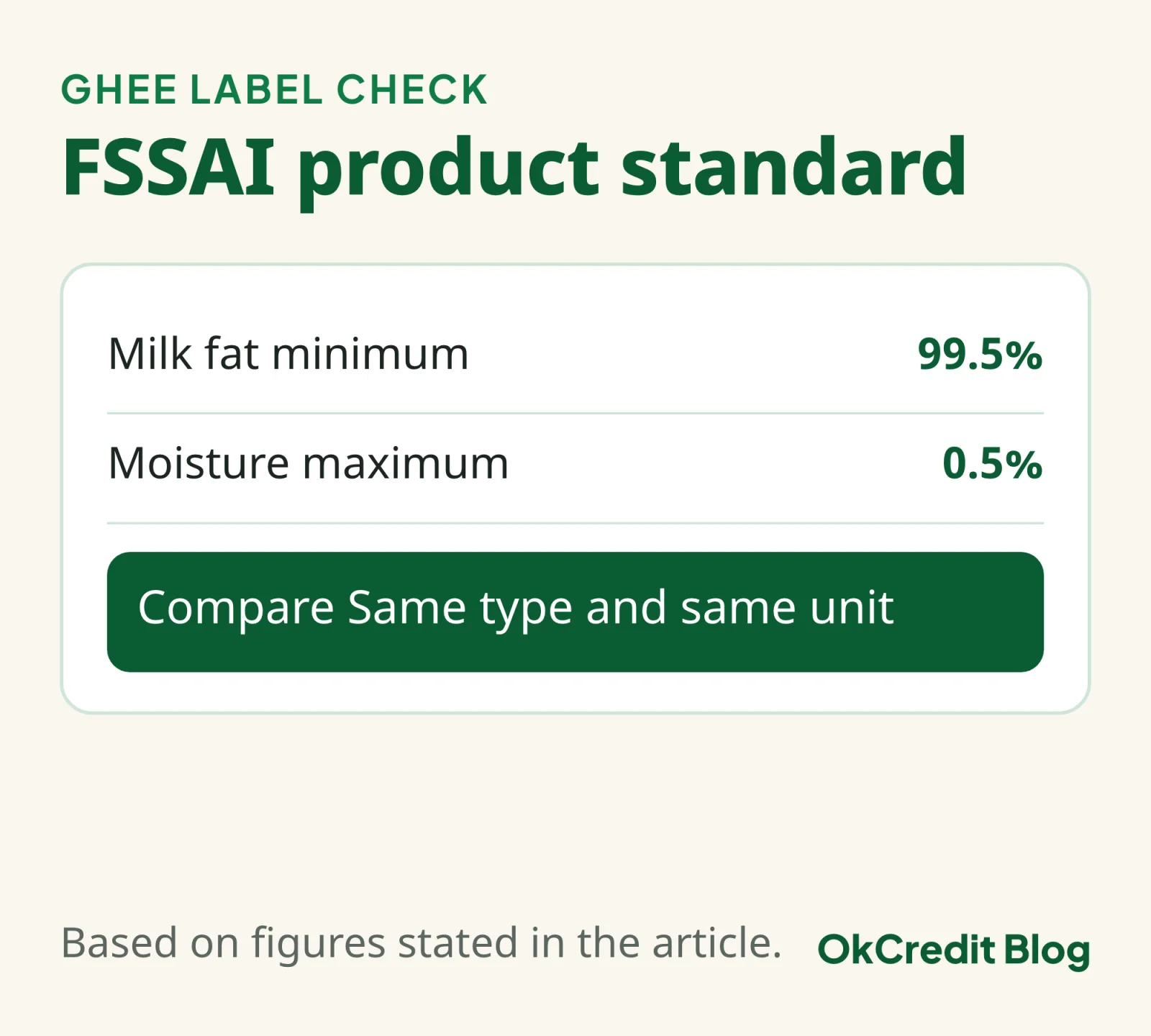
Two label checks to review on the ghee pack.
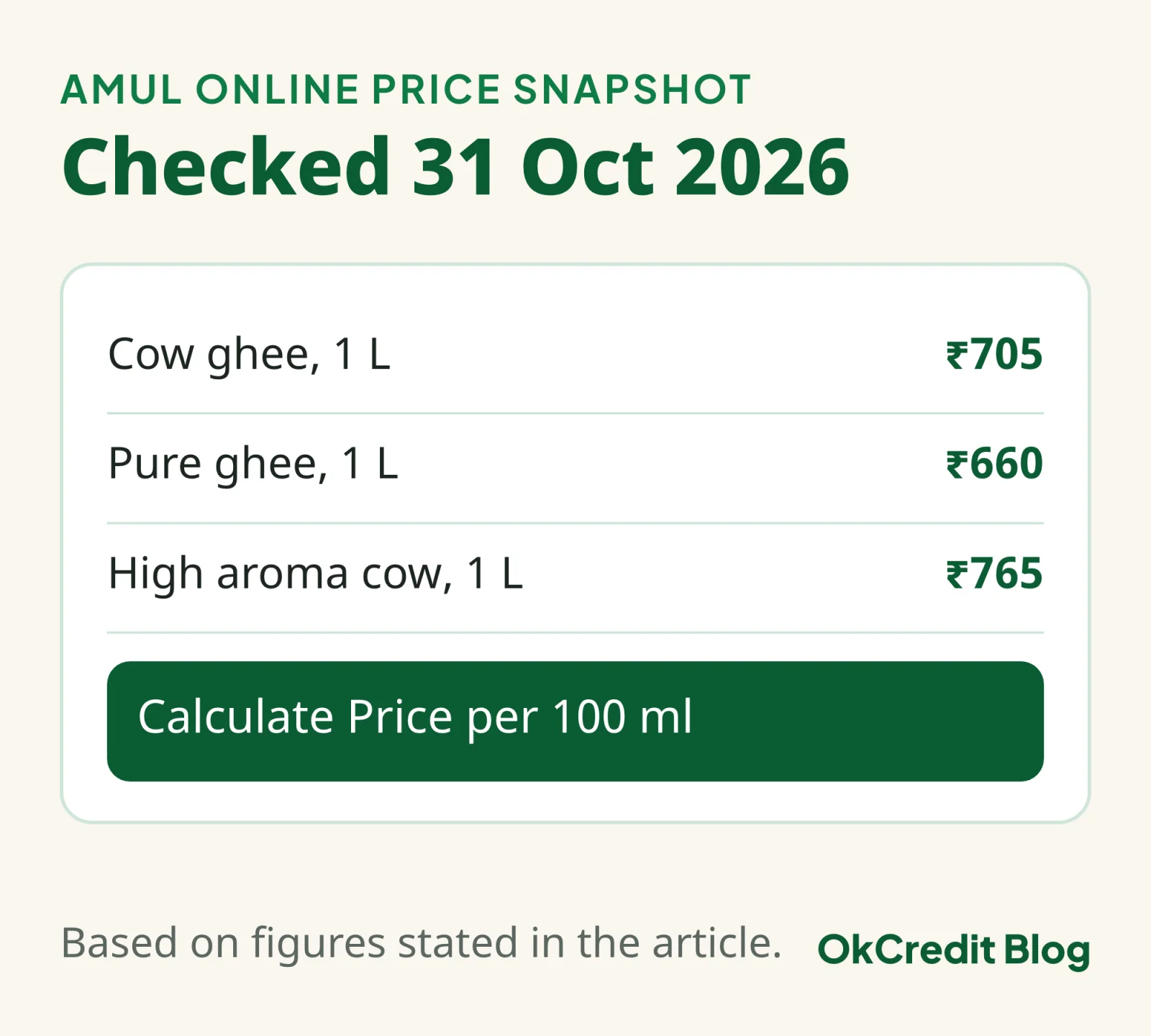
Online price snapshot recorded on 31 October 2026.
Frequently asked questions
Which is the number one ghee brand in India?
There is no single official quality ranking that applies to every use. Compare the exact variant, ingredients, current pack price, label, traceability and taste for your household or recipe.
Is cow ghee always better than buffalo ghee?
They are different products with distinct taste and characteristics. Choose based on recipe, preference, budget and the exact label. Do not treat one type as universally superior.
What moisture limit does the FSSAI standard set for ghee?
The FSSAI standard sets maximum moisture at 0.5% for ghee (Food Safety and Standards Regulations, Chapter 2.1). Check the current standard and exact product category for amendments.
How do I compare ghee prices between brands?
Compare the same type and pack unit, calculate price per 100 ml or per 100 g, and include any delivery charge. Grams and millilitres are not interchangeable for ghee.
Can a home test prove that ghee is pure?
No. Home appearance or viral tests do not prove compliance. Preserve the pack and bill and contact the seller or food-safety authority if you suspect a problem.
Which pack size should a shop stock?
Use actual sales velocity, customer demand, expiry, cash tied up and supplier refill time. Start with a modest quantity and increase only when sell-through supports it.