Yes, most fresh fasa udhaar comes back; the odds drop as the debt ages. Udhaar a few weeks old usually clears with one reminder, months-old udhaar needs a plan, and anything past a year usually needs a settlement offer. There is a legal clock too: under the Limitation Act, 1963, a recovery suit must be filed within 3 years (as of 2026).
Money getting stuck is not a personal failing. The Economic Survey 2025-26 estimates roughly Rs 8.1 lakh crore locked in delayed payments to MSMEs across the country (as of 2026). That figure is about business-to-business dues, not the udhaar in your khata, but the pattern is identical: the buyer has the goods, the seller has a promise. Below is the honest answer by age of debt, then the legal limit, then the system that gets stuck money moving.
Does fasa udhaar ever come back? The honest answer
The fresher the udhaar, the more certain the recovery; udhaar older than a year rarely comes back in full, though a part of it often can. No government or industry body publishes recovery rates for shop udhaar in India, so you will find no percentages here, only what the counter teaches.
| Age of udhaar | Chance of recovery | What to do |
|---|---|---|
| Fresh (a few weeks) | High | Show the hisaab once, fix a date |
| 1 to 3 months | Fair | One tagada every week, accept instalments if needed |
| 3 to 12 months | Low, takes work | Sit down with the written hisaab, start with a small part-payment |
| Over 1 year | Very low | Offer a round-down lump-sum settlement, decide before 3 years are up |
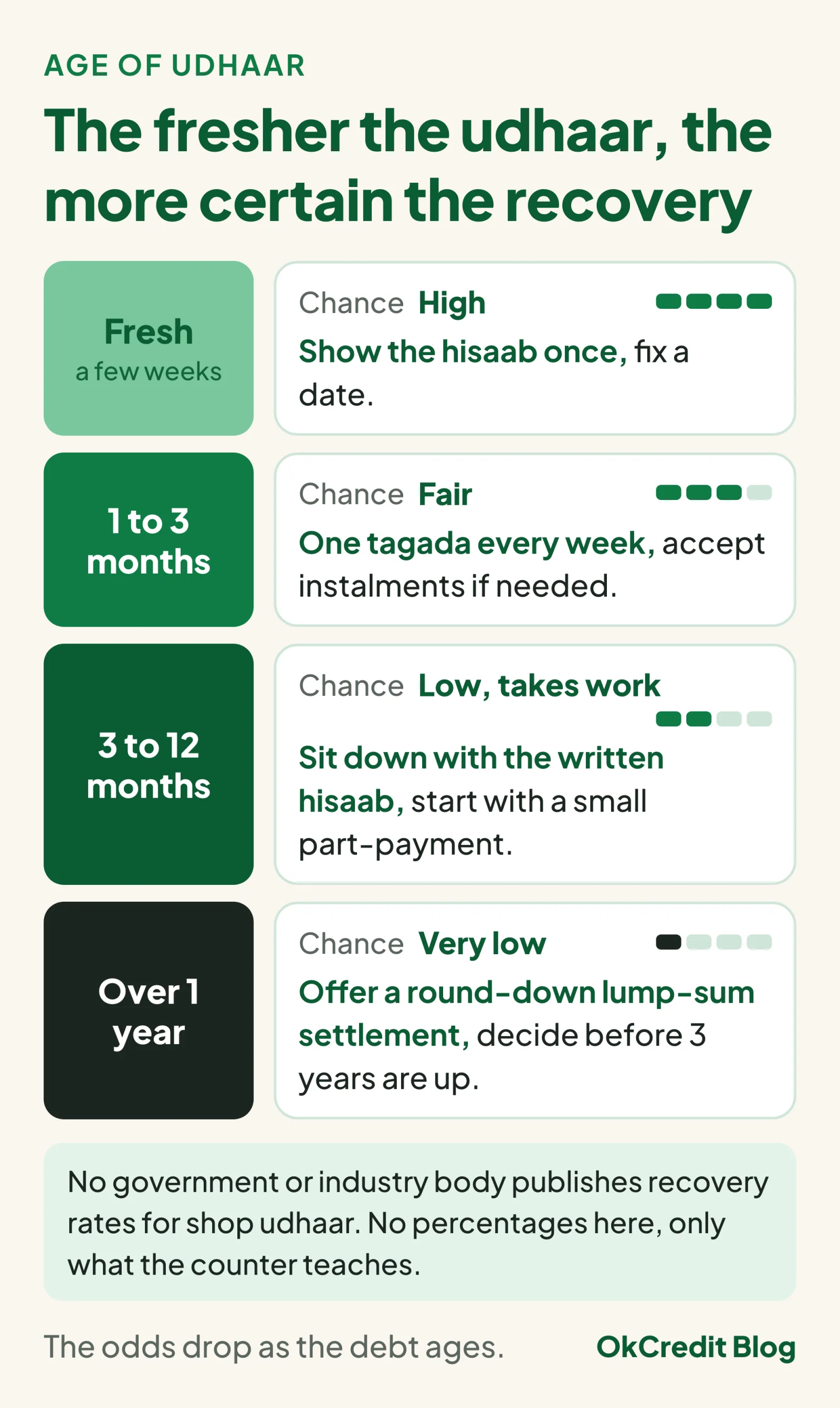 The odds drop and the method changes as udhaar ages. Fresh udhaar needs only the hisaab; past a year it is a settlement conversation.
Why does it get stuck in the first place? Three reasons, and none of them is that the customer is a thief. Asking feels awkward on both sides, so nobody asks. No date was fixed at the time of sale, so "next week" never ends. And often there is no written record the customer has seen, so the amount itself turns into an argument. Fix those three and most fresh udhaar never becomes fasa udhaar.
How old can udhaar get before the legal route closes?
Three years. The Schedule to the Limitation Act, 1963 gives 3 years to file a suit for the price of goods sold on credit or for money lent (as of 2026; Articles 14, 15, 19 and 21). For ordinary shop udhaar with no agreed credit period, the clock starts on the day you handed over the goods, not on the day of your last reminder.
Two things restart that clock, and both come with conditions. Under section 18, a written acknowledgement of the debt, signed by the customer before the 3 years run out, starts a fresh 3-year period from the date of signing. Under section 19, a part-payment made before expiry also starts a fresh period, but only if the acknowledgement of that payment appears in the customer's own handwriting or in a writing signed by them. A cash entry you made in your own khata is weaker than a slip the customer signed, or a message or UPI note the customer sent.
So the practical rule is simple: before old udhaar goes cold, get something in writing from the customer's side. A signed slip, a WhatsApp reply confirming the amount, a UPI payment with a note. Whether a WhatsApp or SMS reply counts as a "signed" writing is a question of evidence law, so for any amount worth a court case, consult a lawyer.
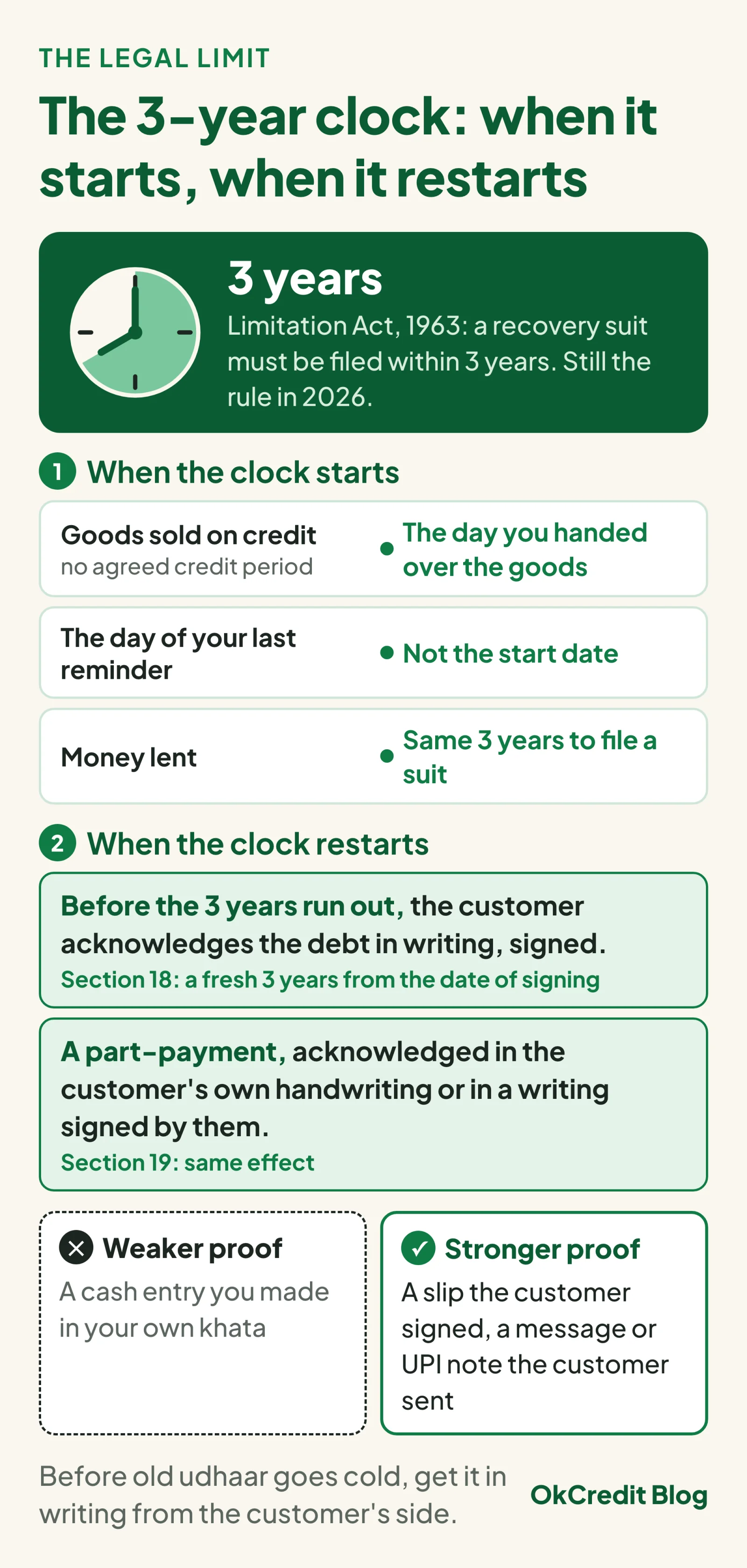 When the clock starts, and what restarts it. Not your own khata entry, but the customer's signature or their own writing.
If you do go the legal way, a money-recovery suit is a civil suit in the local civil court, where the customer lives or where the sale happened. Lok Adalat is the cheaper route: no court fee, you can apply to the District Legal Services Authority even before filing a case, and the award has the force of a civil court decree with no appeal. National Lok Adalats are held four times a year, on the second Saturday of March, May, September and December (2026 calendar). The catch: the customer has to agree to settle. Lok Adalat cannot force anyone.
What is the 3-step system to recover stuck udhaar?
Hisaab, sequence, settle. Most shopkeepers skip the first step and jump straight to tagada, which is why the tagada goes nowhere.
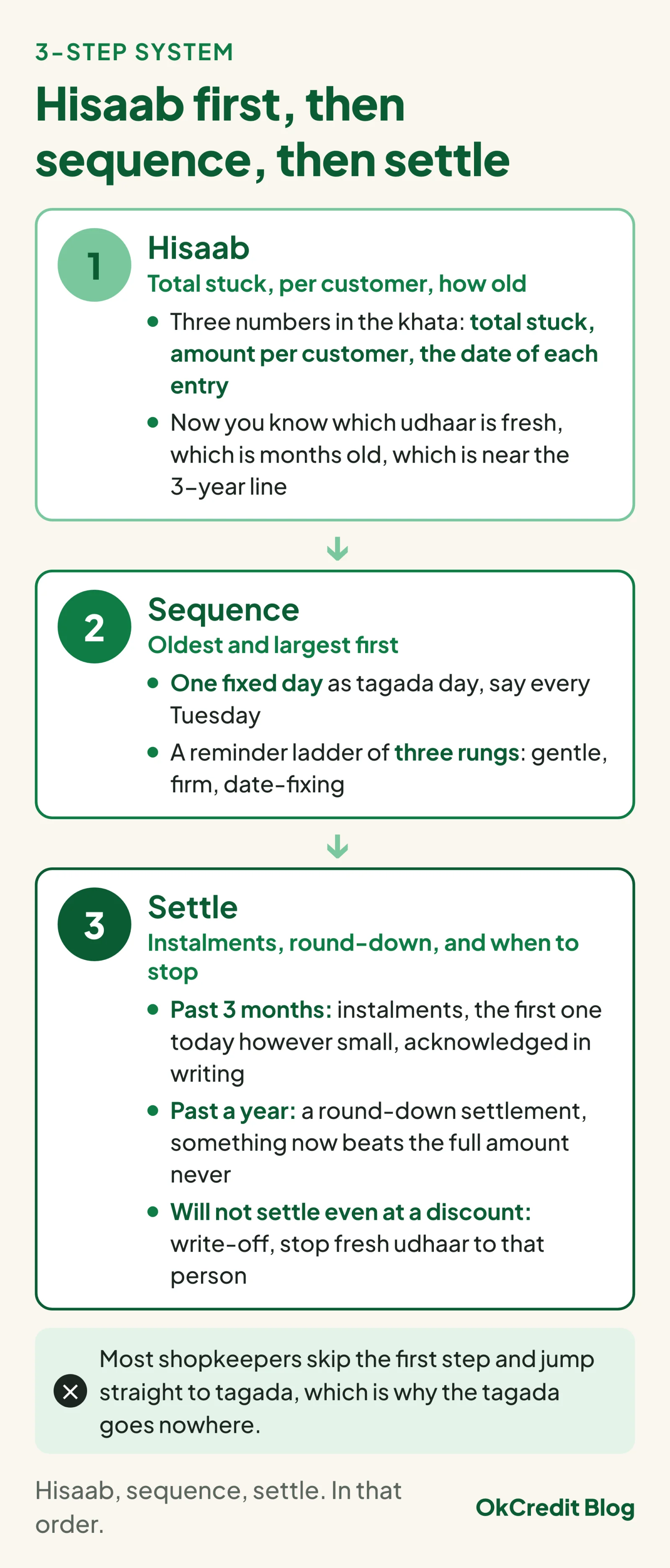 Three steps, in this order. Without the hisaab there is no sequence, and without the sequence the settlement never comes up.
Step 1, hisaab. Open the khata and write down three numbers: total stuck, amount per customer, and the date of each entry. Now you know which udhaar is fresh, which is months old, and which is near the 3-year line. Recovery is about that list, not about how you feel when a certain customer walks past the shop.
Step 2, sequence. Start with the oldest and the largest, because those lose value every week. Pick one fixed day, say every Tuesday, as tagada day; a fixed day keeps you regular and ends the daily "should I ask today?" debate. Then climb a reminder ladder. First rung, gentle: the hisaab and nothing more. Second rung, firm: the amount plus a request to settle this week. Third rung, date-fixing: "Sunday, Rs 2,000, the rest by month end." Ready-to-send messages for each rung are in our post on payment reminder messages, and more collection tactics are in 10 ways to recover udhaar.
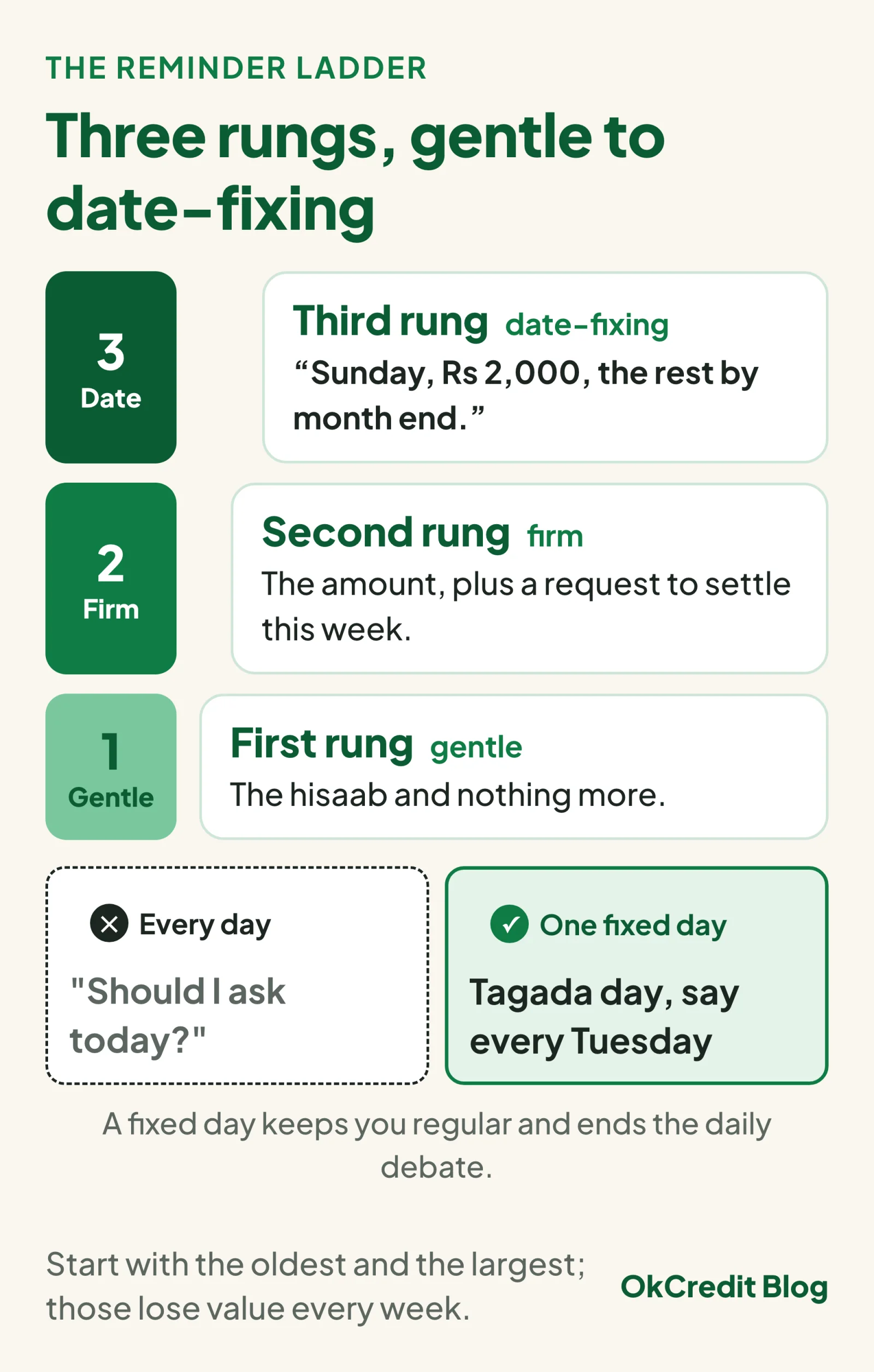 Gentle first, a date at the end. Pick one fixed tagada day instead of asking yourself every morning.
Step 3, settle. For udhaar past 3 months, stop asking for the full amount in one go. Offer instalments, take the first one today however small, and get it acknowledged in writing. For udhaar past a year, offer a round-down settlement: something now beats the full amount never. Whatever the customer will not settle even at a discount is a write-off. Note it, stop fresh udhaar to that person, and move on. Time spent chasing dead dues is time not spent on the shop.
What should you never do when asking a customer for money?
Never take the fight public. No name on the shop board, no photo in a WhatsApp group, no message to the customer's relatives, no threats, no knocking on doors late at night. Two reasons.
The relationship reason: a customer who has been shamed will not pay, will not return, and will tell twenty others. Fasa udhaar rarely recovers from that point.
The legal reason: since 1 July 2024 the Bharatiya Nyaya Sanhita, 2023 has replaced the IPC (as of 2026). Publicly maligning someone can fall under defamation in section 356, and threats to a person, their reputation or property can fall under criminal intimidation in section 351; both are criminal offences. Any older advice quoting IPC sections is out of date. The person who owes you money should not become the person with a complaint against you.
Polite persistence plus process is the whole method. Ask regularly, ask privately, keep the hisaab in front of both of you, and let the legal route stay a last resort.
How do you stop udhaar getting stuck again?
Stuck udhaar is made at the moment of sale, not at the moment of recovery. Three habits close the gap.
Write it down at the time of sale, and let the customer see it. A confirmation by SMS or WhatsApp with the amount and date kills the "I never took that much" argument months later and gives you a written trail from the customer's side. Set a per-customer limit and hold it: the moment the balance touches the limit, the next purchase is cash. And fix a settlement date, ideally the customer's payday, so udhaar has an end by design rather than by argument.
To track customer credit, a free khata app like OkCredit keeps every entry backed up, can send the customer an SMS on each entry, and, with Auto Reminder switched on, sends SMS payment reminders on outstanding balances from your own phone.
Before extending credit to a new face, run through the checklist before giving udhaar. And if you were hoping a "defaulter list" would do the chasing for you, read the truth about CIBIL defaulter lists first.
FAQ
After how many years can a shopkeeper no longer sue for udhaar?
Three years under the Limitation Act, 1963 (as of 2026), usually counted from the date the goods were delivered. A written acknowledgement signed by the customer, or a part-payment acknowledged in the customer's own writing, made before those 3 years end starts a fresh 3-year period. Consult a lawyer for your specific case.
Does a WhatsApp message count as written acknowledgement of udhaar?
It is written evidence, but whether it counts as a "signed" acknowledgement under section 18 or 19 of the Limitation Act is a question of evidence law. Keep it anyway; it is stronger than an entry only in your own khata. Take legal advice before relying on it.
Can I post a customer's name and photo for not paying?
No. Under the Bharatiya Nyaya Sanhita, 2023 (in force since 1 July 2024), public shaming can attract the defamation provision in section 356 and threats can attract criminal intimidation in section 351. It also ends the relationship and, with it, the recovery.
Is Lok Adalat useful for small udhaar?
Yes, if the customer agrees to settle. There is no court fee, you can apply at the District Legal Services Authority before filing any case, and the award is binding like a court decree. National Lok Adalats are held on the second Saturday of March, May, September and December (2026).
What if the stuck money is owed by a business buyer, not a walk-in customer?
If your shop is Udyam-registered and a business buyer owes you, the MSMED Act's delayed-payment route (45-day rule) applies. From 15 October 2025, new references are filed on the MSME ODR Portal at odr.msme.gov.in (as of 2026). Ordinary consumer udhaar does not qualify.