
There is no public CIBIL defaulter list of ordinary borrowers, as of 2026. TransUnion CIBIL keeps private credit reports, not a name-and-shame list. The only public lists cover large bank loans: wilful defaulters owing ₹25 lakh and above, and suit-filed accounts of ₹1 crore and above. Shop udhaar never appears on any of them.
If you searched for a list to check a customer's name against before giving udhaar, or because you are worried your own name is on one, here is what the rules actually say, where the real lists sit, and what a shopkeeper can rely on instead.
Is there really a CIBIL defaulter list?
No. CIBIL is a credit bureau, not a blacklist. TransUnion CIBIL is one of four credit information companies registered with the RBI under the CICRA Act, 2005; the other three are Experian, Equifax and CRIF High Mark, and as of 2026 there are still exactly four. Each bureau holds a credit report on you, built from what banks and NBFCs send in. A missed EMI shows up inside your own report as a DPD (days past due) remark. It shows up nowhere else.
What does exist in public is narrower than the search results suggest. On RBI direction, the bureaus themselves host two lists of large bank loans. The wilful defaulter list covers accounts of ₹25 lakh and above, whether or not the lender has filed a suit. The suit-filed list of large defaulters covers accounts of ₹1 crore and above where the lender has gone to court. You can search them on suit.cibil.com, suit.experian.in and the CRIF High Mark suit-filed cases page. The RBI's own old "defaulters list" page is an archive of schemes from the 1990s; the RBI stopped publishing these lists itself and handed the job to the bureaus.
| Myth | Fact (as of 2026) |
|---|---|
| CIBIL publishes a list of everyone who missed a payment | CIBIL keeps individual credit reports. A default is visible only in that person's own report and to lenders who pull it with consent |
| A search on the RBI website shows all defaulters | The RBI does not host live lists. The four bureaus display the wilful-defaulter list (₹25 lakh+) and the suit-filed large-defaulter list (₹1 crore+) |
| A kirana shop can look up a customer's CIBIL | Only banks, NBFCs and RBI-notified "specified users" can pull a report. Shops are not members under CICRA 2005 |
| Udhaar at a shop lowers your CIBIL score | Informal shop credit is never reported to any bureau. Only regulated lenders report |
| Someone can remove a genuine default for a fee | A genuine default is removed only by paying. Wrong entries are corrected free through a dispute with a 30-day clock |
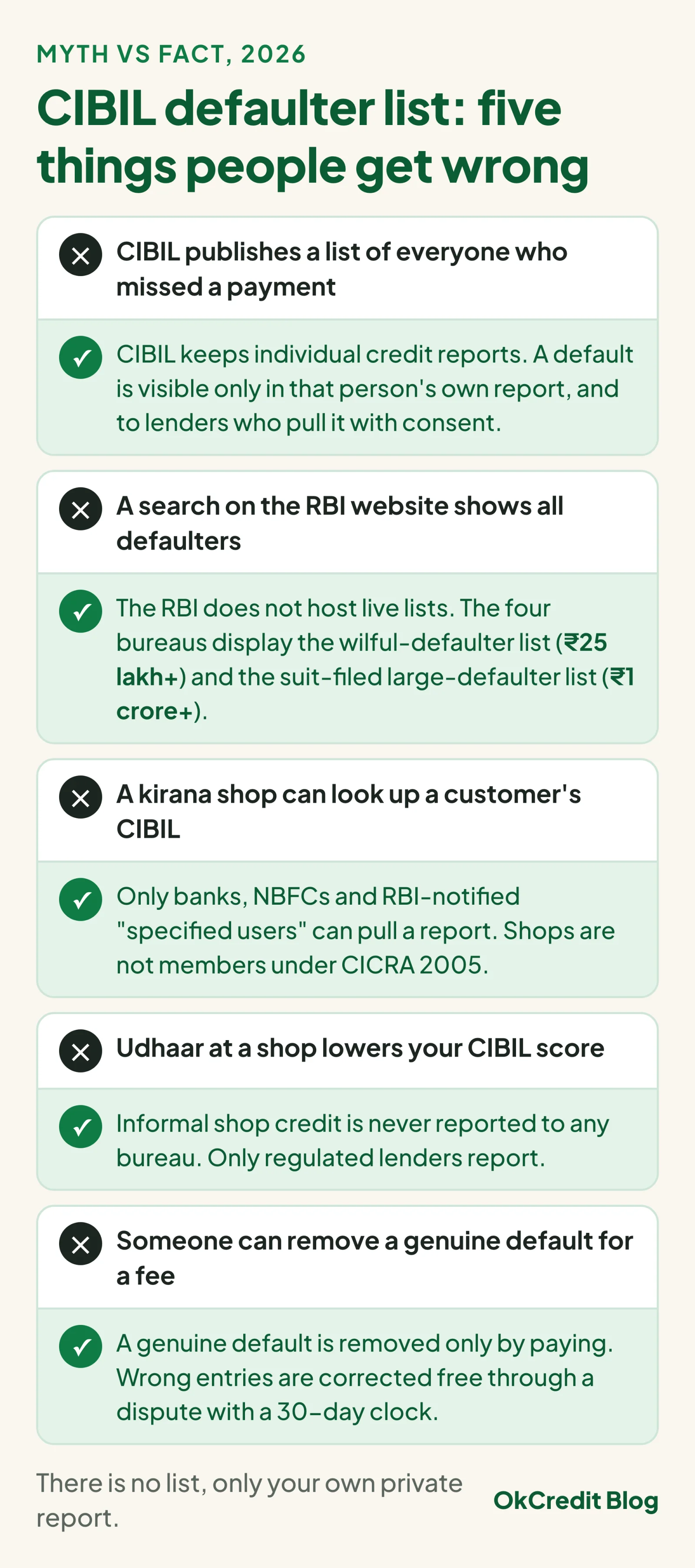 Five things people assume, and next to each one what is actually true in 2026.
What is the RBI wilful defaulter list and who does it apply to?
A wilful defaulter is a borrower or guarantor who owes ₹25 lakh or more, has the capacity to pay, and still does not pay, or who diverted the loan money. That definition sits in the RBI (Commercial Banks, Treatment of Wilful Defaulters and Large Defaulters) Directions, 2025, issued on 28 November 2025. Until then the rule lived in a July 2024 Master Direction; the thresholds carried over unchanged. A large defaulter is anyone owing ₹1 crore or more where a suit has been filed or the account is classified doubtful or loss.
The Directions bind commercial banks, small finance banks, regional rural banks, co-operative banks, all-India financial institutions and the larger NBFCs. These lenders report both lists to all four bureaus every month. For the borrower who lands on the wilful defaulter list, the penalties are heavy: no fresh loans from any bank or NBFC, possible criminal action, and the name stays until the outstanding drops below ₹25 lakh, after which the lender must have it removed within 30 days.
Now put a ₹3,000 kirana udhaar next to that. A shop is not a lender under these Directions. The amount is more than 800 times below the ₹25 lakh threshold. No court is involved. The list is built from bank loan books, and a bahi khata is not a bank loan book.
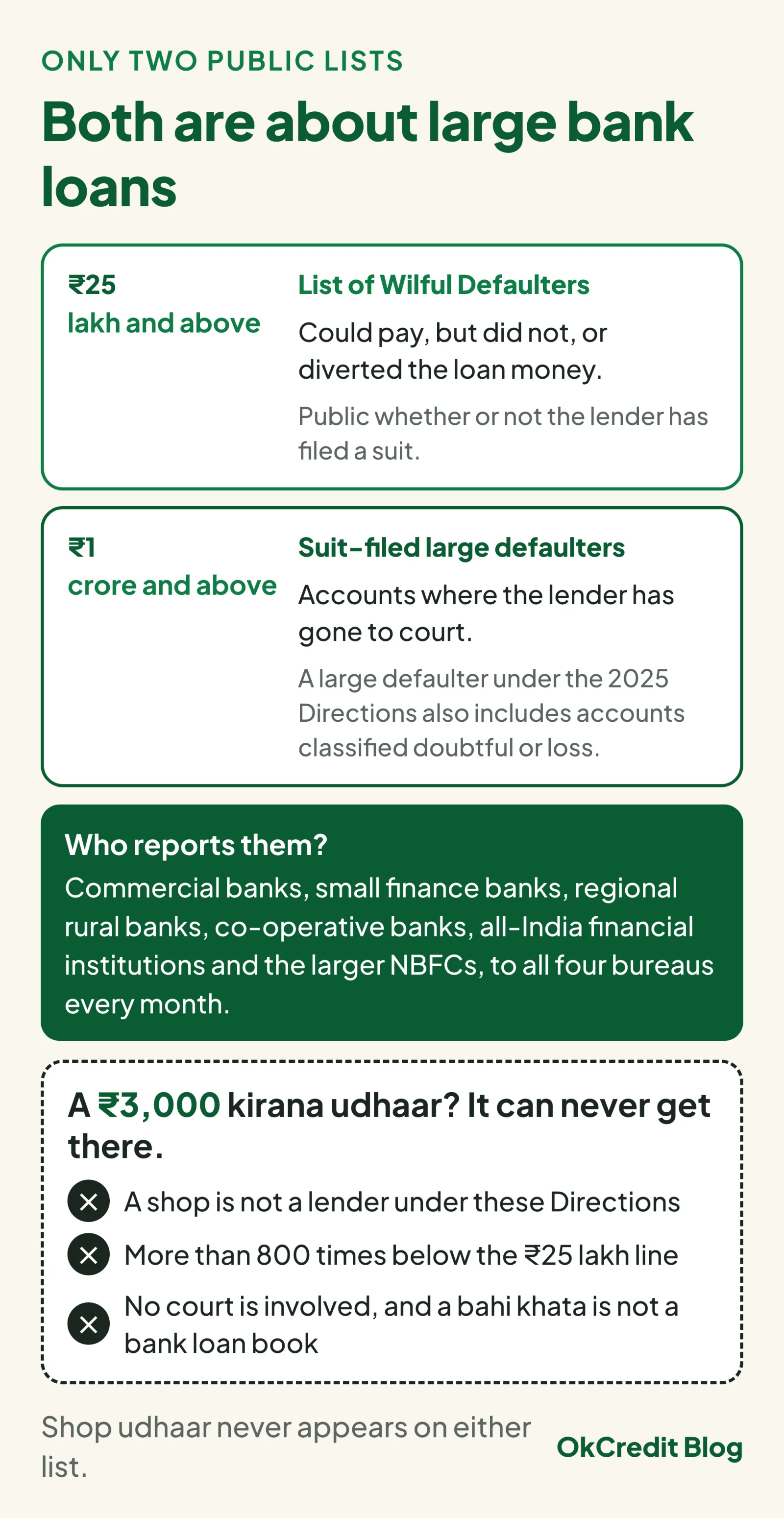 Both lists are built from bank loan books. Shop udhaar has no lender, no threshold and no court behind it.
How do I check whether my name is a defaulter?
Pull your own credit report; it is the only place a retail default is recorded. RBI rules give every individual one free full credit report, score included, every calendar year from each of the four bureaus, and the link has to be on the bureau's homepage. That is four free checks a year if you spread them out. The score runs from 300 to 900 on all four bureaus, because the RBI mandates one common scale.
On the report, three things matter more than the score. The account status line says "Settled" if you paid less than the full amount by agreement, and "Written off" if the lender gave up on the balance; both hurt for years. The DPD column shows how late each month's payment was: 000 means on time, 030 or 090 means 30 or 90 days late. A "Suit filed" or "Wilful default" remark on a report is not the same as being on a public list: only wilful defaults of ₹25 lakh and above and suit-filed accounts of ₹1 crore and above reach the lists described above. Since April 2024 the bureaus must also SMS or email you whenever a lender pulls your report, so a surprise enquiry is itself a warning sign.
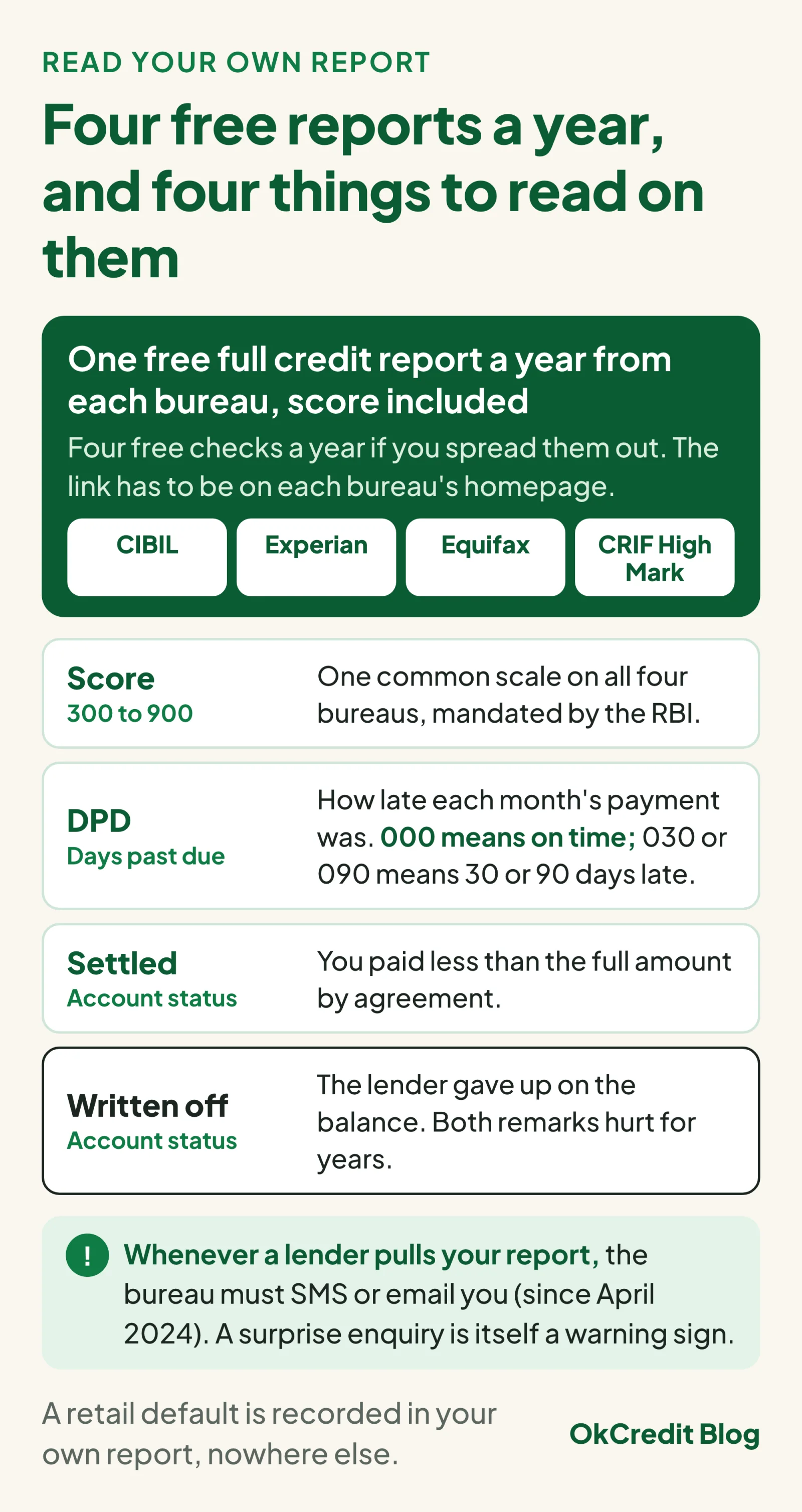 Four free reports a year, and the same four things to read on each of them.
For the public lists, the search on suit.cibil.com is by name and lender. It only makes sense if you or your firm ever borrowed ₹25 lakh or more from a bank. If the report shows a low score rather than a default, the fix is a different one; how to raise a CIBIL score is covered separately.
How can a shopkeeper check a customer's defaulter status?
You cannot, and it would not help even if you could. Under CICRA 2005 only credit institutions (banks, co-operative banks, NBFCs, housing finance companies, credit-card companies) are bureau members who can report and pull data. The other exception is RBI-notified "specified users" such as insurers and telecom companies. A shop is neither, and unauthorised access is an offence with a fine of up to ₹1 lakh plus ₹10,000 a day (as of 2026). Even if a customer volunteered their own report, it would tell you about their car loan, not about whether they paid the shop next door, because shop udhaar is never reported to any bureau.
What you do have is better than a bureau for your purpose: your own khata. It answers the questions a lender's report cannot. How often does this customer buy? How many days pass between purchase and payment? Do they clear the full balance or chip away at it? Did they keep the last promised date? A small-start ladder does the rest. First udhaar ₹500, capped there until two clean cycles, then ₹1,500, then more. A neighbouring shopkeeper's word is a fair reference, but keep it a conversation, not a document. The checklist before giving udhaar walks through each of these signals.
One line matters more than the rest. Never put customers' names on a "defaulter" board, a wall poster, a WhatsApp group or a social post. Calling someone a defaulter in public is a defamation exposure today under section 356 of the Bharatiya Nyaya Sanhita, 2023 (up to two years' imprisonment, a fine, or both, plus a possible civil suit). The Digital Personal Data Protection Act, 2023 is also in force, its Rules were notified in November 2025, and its penalties for mishandling personal data start applying from 14 May 2027. The protection you want comes from a clean private record, not a public one. To keep that record, a free khata app like OkCredit can send the customer an SMS on every entry and backs the ledger up online, so the proof survives a lost phone (Android). If an old balance has already gone sour, whether stuck udhaar comes back is its own question.
How does a name get removed from the defaulter list?
By paying, and then waiting about a week. Before 1 July 2026 lenders updated the bureaus fortnightly (on the 15th and month-end), and before January 2025 only once a month. Since 1 July 2026 they report as on the 9th, 16th, 23rd and last day of every month, per the RBI (Credit Information Companies) Directions, 2025. A cleared account now shows on your report within roughly one to two weeks instead of the old 15 to 30 days. The steps are the same as always: pay the dues, collect a no-dues certificate or closure letter, and check the report two weeks later. For the wilful defaulter list, the name must come off within 30 days of the outstanding falling below ₹25 lakh after the agreed payment.
If the entry is wrong, the dispute is free and has a statutory clock. Raise it with the lender first, then with the bureau. The whole complaint must be resolved within 30 calendar days (21 for the lender, 9 for the bureau); beyond that you are owed ₹100 for every calendar day of delay, credited within five working days of resolution. A lender that rejects your correction has to give reasons in writing. If nothing moves, the RBI Integrated Ombudsman takes the complaint.
That also settles the scam question. Anyone charging money to "get your name off CIBIL" is selling what the RBI framework already gives you free, or promising to erase a genuine default, which nobody can do. A default is closed by paying, not by an agent. Rules and thresholds change; for your own account, confirm with the lender, and for a large or contested case, talk to a CA or a lawyer.
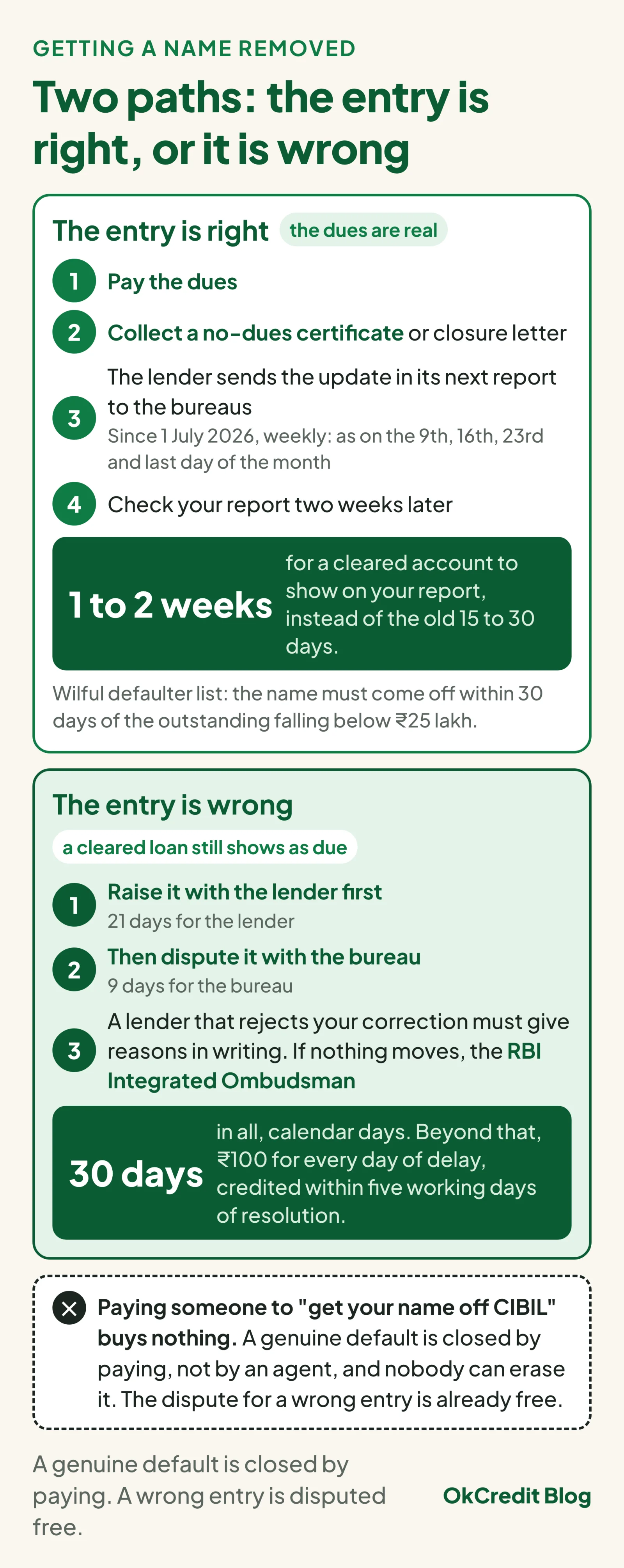 A genuine entry comes off by paying, a wrong one through a free dispute. There is no third route.
Frequently asked questions
Can I check the CIBIL defaulter list by name for free?
You can search the public lists on suit.cibil.com, suit.experian.in and the CRIF High Mark suit-filed cases page at no cost, but they contain only wilful defaulters of ₹25 lakh and above and suit-filed bank accounts of ₹1 crore and above. For anything smaller, the only record is your own credit report, which every bureau gives free once a calendar year.
Does the wilful defaulter list include small personal loans or credit cards?
No. As of 2026 the wilful defaulter list starts at ₹25 lakh outstanding, and the suit-filed large-defaulter list at ₹1 crore. A missed personal loan EMI or credit-card bill appears inside your own credit report as a DPD, written-off or settled remark, not on any public list.
Does udhaar from a kirana shop affect my CIBIL score?
No. Only credit institutions such as banks and NBFCs can report to the four bureaus under CICRA 2005, and a shop is not one. Shop udhaar has no effect on your CIBIL score, and a shop cannot look up your report either.
How long does a cleared loan take to update in CIBIL in 2026?
About one to two weeks. Since 1 July 2026 lenders report to the bureaus as on the 9th, 16th, 23rd and last day of each month, replacing the fortnightly cycle that ran from January 2025 to June 2026. Collect a no-dues certificate at closure and check your report after two weeks.
Can someone remove my name from the CIBIL defaulter list for a fee?
No. A genuine default is removed only by paying the dues. A wrong entry is corrected free through a dispute that must be resolved within 30 days, with ₹100 per day compensation after that. Anyone charging to "remove your name" is either selling the free process or promising something no one can deliver.