
The RBI wilful defaulter list names borrowers who owe a lender ₹25 lakh or more and have defaulted despite being able to pay, or after diverting the money. As of 31 March 2025, the latest data given to the Lok Sabha in March 2026, it carried roughly 18,000 names owing about ₹3.8 lakh crore, per a March 2026 Lok Sabha reply. A kirana customer's udhaar can never appear on it.
What is the RBI wilful defaulter list?
Under the RBI (Commercial Banks, Treatment of Wilful Defaulters and Large Defaulters) Directions, 2025, dated 28 November 2025, a wilful defaulter is a borrower or guarantor with ₹25 lakh or more outstanding whose default is deliberate: capacity to pay but no payment, funds diverted or siphoned, secured assets sold without the lender's approval, or a promised equity infusion not made despite the means (para 3(1)(xviii)). For a company, promoters and directors go on the list personally; independent and nominee directors are shielded unless connivance is conclusively established (para 5(14)).
A large defaulter is a separate category: ₹1 crore or more outstanding, plus either a suit filed or a doubtful/loss classification (para 3(1)(xi)). Intent does not matter there. These Directions repealed the July 2024 Master Direction, so any page still citing it as the rulebook is stale as of 2026.
The label is never a phone call. The lender's Identification Committee issues a show-cause notice with all the material relied on, and the borrower gets 21 days to answer (para 5(4)). Then come 15 days for a written representation to a separate Review Committee, which must offer a personal hearing (paras 5(7), 5(9)). No lawyer is allowed, since it is an in-house proceeding (para 5(10)), and the outcome is a reasoned written order. Every NPA of ₹25 lakh or more is screened this way within six months of the NPA date (para 6).
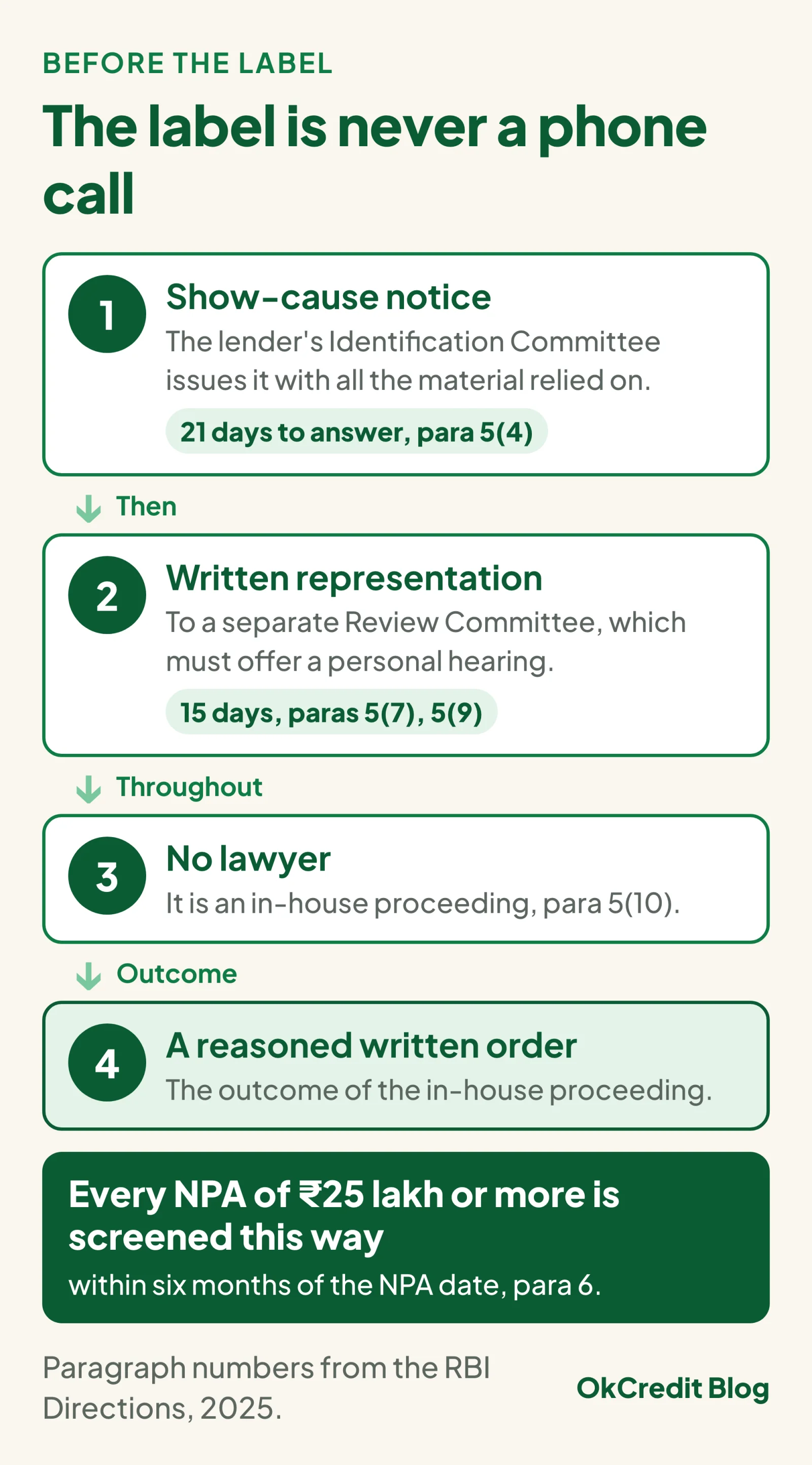 Notice, representation, hearing, order. The label arrives at the end of a paper trail, never by phone.
| Wilful defaulter | Large defaulter | Shop udhaar | |
|---|---|---|---|
| Threshold (2026) | ₹25 lakh+ outstanding | ₹1 crore+ outstanding | A few hundred to a few thousand rupees |
| What qualifies | Default plus capacity to pay, diversion, siphoning, asset sale or unmet equity promise | Suit filed, or account doubtful/loss; intent irrelevant | A customer who has not cleared the khata |
| Who decides | Lender's Identification and Review Committees, with a hearing | The lender, on account status | Nobody; no authority, no register |
| Public? | Yes, suit-filed and non-suit-filed, on the four CIC websites | Only the suit-filed list | Never; a shop cannot report to any bureau |
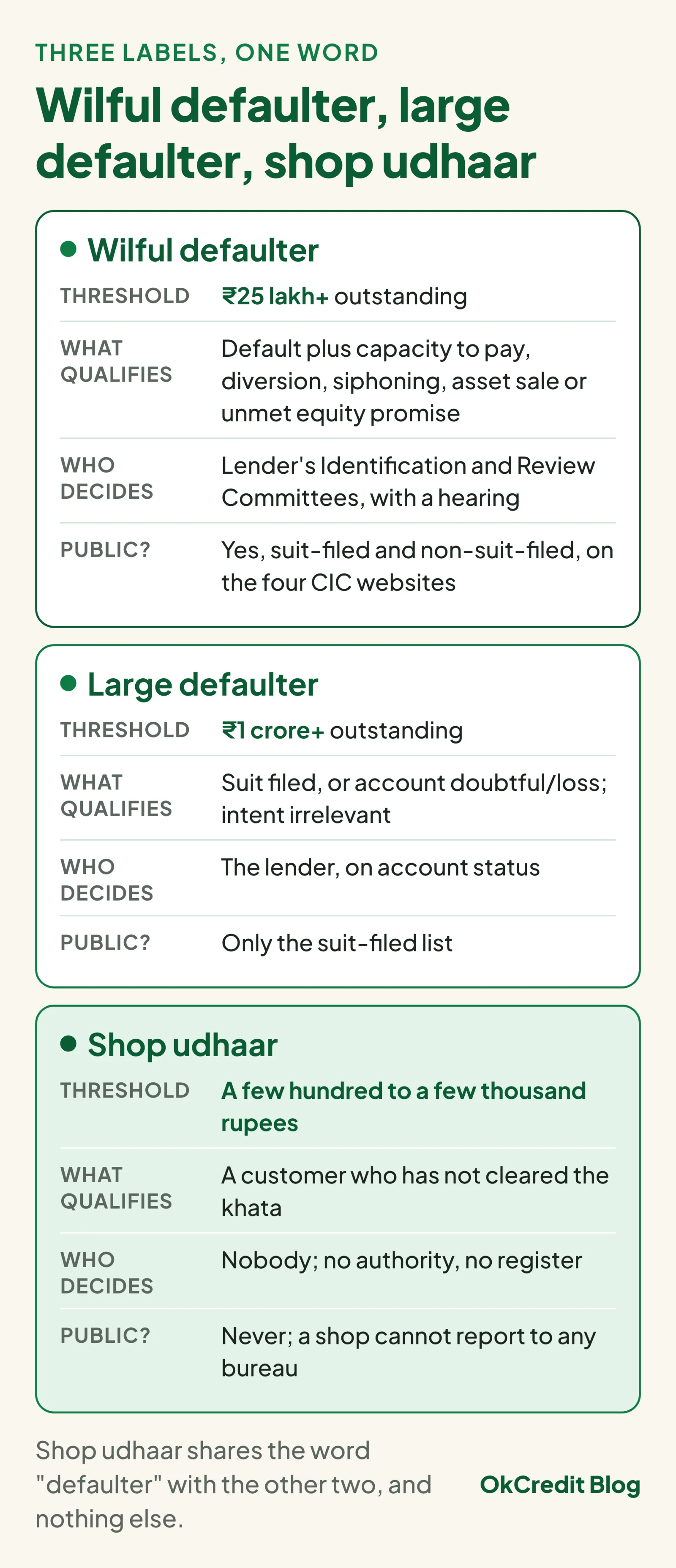 The same table, one card per label. Shop udhaar has no threshold, no authority and no register.
Who publishes the list and how do you check it?
RBI does not publish defaulter names and has not since 2003; the lists sit on the websites of the four credit information companies. Lenders feed them monthly (para 12(1)), and the RBI (Credit Information Companies) Directions, 2025 make every CIC display the wilful defaulter list, suit-filed and non-suit-filed, on its site (para 23). The large defaulter list is public only for suit-filed accounts (para 22).
To check, open a CIC's list portal and search by name. As of September 2026 the live pages are suit.cibil.com (TransUnion CIBIL), crifhighmark.com/list-of-suit-filed-cases (CRIF High Mark) and suit.experian.in (Experian); Equifax India publishes monthly files in its suit-filed accounts section. Each portal keeps the ₹25 lakh wilful defaulter list apart from the ₹1 crore suit-filed list, so read the heading first.
There is no equivalent list for ordinary borrowers. A missed EMI goes on the person's credit report, visible only to that person and to CIC members. Each of the four CICs must give you one free full credit report, score included, every calendar year (para 21(7)). The searchable "CIBIL defaulter list" does not exist; the CIBIL defaulter list post takes that myth apart.
What happens to a wilful defaulter?
Once any lender classifies a borrower as a wilful defaulter, no bank may grant that person, or any entity they are associated with, an additional credit facility (para 7(3)(i)), and para 2(2) extends the bar to every RBI-regulated entity.
The bar outlives the listing: one year after the name is removed for any credit (para 7(3)(ii)), five years after removal for financing a new venture (para 7(3)(iii)).
Promoters and directors carry it personally. Para 7(4) writes a covenant into every loan agreement: nobody on the list may be inducted onto a borrower's board, and there is no renewal, enhancement or restructuring while the name stays there. Even after an IBC change of ownership clears the company, its erstwhile promoters, directors and guarantors keep both bars (para 15(3)).
Criminal proceedings are discretionary. Para 7(1) says the bank "can examine" whether to initiate them under the applicable law, today the Bharatiya Nyaya Sanhita, 2023, and removal from the list does not end proceedings already begun. Banks must also hold a board-approved policy on publishing photographs of declared wilful defaulters (para 7(2)).
Removal is slow by design. The lender informs all four CICs within 30 days of the outstanding falling below ₹25 lakh (para 12(2)), and a compromise-settled account leaves the list only when the compromise amount is fully paid, never on part payment (para 13).
Why can a kirana customer never be on it?
Only a "credit institution" under section 2(f) of the Credit Information Companies (Regulation) Act, 2005 can report to a bureau: banks, co-operative banks, NBFCs, housing finance companies, ARCs, credit card companies and others RBI notifies. A shop is none of these. Section 17 lets a CIC share information only with members and specified users, and section 22 makes unauthorised access an offence, with a fine up to ₹1 lakh plus ₹10,000 a day. Even a non-lender seeking specified-user access needs ₹2 crore net worth and three years' experience (CIC Directions, 2025, para 14(3)).
So a dukaan cannot report a customer, cannot pull a customer's report, and no app or agent can do either on the shop's behalf. A customer who shows their own free annual report is the only lawful way you ever see one.
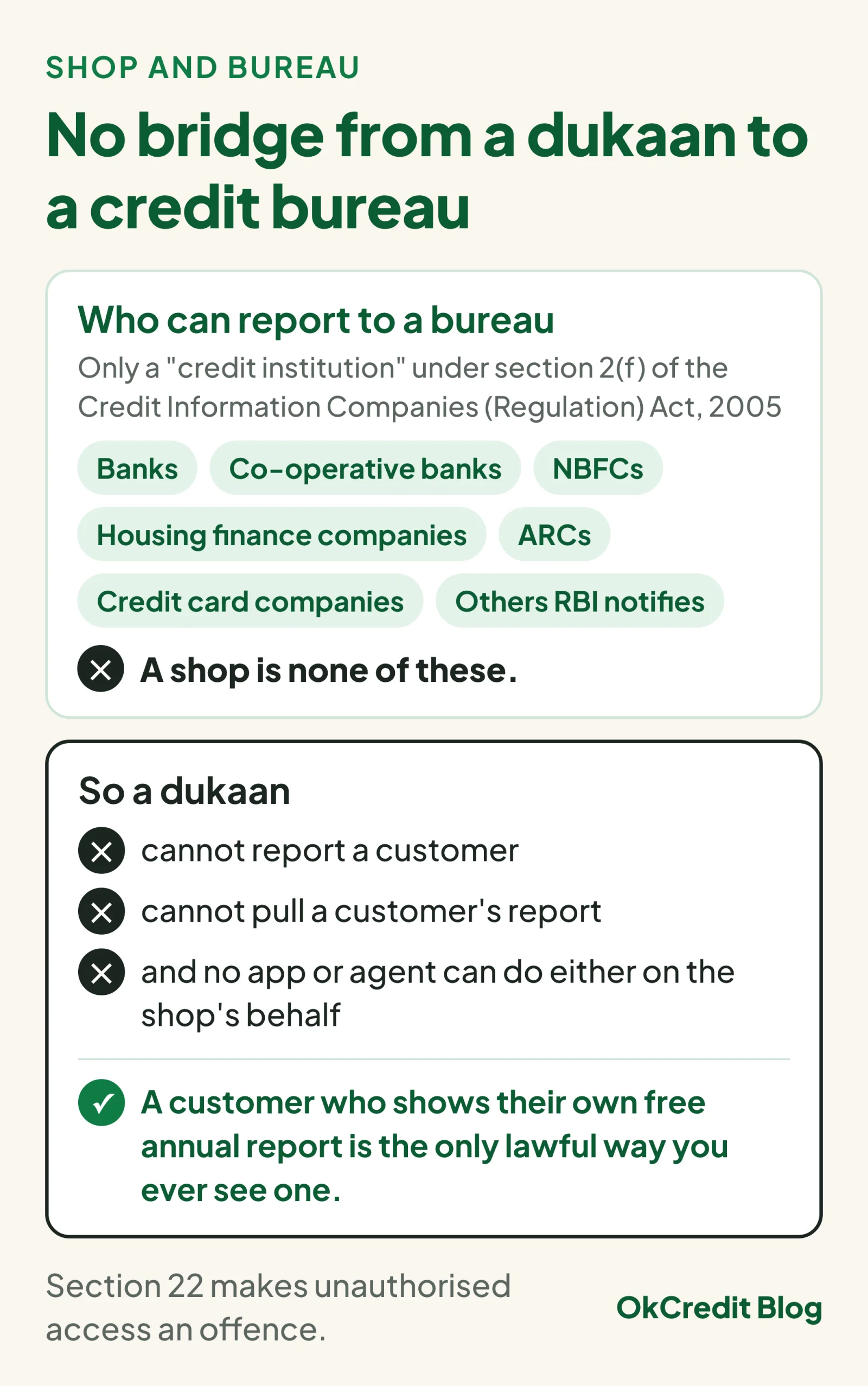 Only credit institutions can report to a bureau. A shop is not one, so nothing it records ever reaches a credit file.
The threshold settles it anyway. The list starts at ₹25 lakh; a bad kirana khata is a few hundred or a few thousand rupees. The two share the word "defaulter" and nothing else, and a customer's bureau file, good or bad, says nothing about whether they pay the shop. The signals that do are in the warning signs post.
What actually protects a shopkeeper who gives credit?
What protects you is a record the customer has acknowledged, a limit set before the first udhaar, and a clear calendar; none of it depends on any list.
What protects a shopkeeper
A record the customer has acknowledged. Section 28 of the Bharatiya Sakshya Adhiniyam, 2023 makes entries in regularly kept books of account, including electronic ones, relevant in court, but adds that they alone are not sufficient to charge anyone with liability. Make the entry at the counter and get the customer's acknowledgement, a reply message or a signature. A free digital khata app like OkCredit can send the customer an SMS on every entry, so both sides hold the same record, keeps an automatic online backup and, with Auto Reminder switched on, sends SMS payment reminders on outstanding balances from your own phone (Android app).
A per-customer limit. Decide the cap before the first udhaar; the kitna udhaar kis customer ko post shows how to size it.
The three-year clock. Under the Limitation Act, 1963 you have three years to sue, from delivery of the goods (Article 14) or from the end of an agreed credit period (Article 15). A written acknowledgement signed by the customer before expiry restarts the clock from the date of signing (section 18). A part payment restarts it only if acknowledged in the payer's handwriting or in a writing signed by the payer, and only before expiry (section 19).
Polite escalation. A reminder, then a written demand, then a lawyer for amounts worth suing over. Never public naming, and never a list of your own.
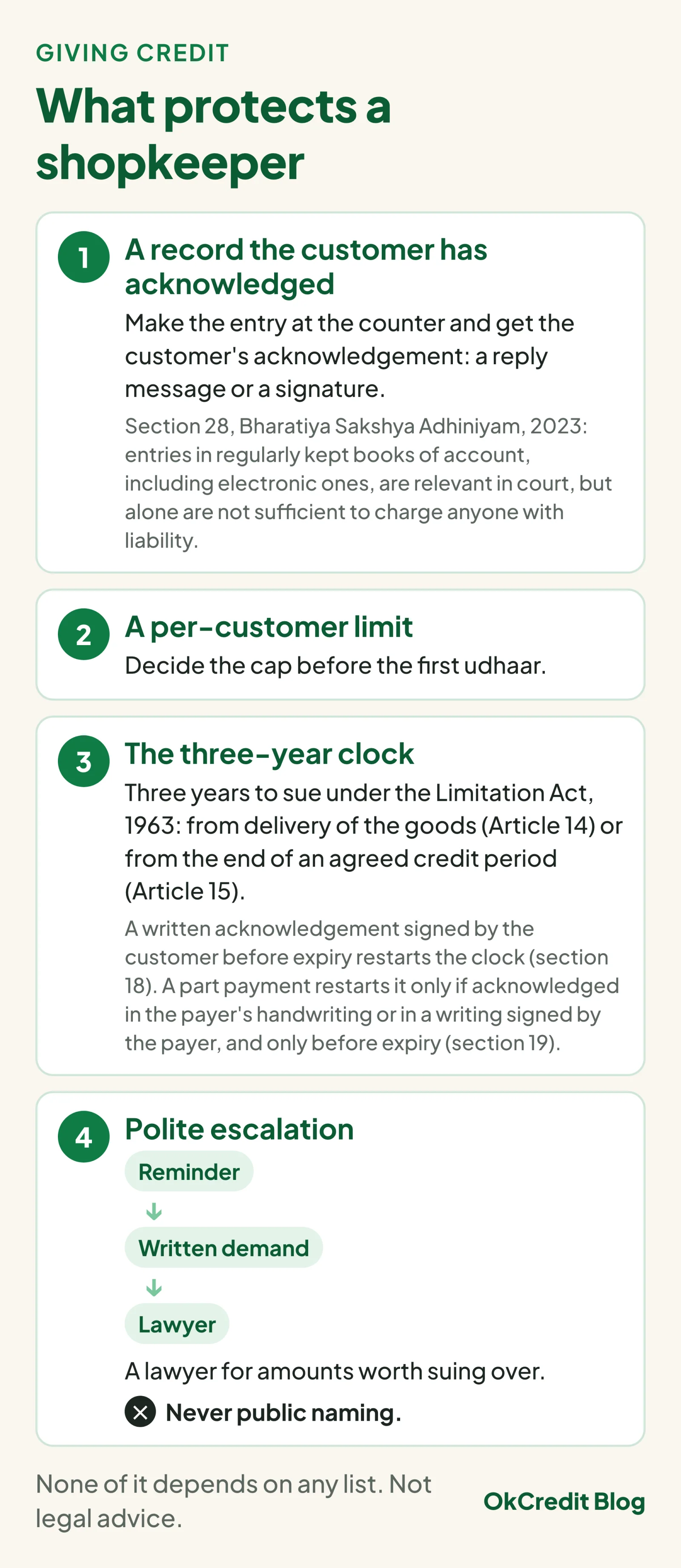 A record, a limit, a calendar and a polite ladder. None of it depends on any list.
Before the next big udhaar, run the udhaar dene se pehle checklist. None of this is legal advice; for a live dispute, consult a lawyer with your entries in hand.
FAQ
Is the RBI wilful defaulter list public in 2026?
Yes, but RBI does not host it. As of 2026 the four CICs (TransUnion CIBIL, CRIF High Mark, Experian, Equifax) must display the ₹25 lakh wilful defaulter list, suit-filed and non-suit-filed, on their websites. The ₹1 crore large defaulter list is public only for suit-filed accounts.
What is the difference between a wilful defaulter and a large defaulter?
A wilful defaulter owes ₹25 lakh or more and defaulted deliberately, as decided through a committee process with a hearing. A large defaulter owes ₹1 crore or more with a suit filed or a doubtful/loss classification; intent is irrelevant.
Can a shopkeeper add a customer to the wilful defaulter list?
No. Only credit institutions under CICRA 2005 can report to a credit bureau, and a shop is not one. The list also starts at ₹25 lakh. A shop cannot report a customer, cannot pull a customer's report, and cannot pay anyone to do either.
How long can I recover udhaar from a customer?
Three years under the Limitation Act, 1963, from delivery of the goods or from the end of an agreed credit period. A written acknowledgement signed by the customer before expiry restarts the clock (section 18). A part payment restarts it only if acknowledged in the payer's handwriting or in a writing signed by the payer, and only before the period expires (section 19).