
A good payment reminder message names the customer, the exact amount, what it was for, a date, and one way to pay, all in under three lines. Below are 43 copy-paste templates for WhatsApp and SMS, in English and Hinglish, arranged from a friendly pre-due nudge to a final notice, with the 2026 WhatsApp and legal rules that keep you safe.
Swap the brackets before sending: [Name], [Rs amount], [date], [item], [shop name], [UPI ID]. Keep the customer's name exactly as they write it. A reminder that says "Sunita ji" and "the 5 kg atta from 14 August" gets paid; a reminder that says "Dear Customer" gets ignored.
What does a good payment reminder message look like?
The message that gets paid has five parts and fits in three lines: the person's name, the exact rupee amount, the item or bill it belongs to, a date (due or promised), and one payment option. Anything beyond that is noise. Politeness is one short line, not a paragraph.
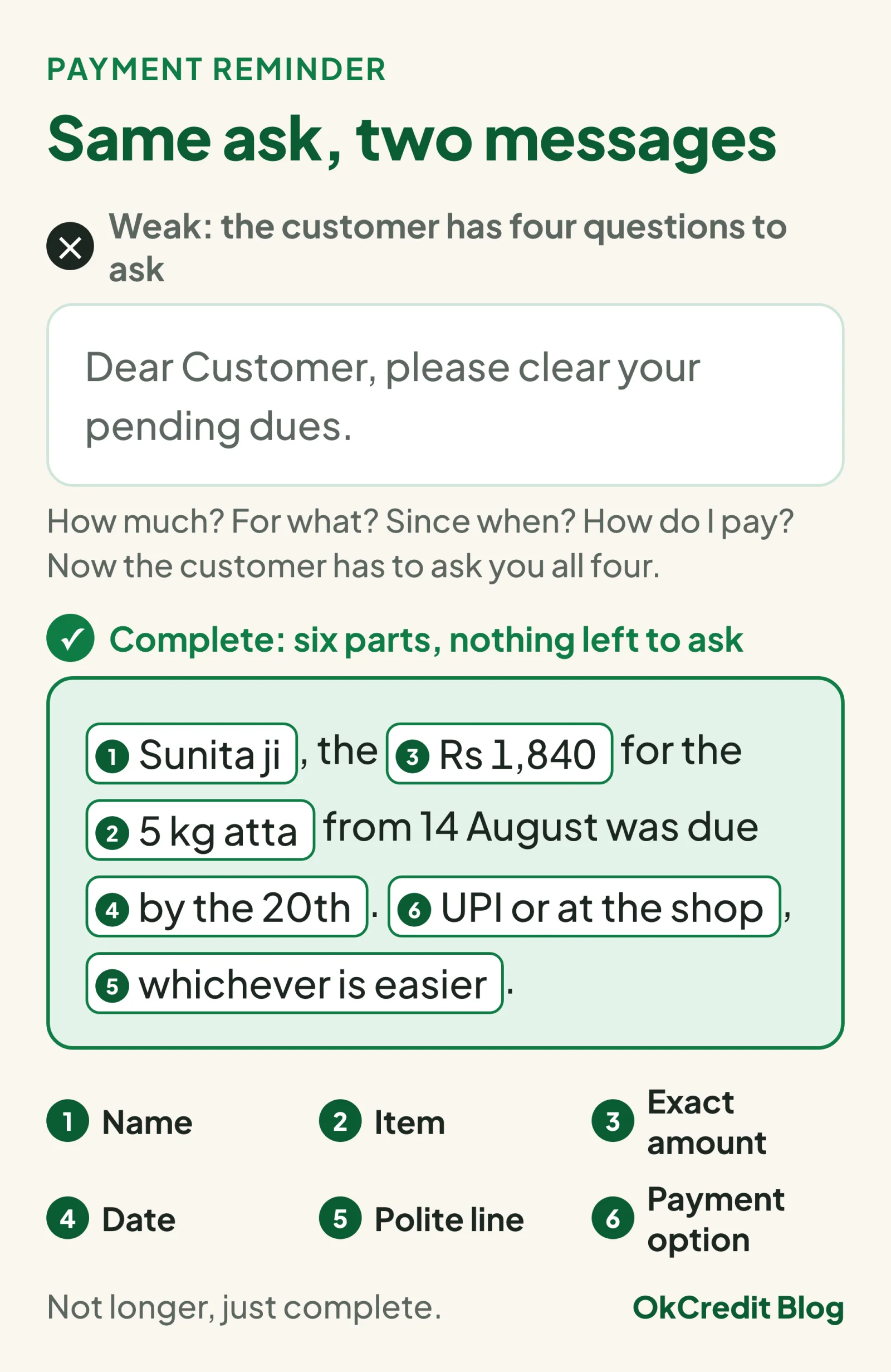 Same ask, written two ways. The second message has all six parts, so the customer has nothing left to ask you.
Tone follows a ladder, and you climb it one step at a time:
- Pre-due: before the date, informational, zero pressure.
- Gentle: a few days late, you assume they forgot.
- Firm: a promise was broken, you ask for a fixed date and pause new udhar.
- Final: the last message before you take advice, written to be kept on record.
Never jump two steps. A firm message to someone who is three days late costs you a regular customer over a few hundred rupees. A gentle message to someone who has dodged you for two months costs you the money.
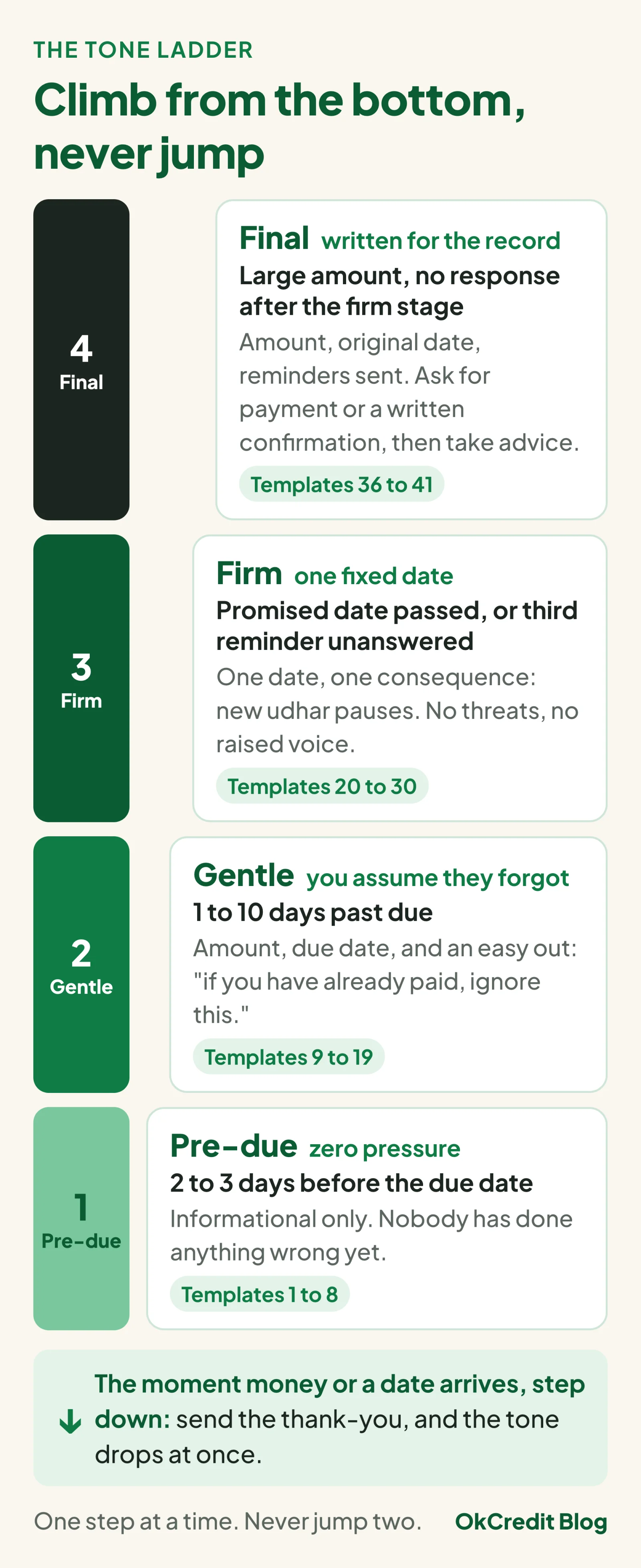 Climb the ladder from the bottom. A firm message to a customer who is late for the first time costs you next month's sale.
| Situation | Tone | Best channel | Templates |
|---|---|---|---|
| 2 to 3 days before the due date, or the week salary lands | Friendly, informational | 1 to 8 | |
| 1 to 10 days past due, first or second miss | Gentle, "you probably forgot" | 9 to 19 | |
| Promised date passed, or third reminder with no reply | Firm, one fixed date | WhatsApp first, then a call | 20 to 30 |
| Customer replies with an excuse | Calm, pin the date | Reply in the same chat | 31 to 35 |
| Large amount, no response after firm stage | Final, formal, on record | WhatsApp, and SMS if unread after 48 hours | 36 to 41 |
| Payment received | Warm, close the loop | Same channel | 42 to 43 |
If you want the wider recovery picture beyond messages, the ten methods in udhaar vasooli ke 10 tarike sit around this ladder.
Pre-due reminders: messages to send before the due date
A pre-due reminder is the cheapest one you will ever send, because nobody has done anything wrong yet. Send it two or three days before the date, or in the first week of the month when salaries land, and you skip the whole awkward chase for most customers. Around festivals, send it a week early; wallets are busy in Diwali and Eid week and your bill competes with new clothes.
1. Salary-week nudge (English) Hi [Name], your grocery bill of [Rs amount] from [date] is due this Friday. Whenever you get a minute. UPI to [UPI ID] works, or drop by the shop. Thanks!
2. Specific item, no rush (English) [Name] ji, quick note before the weekend: [Rs amount] for the [item] you took on [date] comes due on [date]. No hurry today, just keeping you in the loop.
3. First of the month (English) Namaste [Name]. Salary week is here, so a small reminder: [Rs amount] outstanding at [shop name]. Cash or UPI, whichever is easier for you.
4. Monthly khata total with a check (English) Hello [Name], the monthly khata total at [shop name] is [Rs amount], due [date]. Reply "ok" if the amount matches your notes and I will send the UPI ID.
5. Order delivered, balance due (English) Hi [Name], your [item] order reached you on [date]. The balance of [Rs amount] is due on [date]. UPI: [UPI ID]. Thanks for ordering with us!
6. SMS-ready, short (English) [Shop name]: Rs [amount] due on [date] for your [item] purchase. Pay via UPI [UPI ID] and reply DONE. Thank you.
7. Bhai-register (Hinglish) [Name] bhai, [date] ko liya hua [item] ka [Rs amount] [date] tak clear kar dena. Koi jaldi nahi, bas yaad dila raha hoon.
8. Festival timing (Hinglish) Namaste [Name] ji, Diwali se pehle hisaab clear karna ho toh [Rs amount] [date] tak bhej dijiye. UPI: [UPI ID]. Tyohaar ki shubhkamnayein!
Gentle reminders for a payment that is a few days late
A gentle reminder assumes the customer forgot, because most of the time they did. Say the amount, the date it was due, and give them an easy out: "if you have already paid, ignore this." Two variants are worth keeping saved: the part-payment ask for a customer who is short this week, and the small-amount version for dues of a few hundred rupees, where the message has to be lighter than the money.
9. Busy-week excuse offered for them (English) Hi [Name], the [Rs amount] for [item] was due on [date]. Easy to miss in a busy week. Could you clear it today or tomorrow? UPI: [UPI ID].
10. Soft, open-ended (English) Hello [Name], hope all is well at home. The [Rs amount] from [date] is still showing in my khata. Whenever you are free, please send it across.
11. Already-paid safety line (English) [Name] ji, gentle reminder about [Rs amount] outstanding since [date]. If you have already paid, ignore this and I will recheck my entries.
12. Part-payment ask (English) Hi [Name], [shop name] here. Just a nudge on the [Rs amount] due last [day]. If it is easier, pay half now and the rest on [date]. Either way, tell me and I will note it.
13. Small amount (English) Hi [Name], only [Rs amount] pending from [date]. It is a small figure, so clearing it today keeps both our books neat. UPI: [UPI ID].
14. Ask for a day, not the money (English) Hello [Name], your [Rs amount] balance is a week past due. Not a problem, just let me know which day works and I will mark it in the khata.
15. Night tally (English) Hi [Name], I was tallying the khata tonight and [Rs amount] from [date] is still open. A quick UPI when you see this would help a lot.
16. Second gentle reminder with a recheck offer (English) Hi [Name], reminder two on the [Rs amount] due [date]. Cash at the counter or UPI, either is fine. If any item on the bill looks wrong, say so and I will recheck it.
17. Bhai-register, forgot angle (Hinglish) [Name] bhai, [date] wala [Rs amount] abhi tak nahi aaya. Shayad dhyan se nikal gaya hoga. Aaj kal mein bhej do, UPI [UPI ID].
18. Part-payment (Hinglish) Namaste [Name] ji. [Item] ka [Rs amount] [date] se baaki hai. Poora ek saath mushkil ho toh aadha aaj aur aadha [date] ko bhi chalega.
19. Small amount (Hinglish) [Name], chhota sa hisaab: [Rs amount], [date] ka. Ek baar mein nipta do, phir naya khata fresh shuru.
Firm reminders for the customer who keeps postponing
A firm reminder asks for one fixed date and says plainly that new udhar stops until the old amount is cleared. That is the whole firmness. No raised voice, no threats, no mention of anyone but the customer. Firm and rude are different things; the first gets you paid, the second gets you blocked or worse.
Before you send the first firm message, read your own khata once. If the customer disputes the total, you want the entries with dates in front of you, not a guess.
20. Count the reminders (English) [Name], the [Rs amount] from [date] is now [number] days overdue and two reminders have gone unanswered. Please pay by [date] so I can keep the account open.
21. Your own cash flow, honestly (English) Hi [Name], I need [Rs amount] cleared by [date]. My stock payment goes out on [date] and I count on these dues to cover it.
22. Today's last reminder (English) [Name] ji, this is today's last reminder for [Rs amount]. Please send it by [time], or tell me the exact date you can pay.
23. Pause new udhar (English) Hello [Name], I cannot add new udhar to the account until the [Rs amount] from [date] is settled. Pay by [date] and we carry on as usual.
24. Broken promise, one more date (English) [Name], the promised date [date] has passed and [Rs amount] is still due. Give me one firm date this time, and please keep it.
25. Weeks, not days (English) Hi [Name], [Rs amount] has been outstanding for [number] weeks. I have held it without any fuss, but I need it by [date]. UPI: [UPI ID].
26. Door open for a genuine problem (English) [Name], three reminders and no payment. Please clear [Rs amount] by [date]. If there is a real difficulty, call me and we will work something out.
27. Keep it on message (English) Hi [Name], I would rather settle this over a message than keep bringing it up every time you come in. [Rs amount] by [date], please confirm.
28. Seedhi baat (Hinglish) [Name] bhai, [Rs amount] [date] se pending hai aur do baar yaad dila chuka hoon. [Date] tak pakka chahiye, seedhi baat.
29. Udhaar band (Hinglish) [Name] ji, jab tak [Rs amount] clear nahi hota, naya udhaar nahi de paunga. Dukaan chalani hai, aap samajhte hain. [Date] tak bhej dijiye.
30. Aakhri reminder, aaj ka (Hinglish) Aaj ka aakhri reminder, [Name]: [Rs amount], [date] ka. Aaj shaam tak UPI kar do ya ek pakki tareekh batao.
Replies when the customer says "next week, pakka"
The excuse is not the problem; a vague excuse is. Every reply below turns "next week" into a date you can write in the khata.
31. "Next week for sure" Sure, [Name]. Which day next week? I will note [date] in the khata and message you that morning.
32. "Salary has not come yet" Understood. Salary on [date]? Send [Rs amount] on [date] then, and I will not remind you before that.
33. "I will pay when I visit" No need to make a trip, [Name]. UPI to [UPI ID] takes a minute. The bill total is [Rs amount].
34. "The amount is wrong" Happy to recheck. Here is the entry list: [items with dates]. Tell me which line looks off and we fix it today.
35. Silence after a promised date [Name], [date] came and went. I am not upset, I just need a straight answer: [Rs amount] on [new date], yes or no?
Final reminder and the message before a legal notice
The final reminder is written for the record, not for the relationship. It states the amount, the original date, the reminders already sent, and asks for one of two things: payment by a date, or a written confirmation of the amount and a settlement date. Getting the customer to confirm the debt in writing matters. Under the Limitation Act 1963, a written and signed acknowledgement of a debt made before the limitation period runs out restarts the clock (section 18), and a part-payment made before expiry does the same when it is recorded in writing signed by the payer (section 19). For goods sold on credit, the period is three years from delivery, as of 2026. Whether a WhatsApp reply counts as a signed writing is a question for a lawyer, so treat the written confirmation as helpful, not as a guarantee.
36. Formal final reminder (English) Dear [Name], final reminder from [shop name]. [Rs amount] has been outstanding since [date]; reminders were sent on [dates]. Please pay by [date], or reply confirming the amount and the date you will settle it.
37. Settlement offer (English) [Name], to close this cleanly: pay [Rs amount] by [date], or if that is hard right now, [Rs settlement amount] by [date] settles the account in full. Reply to confirm which one.
38. Written acknowledgement request (English) Hello [Name], please reply with "I confirm [Rs amount] is due to [shop name]" so we both have it in writing. After that we agree on a date, and I stop reminding.
39. Notice intimation (English) [Name], if I do not hear from you by [date], I will take advice on recovering the [Rs amount] formally. I would much prefer to settle this between us. Please reply.
40. Aakhri message (Hinglish) [Name] ji, yeh meri taraf se aakhri message hai. [Rs amount] [date] se baaki hai. [Date] tak payment kar dijiye, ya likhit mein confirm kijiye ki itna baaki hai aur kab denge.
41. Final SMS, fits one screen (English) [Shop name]: FINAL reminder. Rs [amount] due since [date]. Pay by [date] via UPI [UPI ID], or reply with a settlement date.
When the payment comes in
Close the loop every single time. A thank-you message is the cheapest reason a customer has to pay on time next month.
42. Account clear (English) Received [Rs amount], [Name]. Thank you, the account is clear. See you at the shop.
43. Khata clear (Hinglish) [Rs amount] aa gaya, [Name] bhai. Shukriya. Khata clear, aage bhi aise hi.
Never write this
Short list, and it is not negotiable:
- "I will come to your house." Any threat to a person, their reputation or property is criminal intimidation under section 351 of the Bharatiya Nyaya Sanhita 2023, the law that replaced the IPC from July 2024.
- Messages to the customer's spouse, parents, employer or neighbours. The debt is theirs alone.
- Posting or tagging them in a society group, a mohalla group, or on social media. Written words meant to be read are covered by defamation under BNS section 356, and "I will tell everyone" is intimidation before you have even posted.
- Abuse, insults, or anything about a woman customer's character. Section 352 (insult) and section 79 (insulting a woman's modesty) exist for exactly this.
- Threatening a police case or jail for an ordinary udhar. Unpaid udhar is a civil matter.
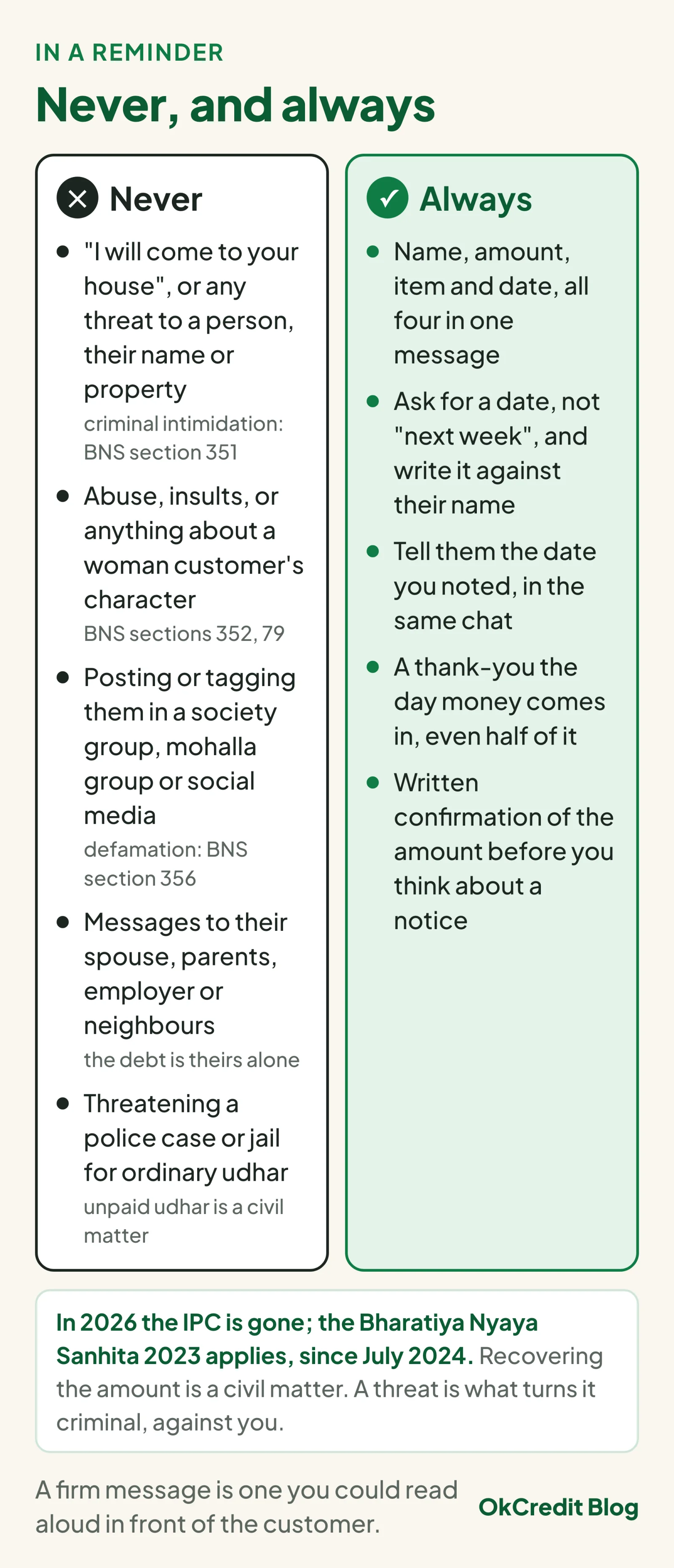 The lines on the left can turn a civil recovery into a criminal case against you. Every line on the right builds a record.
These are general points as of 2026, not legal advice. Before sending anything you would call a notice, talk to a lawyer; a proper demand notice costs less than a defamation complaint against you. And if the amount is large enough to worry about, kya mera fasa udhaar wapis aayega walks through what realistic recovery looks like.
When and how to send reminders so the payment actually comes
Send reminders on working-day mornings, between about 10 and 11, when the customer has opened their phone but has not yet spent the day's money. Avoid Sunday, avoid after 8 pm, and avoid the day before salary, when the honest answer is "kal". Salary days themselves, the 1st to the 7th of the month for most salaried households, are the best days of the month to ask.
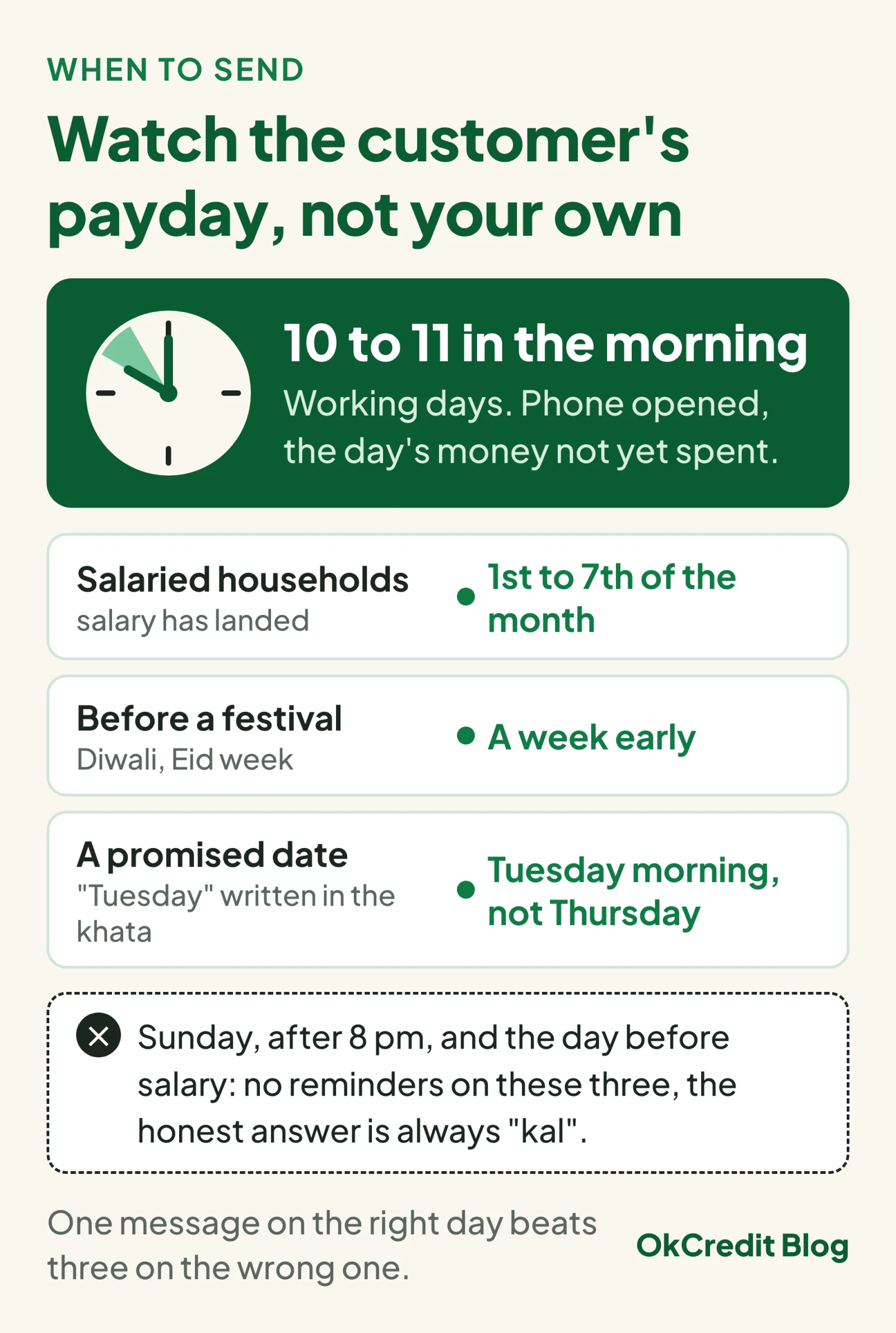 Watch the clock and the calendar. One message on the right day brings more payments than three on the wrong one.
Frequency is a cap, not a target. One pre-due message. At most two gentle reminders in ten days. Firm reminders once a week, never daily. One final message. A customer who gets a reminder every morning stops reading them, then blocks the number.
One channel at a time. WhatsApp first, because it gets read fast when the customer is online and you can see whether it was read. Switch to SMS only when the WhatsApp message sits unread for two days; SMS lands even when their data is off. Do not send the same reminder on both at once, and do not follow a message with a call the same hour.
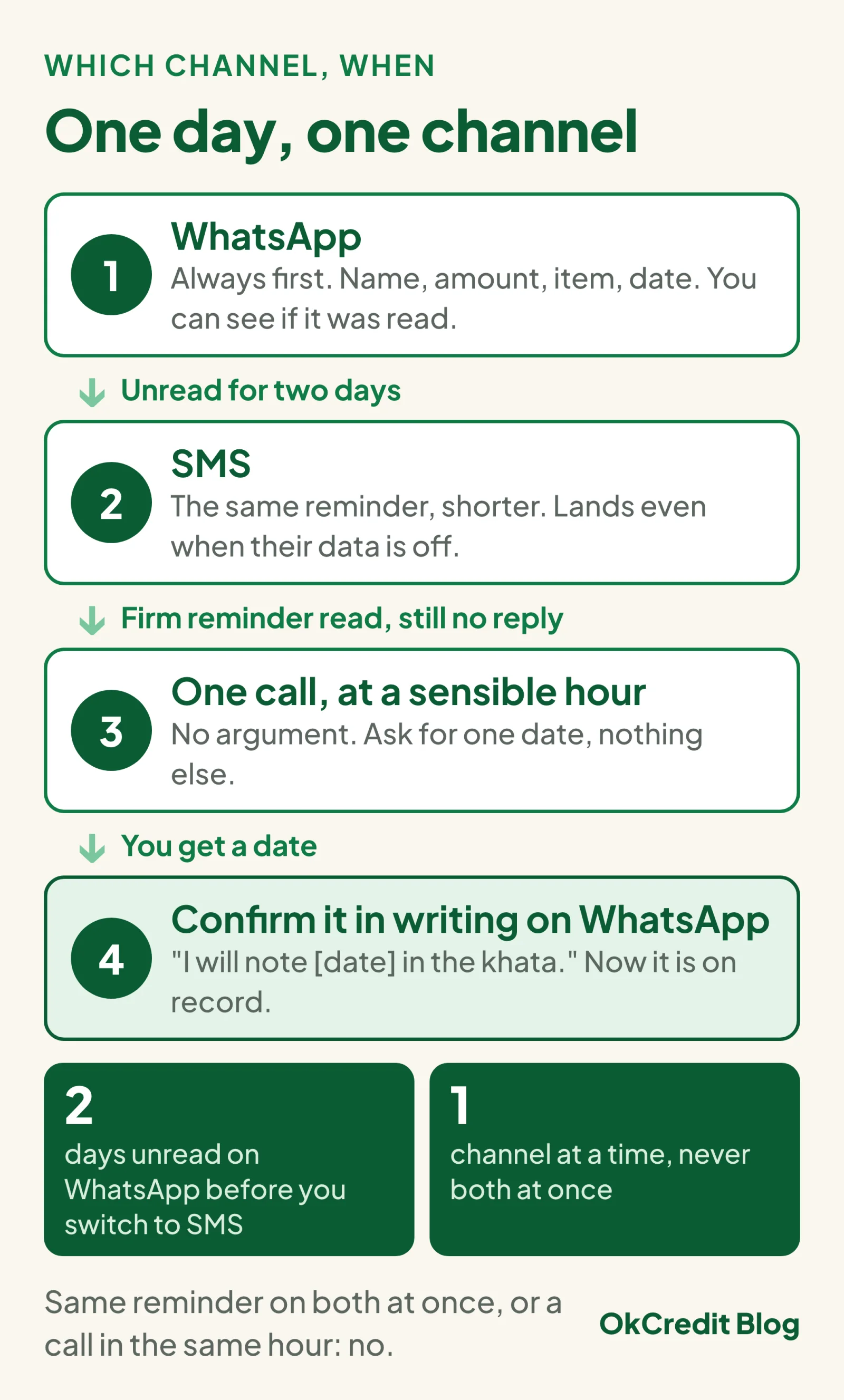 One day, one channel. Move to the next channel only when the last one has stayed silent for two days.
Always record the promise date. The moment a customer says "Tuesday", write Tuesday against their name. Half of collection is remembering what was promised; the other half is messaging on Tuesday morning, not Thursday. If you keep the khata on a free app like OkCredit, every entry can go to the customer as an SMS the moment it is recorded, so the amount is already on their phone before you send a reminder, and with Auto Reminder switched on the app sends SMS payment reminders on outstanding balances from your own phone (OkCredit on Google Play).
WhatsApp Business features that help, and the rule that gets numbers banned
The WhatsApp Business app is free to download and use, as of 2026, per WhatsApp's own FAQ. Three of its tools do most of the work here:
| Feature | What to do with it |
|---|---|
| Quick replies | Save templates 1, 9, 20 and 36 as shortcuts. Type "/due" and the message fills in; you change the name and the amount. |
| Labels and Lists | Put every udhar customer under an "Udhar baaki" label or list, with sub-groups like "Needs follow-up" and "Paid", so Monday's reminder round is one filtered view. |
| Away and greeting messages | Set an away message with the shop's UPI ID, so a customer who replies at night can pay without waiting for you. |
You do not need the catalog or a paid plan for any of this.
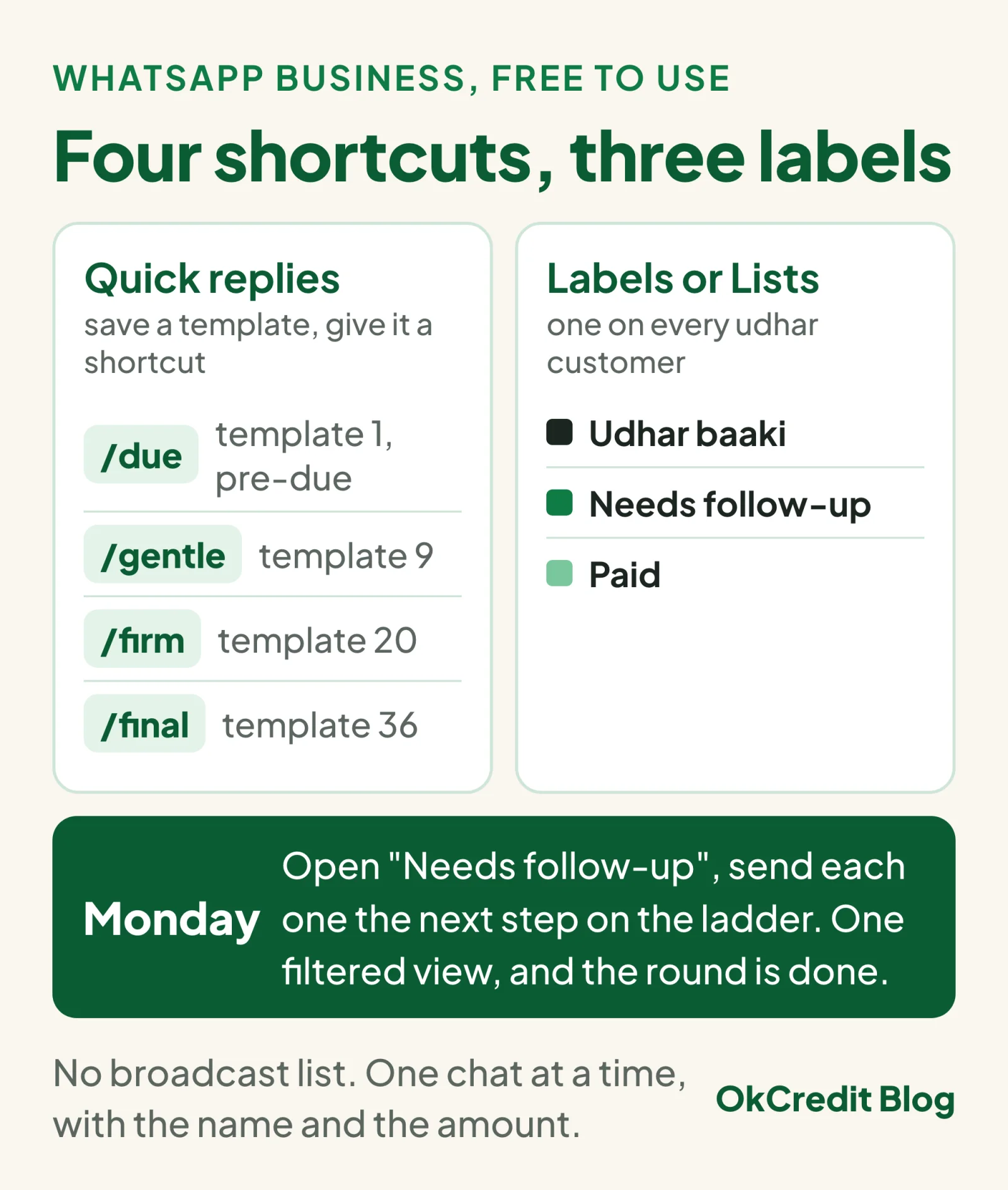 Four shortcuts, three labels. A few minutes of setup, and Monday's reminder round is one filtered view.
The rule to respect: WhatsApp's terms of service ban bulk and automated messaging, and its business messaging policy says you may message only people who gave you their number and agreed to hear from you, and that a number collecting blocks and spam reports can have its messaging limited or be banned. So send reminders one chat at a time, only to your own credit customers, never through a broadcast list, and stop when someone asks you to. A banned number costs you every customer chat at once.
The best reminder is still the one you never have to send. A two-minute check before extending credit, the kind in udhaar dene se pehle checklist, removes most of the names that reach the firm stage.
FAQ: payment reminder messages
What is the best time to send a payment reminder message?
Working-day mornings between 10 and 11 am, and the first week of the month when salaries land. Never late at night, not on Sundays, and not the day before salary, when the only possible answer is "tomorrow".
How often should I remind a customer about udhar?
One pre-due message, at most two gentle reminders in ten days, firm reminders once a week, and one final message. Daily reminders train the customer to ignore you and get your number reported.
Should the reminder be in Hindi, Hinglish or English?
Write in the language the customer uses with you at the counter. If they message you in Hinglish, reply in Hinglish; a formal English reminder to a Hinglish-speaking customer reads as cold and gets fewer replies. Keep the amount and the date in numerals either way.
What if the customer reads the message and does not reply?
Wait two days, then send the next step on the ladder, not the same message again. If a firm reminder is read and ignored, call once at a sensible hour and ask for a date. If that fails, send the final reminder in writing and take advice before doing anything more.
Is a WhatsApp payment reminder useful legally?
Yes, as a record. Messages with the amount, the dates and the customer's replies show the debt existed and that you asked for it. A written confirmation of the amount from the customer is worth having; whether a WhatsApp reply counts as a signed acknowledgement under the Limitation Act 1963 is a question to put to a lawyer.