The way to recover udhaar from customers without losing them is a system, not a showdown: a written entry for every sale, a settlement date fixed at the counter, reminders on a schedule, and escalation only by process. As of 2026 the law gives you 3 years under the Limitation Act 1963; the ten tactics below do the real work.
Most shopkeepers searching for how to recover udhaar from customers already know exactly who owes what. The problem is not information. It is the awkwardness of asking a regular for Rs 1,400 for the third time, and the fear that the fourth ask will send them to the shop across the road.
What is the right way to recover udhaar?
The right way to recover udhaar is record, date, reminder, process, in that order, and never skipping a step. Udhaar sticks for three boring reasons: nobody wrote it down, nobody fixed a date, and the shopkeeper felt too awkward to ask until the amount had grown into an argument. Fix those three and tagada stops being a fight. It becomes a routine the customer expects, the way they expect the milk bill on the 1st.
How to recover udhaar from customers: 10 ways that work
Use these in order. Most balances clear somewhere between tactic one and tactic five; the rest exist for the few that don't. All amounts below are 2026 examples from a typical kirana counter.
1. Fix the settlement date while handing over the goods
"Rs 640 today, clear by Sunday?" takes two seconds and changes everything. A date agreed at the counter is the customer's promise. A date you bring up three weeks later is your demand, and demands get negotiated. Write the date next to the entry, not just the amount.
2. Keep one tagada day a week
Pick a day, say Tuesday after 6 pm, and run the whole list in one sitting: every open balance gets one message or one visit, then you stop until next Tuesday. Twenty minutes a week. Customers learn the rhythm within a month, and you stop carrying the dread around all week.
3. Run a reminder ladder, not random calls
Day 1 after the due date, a one-liner: "Namaste bhaiya, Rs 1,250 was due Sunday, whenever convenient this week." Day 7: "Reminder, Rs 1,250 pending since 24 August, can you clear by Friday?" Day 15: a phone call, same facts, same politeness. Each rung repeats the number and moves the tone up one notch, never three. Ready-to-send lines are in our payment reminder messages post.
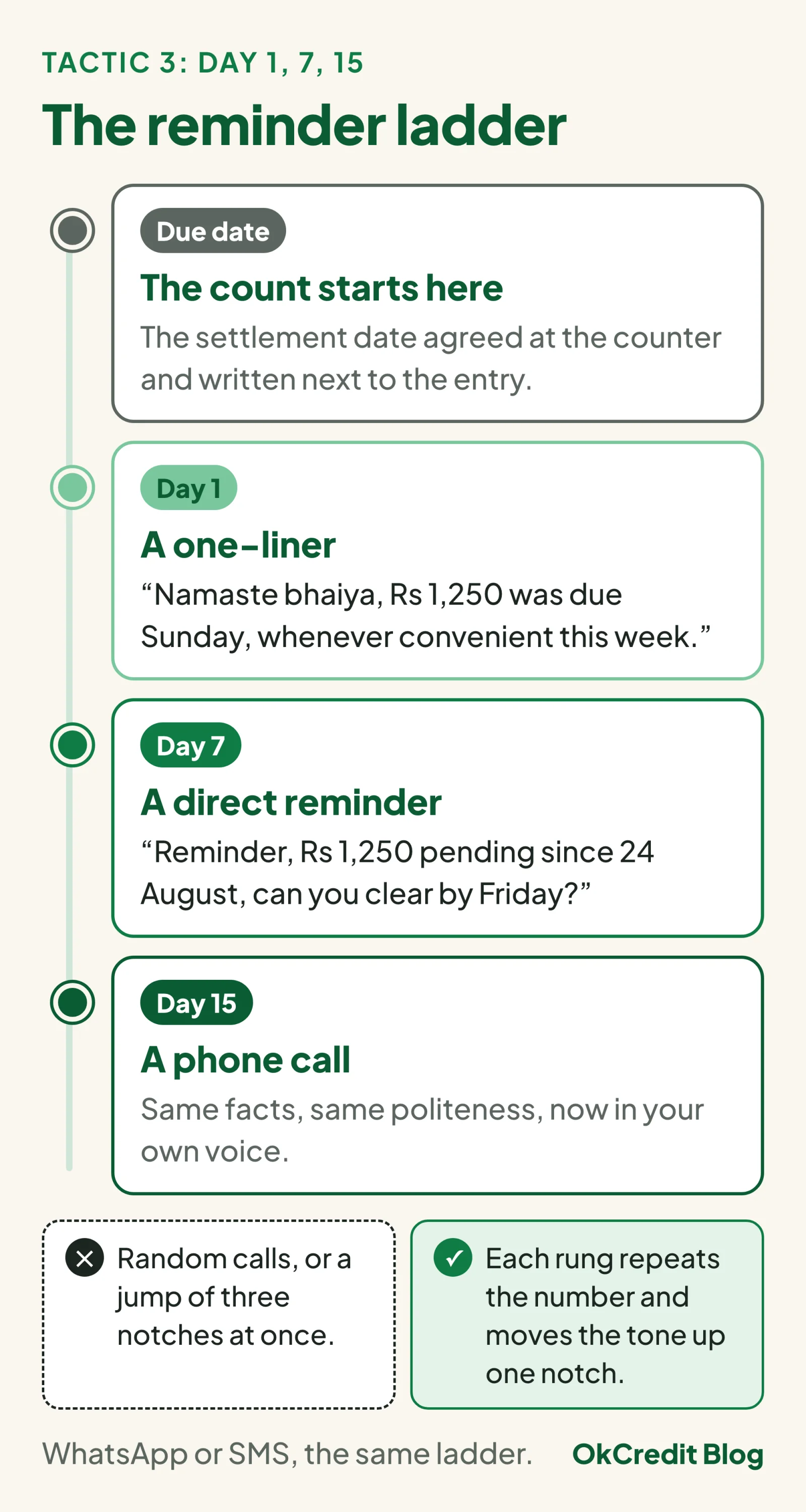 Three rungs, one notch each. Not random calls: each message repeats the number and moves the tone up a single step.
4. Offer a part-payment ladder
A customer who says no to Rs 3,000 will usually say yes to Rs 500. So ask for Rs 500 today and Rs 500 every Tuesday, write the plan down, and tick each instalment. The balance starts moving, which is the whole point. There is a legal bonus too, covered in tactic eight.
5. Ask on salary day and market day
Timing beats persistence. Salaried customers have money between the 1st and the 5th; a reminder on the 28th is a request, the same reminder on the 2nd is a collection. Daily-wage customers pay in the evening, not the morning. Farmers pay when the mandi pays them. Ask the customer once when their money comes in, then align your tagada day to it.
6. Stop new udhaar until the old is cleared
Say it once, kindly, and hold it: "Purana clear ho jaye, phir naya likhte hain." A customer who keeps buying while the old balance sits is deciding every week whom to pay; make paying you the condition for continuing. Most will clear Rs 800 to keep a shop they trust.
7. Shrink the basket instead of refusing
When a flat no feels impossible, split the sale. Ration on udhaar, cold drinks and cigarettes in cash. Or hold the high-margin extras until the balance drops. The customer keeps their shop, you keep your exposure small, and nobody has to say the word "no".
8. Get the acknowledgement in writing, signed
A signed khata entry, or a signed receipt when they pay a part, is what keeps a debt alive in law. Under sections 18 and 19 of the Limitation Act 1963 (unchanged as of 2026), a written acknowledgement signed by the customer, or a part-payment acknowledged in their own handwriting or a signed writing, restarts the 3-year clock, provided it happens before the original 3 years run out. An oral "de dunga" does nothing. An unsigned WhatsApp reply is weak; courts have treated authenticated messages case by case, so aim for something signed or clearly authenticated.
9. Sit down with a neutral witness for stuck dues
When a balance has been dead for months and one-to-one asks have stopped working, propose a sit-down with one person both of you respect: a mohalla elder, a trader association member, a mutual friend. The customer picks or agrees to the person. Not their family, not a crowd. The outcome should be a written plan, amount and dates, signed by both sides in front of the witness.
10. Round down for a one-time settlement on dead dues
Rs 4,200 dead for 14 months? "Rs 3,500 today and we're square" often brings in money that was never coming otherwise. Write "full and final" on the receipt and both sign it. Two rules: use this only for dues you have already written off in your head, and never advertise it, or every customer will wait for the discount.
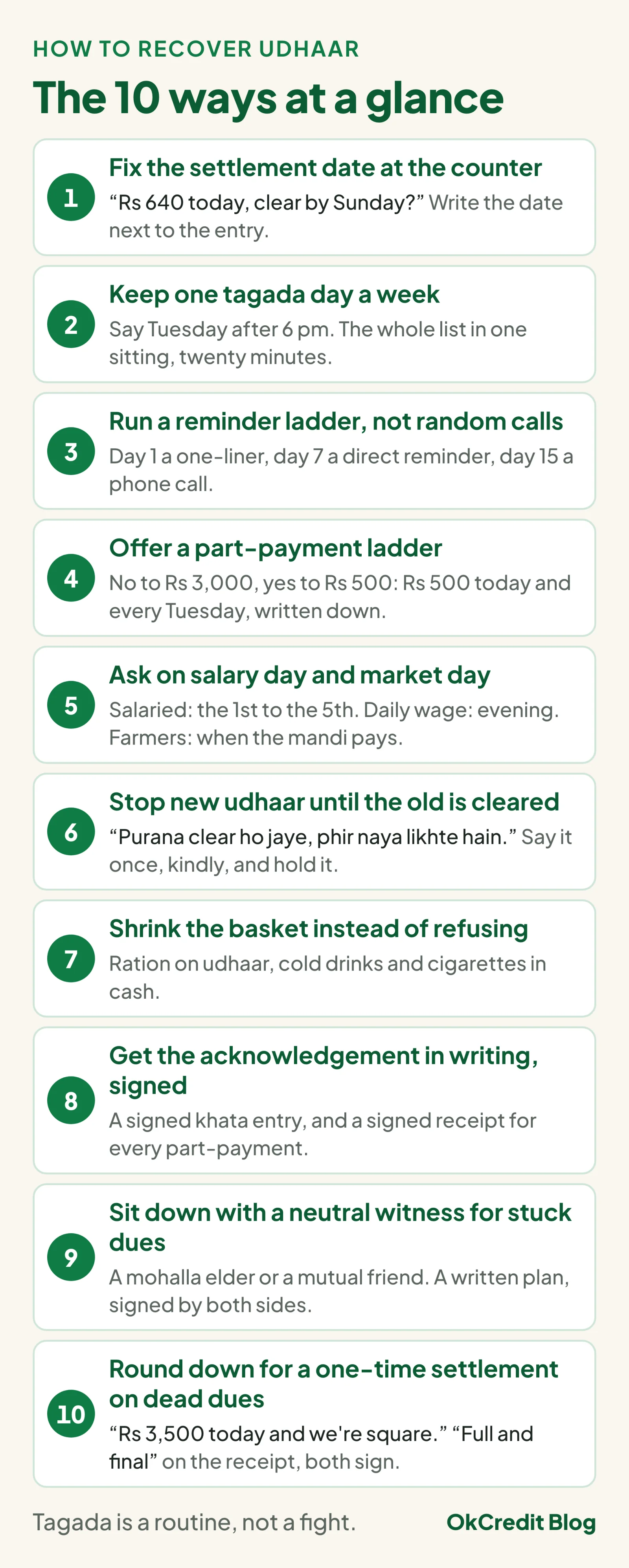 All ten at a glance. Tagada is a routine, not a fight.
What to do and what not to do while collecting udhaar?
Everything in the right-hand column is either an offence under the Bharatiya Nyaya Sanhita 2023 or the fastest way to lose the customer and the money together.
| Do | Don't |
|---|---|
| Remind privately, one-to-one, by message or at the counter | Name the customer in a WhatsApp group or paste a "defaulter list" at the shop |
| Call or visit during working hours | Turn up at their home late at night or before dawn |
| State what happens next by process: no new udhaar, then a written demand | Threaten harm, "dekh lenge", or damage to property |
| Deal with the customer only | Chase their spouse, parents, or employer |
| Keep a dated, signed record of every entry and payment | Rely on memory and oral promises |
| Accept a part-payment and record it | Refuse Rs 500 because it isn't the full Rs 3,000 |
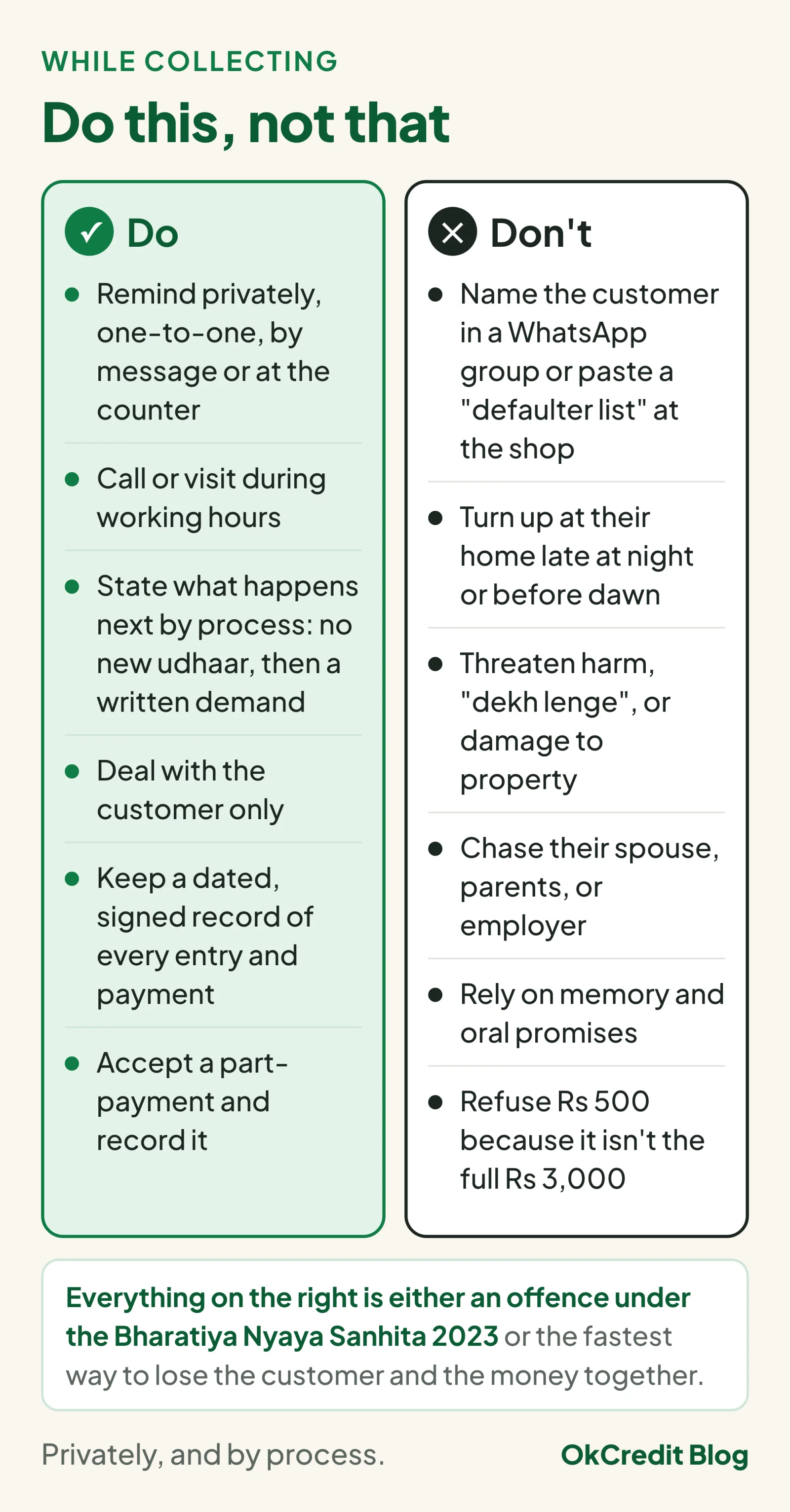 Every line on the left builds a record. Every line on the right is either an offence under the BNS 2023 or the fastest way to lose the customer and the money together.
Why the right-hand column matters, in plain terms: publishing a customer's name as a defaulter can attract BNS section 356 (defamation, up to 2 years' simple imprisonment, or fine, or both, or community service), and a "pay or else" visit can attract section 351 (criminal intimidation, up to 2 years, rising to 7 if the threat involves death, grievous hurt, or arson). The old IPC numbers stopped applying on 1 July 2024. This is general information; consult a lawyer for your specific situation.
When and how should you take the legal route for udhaar?
You have 3 years to file a suit for unpaid udhaar under the Limitation Act 1963, and as of 2026 the clock starts at the date of delivery, or when an agreed credit period ends, not from your last reminder. Before that clock matters, run the process:
- Written demand. A dated letter or message stating the amount, the dates, and a deadline of 15 days. Keep a copy.
- Legal notice. Sent through a lawyer. Many balances clear at this step because the customer realises you are keeping records.
- Lok Adalat. Free to file (no court fee), through your District Legal Services Authority, which notices the other side. If both sides agree, the award has the force of a civil-court decree, final and binding, with no appeal. Nobody can be forced to settle. The remaining National Lok Adalats in 2026 are on 12 December; the NALSA helpline is 15100.
- Civil suit. The last option, and for shop udhaar rarely worth the fees and the months.
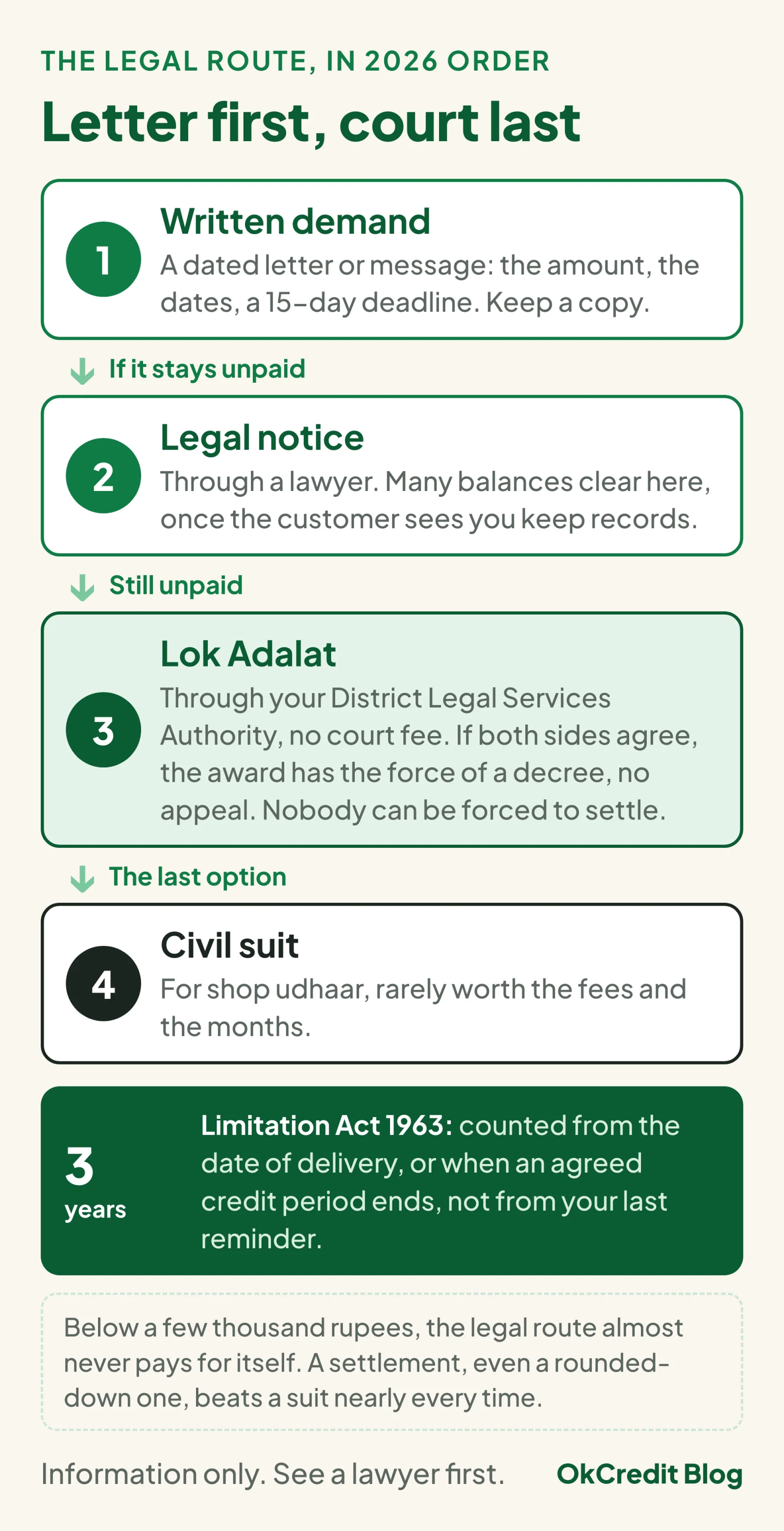 Four steps, in this order. The 3-year clock runs from delivery or the end of the credit period, not from your last reminder.
If the customer paid by cheque and it bounced, section 138 of the Negotiable Instruments Act has its own timetable, unchanged as of 2026: present the cheque within 3 months of its date, send a written demand within 30 days of receiving the bank's return memo, and the customer then has 15 days from receiving your notice to pay. If they don't, the complaint must be filed within the following month. The offence carries up to 2 years' imprisonment, a fine of up to twice the cheque amount, or both, and only applies to a legally enforceable debt. In September 2025 the Supreme Court (Sanjabij Tari v. Kishore S. Borcar) directed courts to serve summons by email or WhatsApp, offer UPI or QR settlement at the first hearing, and charge no surcharge if the accused pays the cheque amount before defence evidence begins, with all High Courts and district courts to implement by 1 November 2025. The Court also noted that ignoring a section 138 notice supports an inference that the claim has merit.
One line on MSME Samadhaan, because it comes up: it is for Udyam-registered micro and small suppliers chasing a business buyer past the 45-day limit under the MSMED Act 2006, not for a shop's udhaar to walk-in customers.
Cost-benefit, honestly: below a few thousand rupees, the legal route almost never pays for itself. A settlement, even a rounded-down one, beats a suit nearly every time. Our post on whether stuck udhaar ever comes back goes deeper on that maths. For anything you plan to file, consult a lawyer first.
How do you stop udhaar from getting stuck in the first place?
Three habits prevent most of the recovery work above. Set a per-customer limit, say Rs 2,000 in 2026 for a regular and Rs 500 for a new face, and don't cross it. Write every entry with the customer watching, and send them the SMS so both sides hold the same proof. Settle every khata once a month, on a fixed date, so no balance ever gets old enough to be embarrassing. To track customer credit, a free khata app like OkCredit keeps every entry backed up and, with Auto Reminder switched on, sends SMS payment reminders from your own phone.
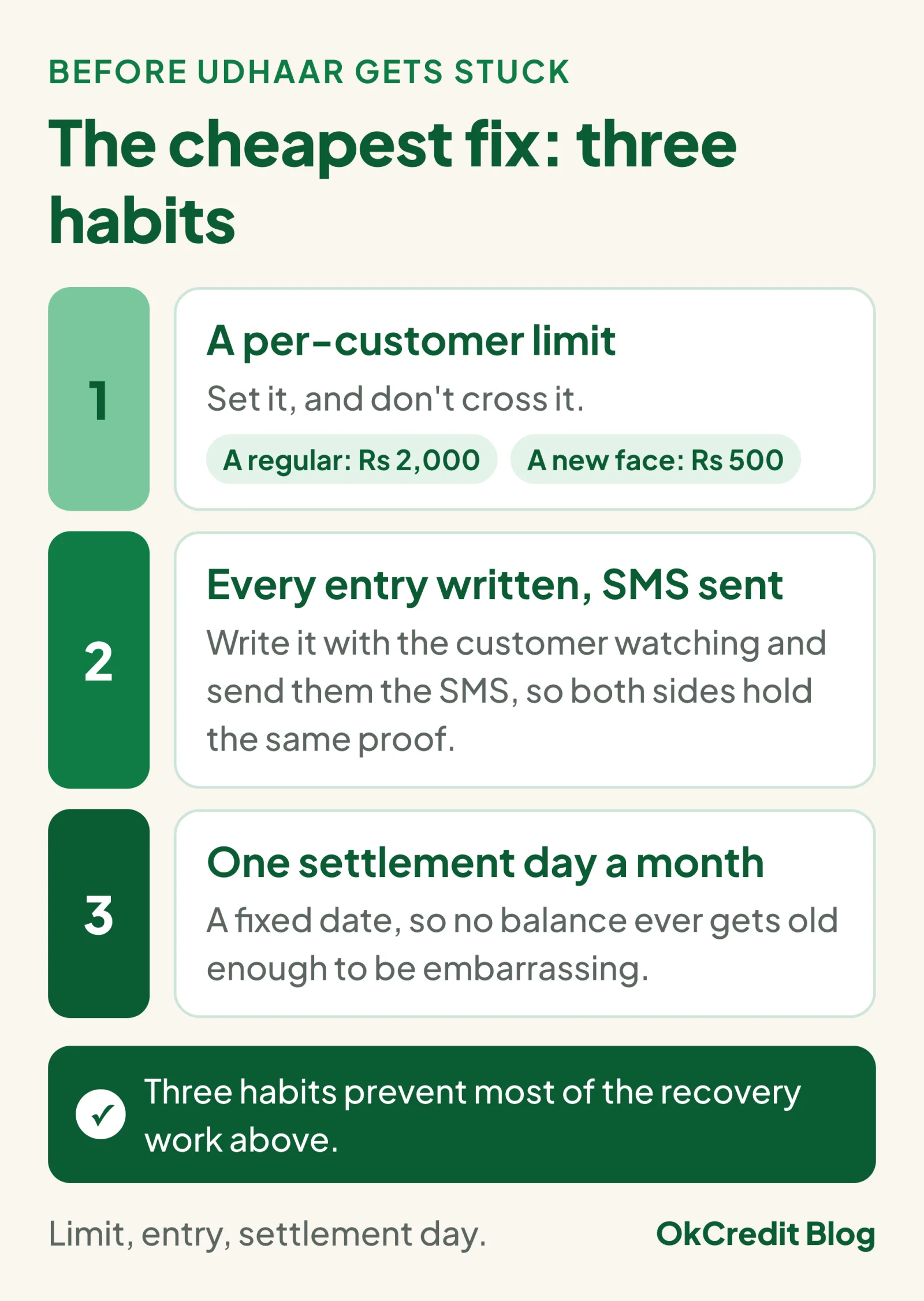 Three habits, every customer. A limit, a written entry with the SMS, and one settlement day a month.
Before you write a new khata, run through the udhaar checklist. And if a customer says "put me on the CIBIL list, I don't care", read the truth about defaulter lists before you answer.
FAQ: recovering udhaar from customers
How long do I have to recover udhaar legally?
Three years under the Limitation Act 1963, as of 2026, counted from the date of delivery or from when an agreed credit period ends. A written acknowledgement signed by the customer, or a part-payment acknowledged in their handwriting or a signed writing, restarts the 3 years, but only if it happens before the original 3 years expire.
Can I post a customer's name in a WhatsApp group if they don't pay?
No. Publishing someone's name as a defaulter can attract BNS 2023 section 356 (defamation), punishable with up to 2 years' simple imprisonment, a fine, or community service. It also ends the relationship for good. Remind privately; consult a lawyer if unsure.
Is it worth going to court for Rs 2,000 of udhaar?
Rarely. Below a few thousand rupees the fees and months outweigh the recovery. Try a part-payment plan or a rounded-down settlement first; if that fails, Lok Adalat costs nothing to file and its award is binding (next National Lok Adalats: 12 December 2026).
The customer paid by cheque and it bounced. What now?
Under section 138 of the NI Act (as of 2026), send a written demand within 30 days of receiving the bank's return memo; the customer has 15 days from receipt to pay; if not, file the complaint within the following month. Since the Supreme Court's September 2025 guidelines, courts are directed to offer UPI settlement at the first stage and charge no surcharge if the cheque amount is paid before defence evidence.
Does a WhatsApp reply saying "de dunga" restart the 3-year limit?
Probably not on its own. Sections 18 and 19 of the Limitation Act need a written acknowledgement signed by the customer, or a part-payment acknowledged in their handwriting or a signed writing, made before the 3 years run out. Courts have looked at authenticated messages case by case, so get something signed or clearly authenticated, and consult a lawyer.