Before giving udhaar to a customer, check five things: how long they have bought from you, how they repaid past udhaar, whether today's amount matches their usual basket, whether the timing (salary date, month-end, festival) is right, and who introduced them. Four or five yeses, give. Three, give small. Fewer, say abhi nahi.
The whole check takes two minutes and uses nothing but your own khata: no bureau score, no list from another shop. Print the table, keep it under the counter, and run it every time someone says "likh do".
What should you check before giving udhaar to a customer?
Five checks, one table, one decision rule.
| # | Check | What a "yes" looks like | Yes / No |
|---|---|---|---|
| 1 | Purchase history with you | Has bought from you regularly for three months or more, not a first-time face | |
| 2 | Repayment pattern on past udhaar | Settled on or before the agreed date the last two or three times, no shrinking part-payments | |
| 3 | Ticket size vs usual basket | Today's udhaar is no bigger than what they normally buy in a fortnight | |
| 4 | Timing | Their salary or settlement date is known and close; not a festival or month-end pile-up on top of an open balance | |
| 5 | Reference | Introduced by someone whose own khata with you is clean, or they live or work somewhere you know |
Decision rule: four or five yeses, give the amount asked and write the settlement date on the entry. Three yeses, give a smaller amount with a short date, a week or ten days. Two or fewer, "abhi nahi", and no apology needed.
The list works because it never asks you to guess a stranger's character. It asks what your khata already knows.
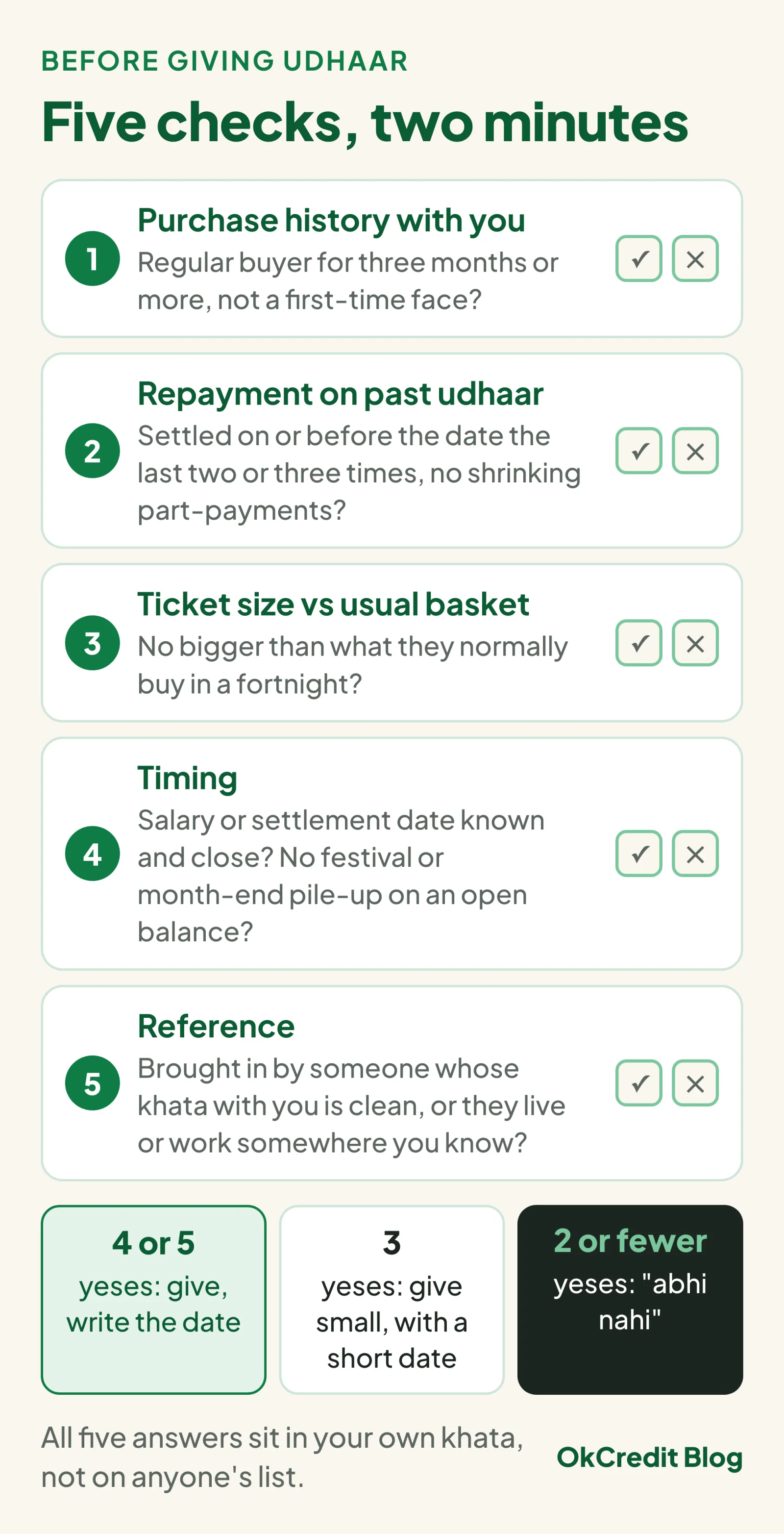 The checklist to keep under the counter. Five questions, and every missing yes makes the amount smaller.
How do you judge an old customer's khata?
Three months of khata pages tell you more about a customer than three years of conversation. Open their page and read the pattern, not the total.
On-time settlement, most months, means give freely within their limit. Late but full, say two or three weeks past the date every time, is workable: keep the ticket smaller and write the date larger. The pattern to stop at is shrinking part-payments. ₹500 became ₹300 became ₹150 while the balance kept climbing. That is what stuck udhaar looks like from the inside; stop adding to it. What a stuck udhaar looks like and whether it comes back covers that stage.
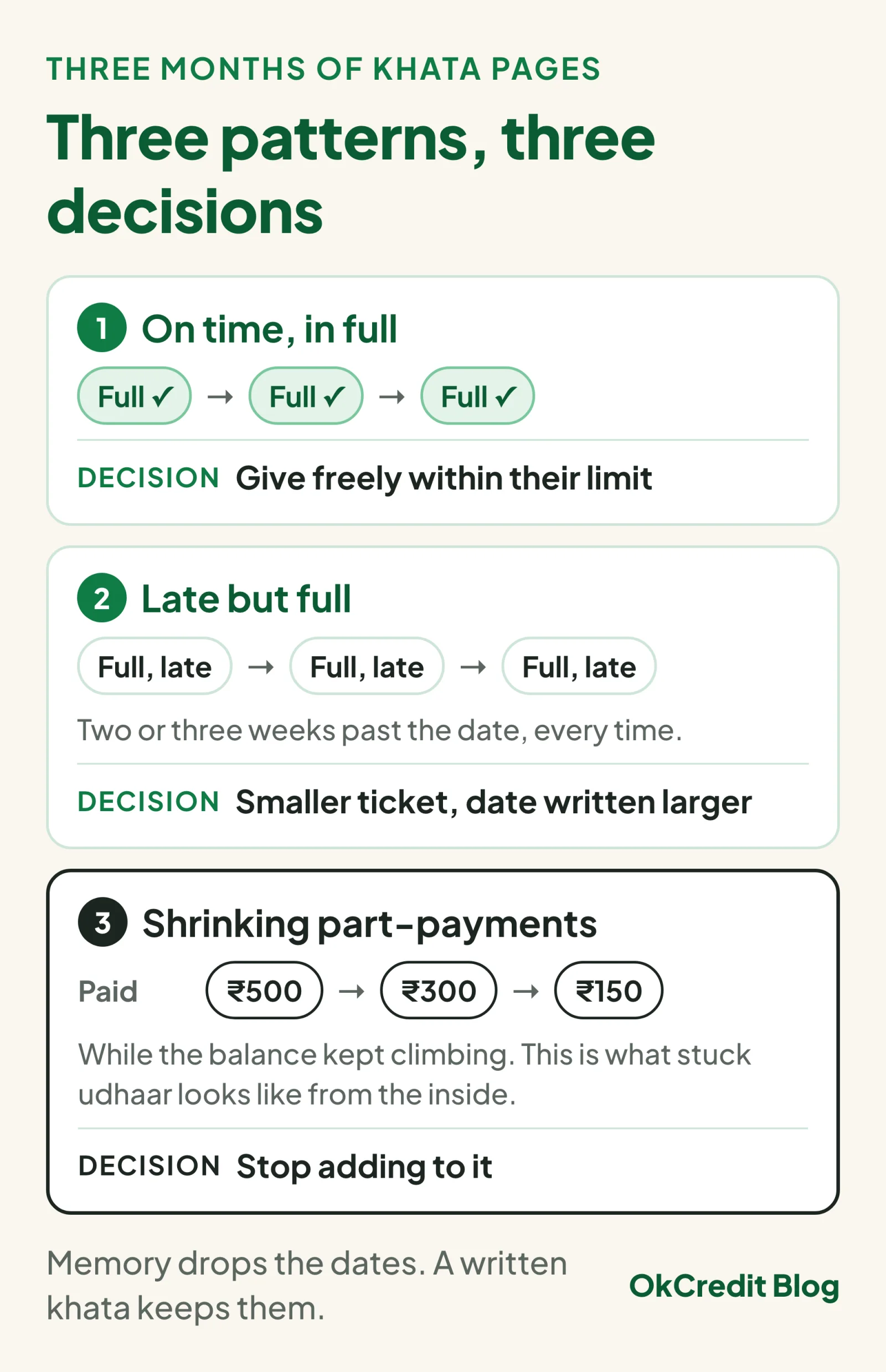 Three patterns, three decisions. The third is the one memory misses and a written khata catches.
Memory cannot do this reading. Memory keeps the total and drops the dates. It rounds ₹1,340 to "around fifteen hundred", forgets the ₹200 paid on a Tuesday, and has nothing to show when the customer says "itna nahi tha". A written khata, paper or phone, holds the date, the item, the amount and every payment against it, and it reads the same on the day of the dispute as it did on the day of the sale.
Should you give udhaar to a new customer?
A new customer gets a small start or nothing. Never a monthly khata on day one.
The ladder (2026 figures, a rule of thumb, not a statistic): ₹100 to ₹200 the first time. If that clears by the date, ₹500 next. After two or three clean settlements, open a monthly khata with a limit set the way the next section shows. Each step is earned by a settlement, not by weeks passing or by how confidently the customer talks.
No reference, no udhaar. A reference is someone whose own page in your khata is clean, or a house or workplace nearby that you can name. It is not a guarantee, but it gives you somewhere to go.
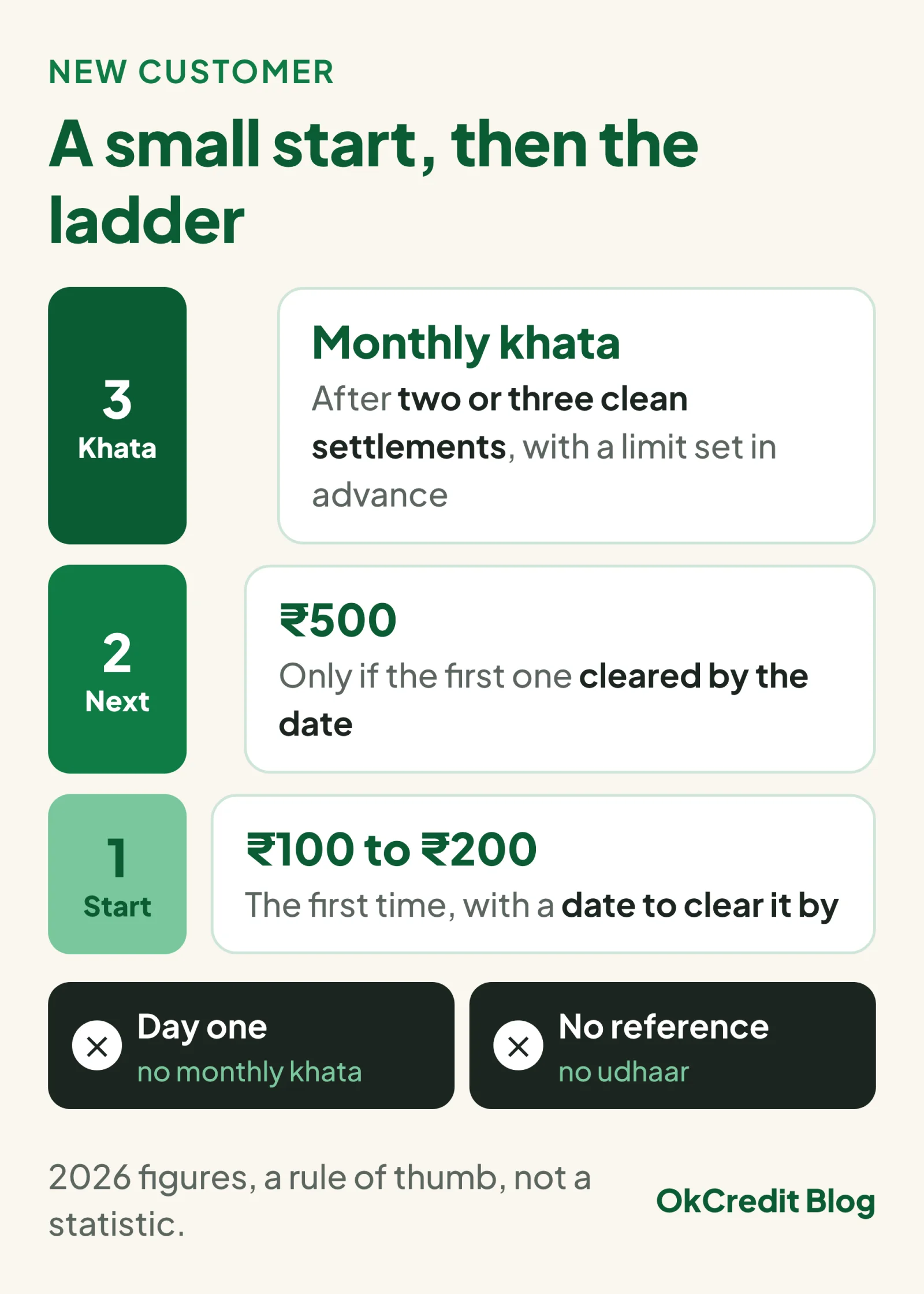 Climb the ladder from the bottom. Day one and no reference get the same answer.
Saying no is easier with the line ready.
| Situation | What to say |
|---|---|
| Stranger, first visit | "Aaj cash kar do, agle mahine se khata khol denge." (Cash today; we can open a khata from next month.) |
| Known face, your total udhaar is already full | "Abhi udhaar band hai, thoda hisaab clear hone do." (Credit is paused till some accounts clear.) |
| Small item plus a big one | "Chhoti cheez likh deta hoon, baaki cash." (I'll write the small item; the rest in cash.) |
One thing you cannot do is check the new customer's CIBIL. Under CICRA 2005, as of 2026, credit bureaus supply reports only to specified users, mainly banks, NBFCs and similar institutions, and RBI's January 2025 credit information directions bar those users from passing the data to anyone else. An individual can pull their own report free once a year per bureau; a shop cannot. The same law is why there is no legal "defaulter list" for kirana udhaar and why passing names to other shops is a bad idea, which the truth about CIBIL and defaulter lists goes into. Your khata is the only credit history you hold on this person, and for a new customer that page is blank. That is the whole reason for the ladder.
How much udhaar should you give each customer?
Set the limit before the customer asks, from three numbers you already know: their monthly purchase from you, a fixed rupee ceiling per customer, and the value of stock on your shelves.
These are rules of thumb and nothing more. No official or survey figure for shop credit limits exists as of 2026, so what follows is one workable way to set your own rule, with the arithmetic shown so you can change the percentages to suit your shop.
Rule one: a customer's cap is half to one month of what they usually buy from you. Rule two: a fixed rupee ceiling per customer that nobody crosses, however good their record. Rule three: total outstanding udhaar across all customers stays within a small slice of stock value, 10 to 20 percent, so one bad month cannot empty a shelf.
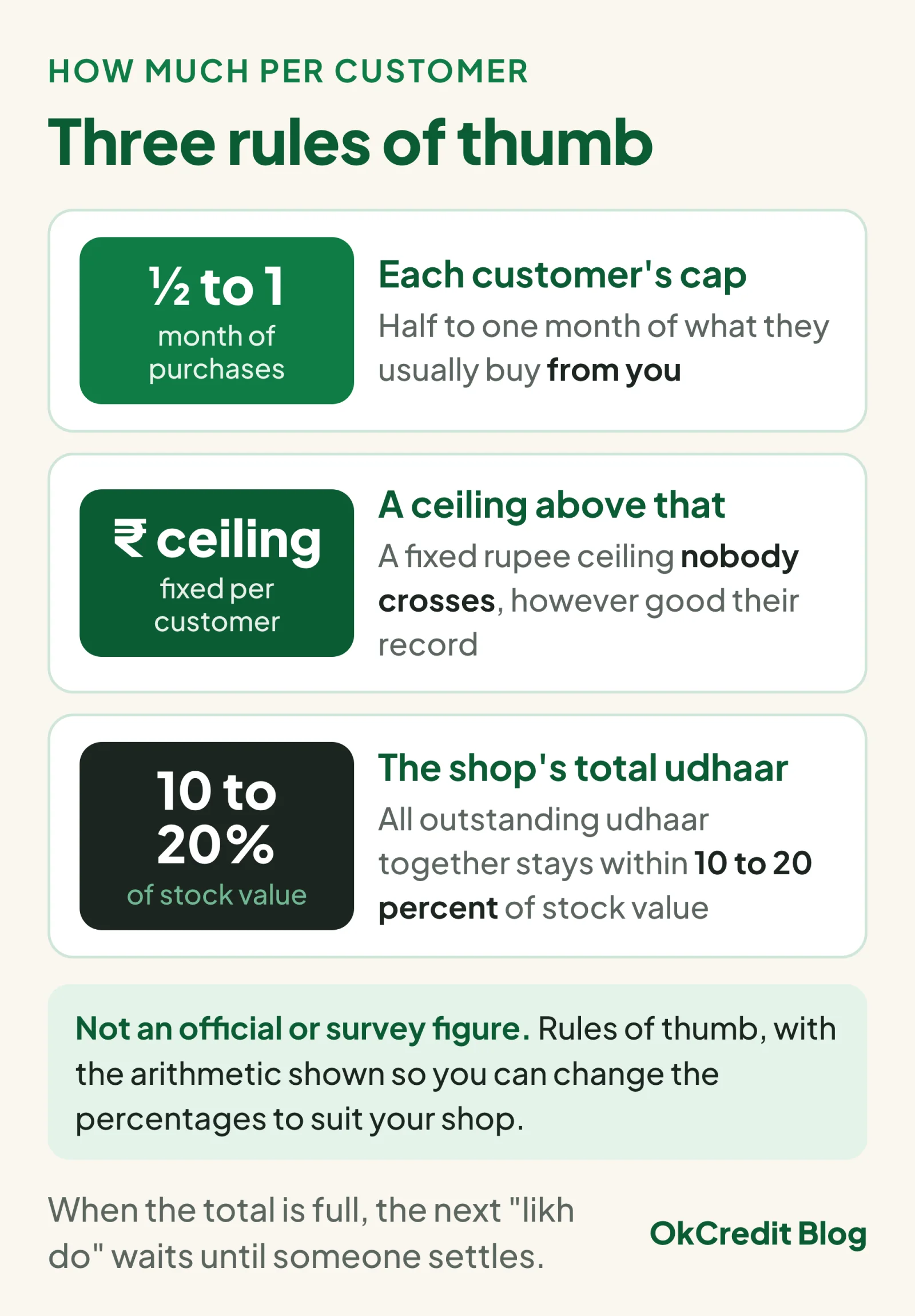 Three rules, one on top of the other. The table below runs them on three shops' round figures.
Worked examples, round 2026 figures, illustrations only:
| Small kirana | Medium general store | Larger shop | |
|---|---|---|---|
| Stock on the shelf | ₹1,00,000 | ₹4,00,000 | ₹10,00,000 |
| Total udhaar ceiling (10% / 15% / 10% of stock) | ₹10,000 | ₹60,000 | ₹1,00,000 |
| A typical customer's monthly purchase | ₹3,000 | ₹6,000 | ₹12,000 |
| Per-customer cap (half to one month) | ₹1,500 to ₹3,000 | ₹3,000 to ₹6,000 | ₹6,000 to ₹12,000 |
| Owner's fixed ceiling per customer | ₹2,000 | ₹5,000 | ₹10,000 |
| Khatas that fit inside the total, at the ceiling | about 5 | about 12 | about 10 |
The last row is the one shopkeepers skip. If five customers at ₹2,000 fill the small shop's total, the sixth "likh do" is a no, even from a good customer, until someone settles. The limit sits on the shop, not only on the person.
How do you record udhaar so there is no dispute later?
Write the entry at the moment of sale, with date, item and amount, and get something back from the customer that shows they saw it.
The second half is what the law cares about. Under the Bharatiya Sakshya Adhiniyam 2023, which replaced the Evidence Act on 1 July 2024, entries in books of account regularly kept in the course of business, including those kept electronically, are relevant evidence (section 28). The same section says those entries alone are not sufficient to fix liability on anyone. In plain words, as of 2026: your khata proves you wrote it, not by itself that they owe it. So pair every entry with a customer-side acknowledgement. A reply to the entry SMS ("ok", "theek hai"), a signature against the line, or a part-payment recorded with their knowledge all do the job. Phone messages count as documents under the same Act; filing electronic copies in court has its own certificate rule, a lawyer's job at that stage.
Write the settlement date at the start, not after. The Limitation Act 1963, unchanged on these points as of 2026, gives three years to sue for goods sold on credit, counted from delivery when no period was fixed, or from the end of the agreed period when one was. A written acknowledgement signed by the customer before those three years run out restarts the clock from the date of signing (section 18). A part-payment made before expiry restarts it too, provided the payment is acknowledged in the payer's handwriting or in a writing the payer signs (section 19). A dated entry plus a signed or written acknowledgement is what keeps an old udhaar alive; a verbal promise does nothing here. For any large amount, consult a lawyer before relying on this; it is general information, not legal advice.
To keep this trail without extra work, a free digital khata app like OkCredit can send the customer an SMS on every entry, so the acknowledgement builds itself, and the khata is backed up online if your phone changes.
What to do once the date passes is a separate job. 10 ways to recover udhaar covers the sequence, and payment reminder messages has the wording that keeps the customer.
FAQ
Can a shopkeeper check a customer's CIBIL score before giving udhaar?
No. Under CICRA 2005, credit bureaus give reports only to specified users such as banks and NBFCs, and RBI's January 2025 credit information directions bar those users from sharing the data further. An individual can pull their own report free once a year per bureau; a shop cannot. Your khata is the only credit history you hold on a customer.
Is a khata entry alone enough proof that a customer owes me money?
Not on its own. Section 28 of the Bharatiya Sakshya Adhiniyam 2023 makes regularly kept books of account, including electronic ones, relevant evidence, but says they are not alone sufficient to fix liability. Pair each entry with the customer's acknowledgement: a reply to the entry SMS, a signature, or a part-payment recorded with their knowledge.
How long do I have to recover shop udhaar legally?
Three years under the Limitation Act 1963, counted from delivery when no credit period was fixed, or from the end of the agreed period when one was. A written acknowledgement signed by the customer before the three years expire restarts the clock, and so does a part-payment made before expiry, provided it is acknowledged in the payer's handwriting or in a writing the payer signs. For a large amount, consult a lawyer.
How much udhaar should I give a new customer?
Start at ₹100 to ₹200 (a 2026 rule of thumb, not a statistic), move to ₹500 once that clears by the date, and open a monthly khata only after two or three clean settlements. No reference, no udhaar.
Should I share defaulter names with other shopkeepers?
No. There is no legal defaulter list for shop udhaar, bureau data cannot be shared under CICRA 2005, and passing names around invites disputes. Your own khata already tells you what the checklist needs.