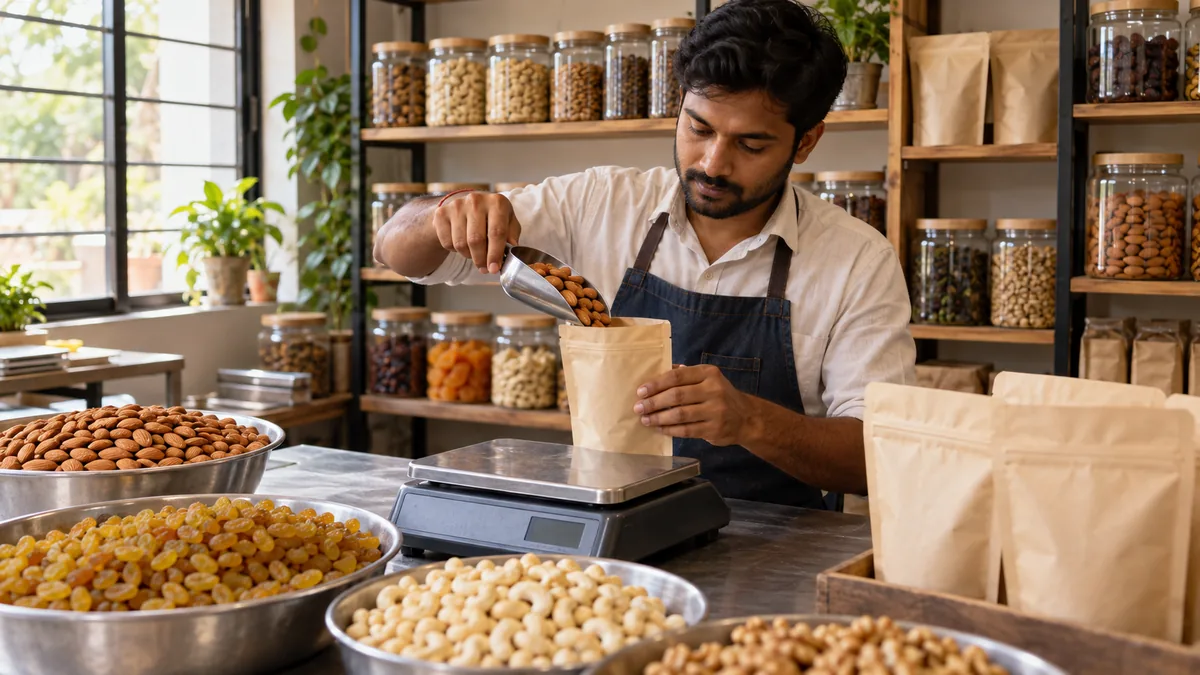
A dry-fruit business can mean a loose-product counter, sealed retail packs, gift boxes or bulk supply to bakeries. Those models need different stock, licences and cash. For a first-time operator, the lowest-risk start is a narrow range sold in small quantities, with supplier invoices, dated stock rotation and actual customer feedback recorded before you add imported nuts or private-label packaging. This guide treats every budget as a planning scenario, not a published market tariff.
Which dry-fruit business model are you opening?
A neighbourhood retailer buys finished goods in bulk and sells loose or in original packs. The packer buys ingredients, weighs them, seals packages and takes responsibility for label accuracy and traceability. A gift-box operator may source sealed items and combine them into a festive assortment, but still needs to check how repacking and food labelling rules apply to the activity. A wholesaler needs deeper working capital, consistent grades and delivery capacity.
Do not begin by renting a large shop because the word “dry fruit” sounds premium. Decide whether your likely buyer is a household purchasing 100–500 grams, a bakery needing cartons, a corporate gift buyer seeking a dated hamper, or an online customer comparing delivered prices. The order cycle and cash lock-up are different for each.
A loose counter can test a few fast-moving lines, such as almonds, cashews, raisins and dates. Pistachio, walnut, figs and premium imported products increase the number of grades and price points you must explain. Too many varieties make stock age harder to notice. Start with fewer SKUs and a dated purchase register.
How should you choose suppliers and grades?
Buy by grade, origin and pack specification, not only by product name. “Almond” is not one uniform lot. Ask for the variety or grade, crop or pack date where available, moisture and foreign-matter specification, invoice, storage conditions and replacement process for damaged or rancid stock. Keep a sealed sample from each lot until it is sold through. It gives you a comparison if a customer reports an off smell.
Visit a wholesale market or authorised distributor and request a small paid sample order first. Compare at least three delivered quotations for the same grade and pack size. A lower quote can hide freight, minimum order quantity, taxes, mixed grades or a no-return term. For imports, ask the supplier to document the importer and traceable batch. Do not call a product “organic”, “premium” or “California” unless the pack and evidence support the claim.
Storage affects saleable stock. Keep nuts away from sunlight, heat, moisture, chemicals and strong odours. Use food-grade containers with tight lids, clean scoops and a pest-control log. FIFO means first in, first out; FEFO means first expiry, first out. For products with a best-before date, follow the date on the label rather than the date you received the carton. Inspect stock weekly for soft texture, insect activity, dampness or stale aroma.
What does a small setup budget include?
Use separate columns for one-time setup and the first operating stock. The figures below are a planning worksheet for a compact retail or packing pilot. They are not vendor quotes; rent and equipment prices vary by city, area, condition and specification. Get written quotations for the exact premises and machine before financing.
| Item | Lean planning amount | Check before paying |
|---|---|---|
| Deposit and first rent | ₹40,000–₹1.5 lakh | Commercial-use clause, lock-in and refundable deposit |
| Shelves, counter and food-safe bins | ₹35,000–₹1 lakh | Steel/food-contact suitability and washable surfaces |
| Weighing scale and sealing tools | ₹12,000–₹55,000 | Capacity, calibration and service availability |
| Opening dry-fruit inventory | ₹1–₹3 lakh | Grade, invoice, minimum quantity and expiry |
| Pouches, labels and cartons | ₹15,000–₹60,000 | Pack size, print minimum and label revision cost |
| Working cash for replenishment | ₹75,000–₹2 lakh | Supplier payment cycle and slow-moving stock |
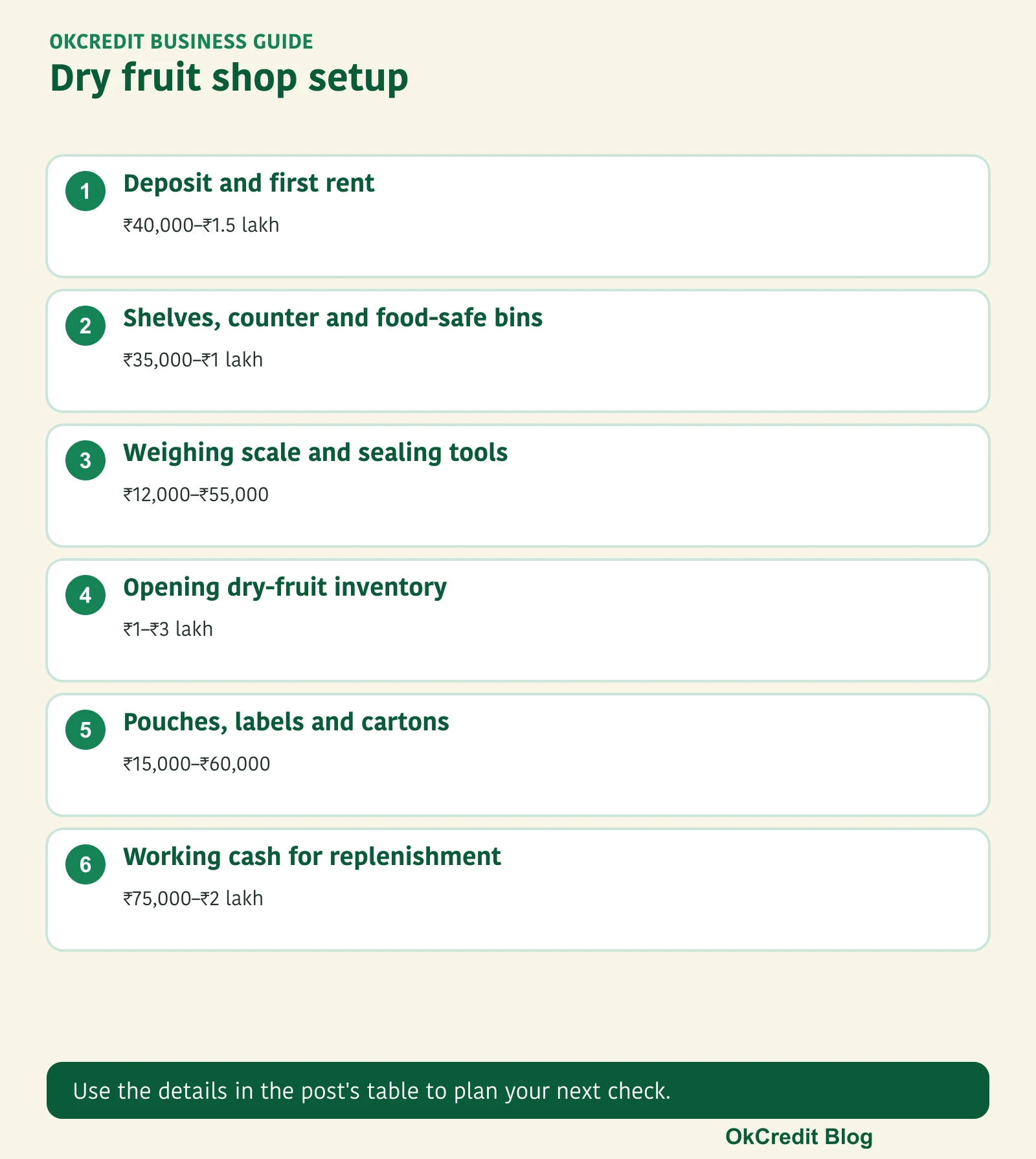
Setup items and planning ranges from the table.
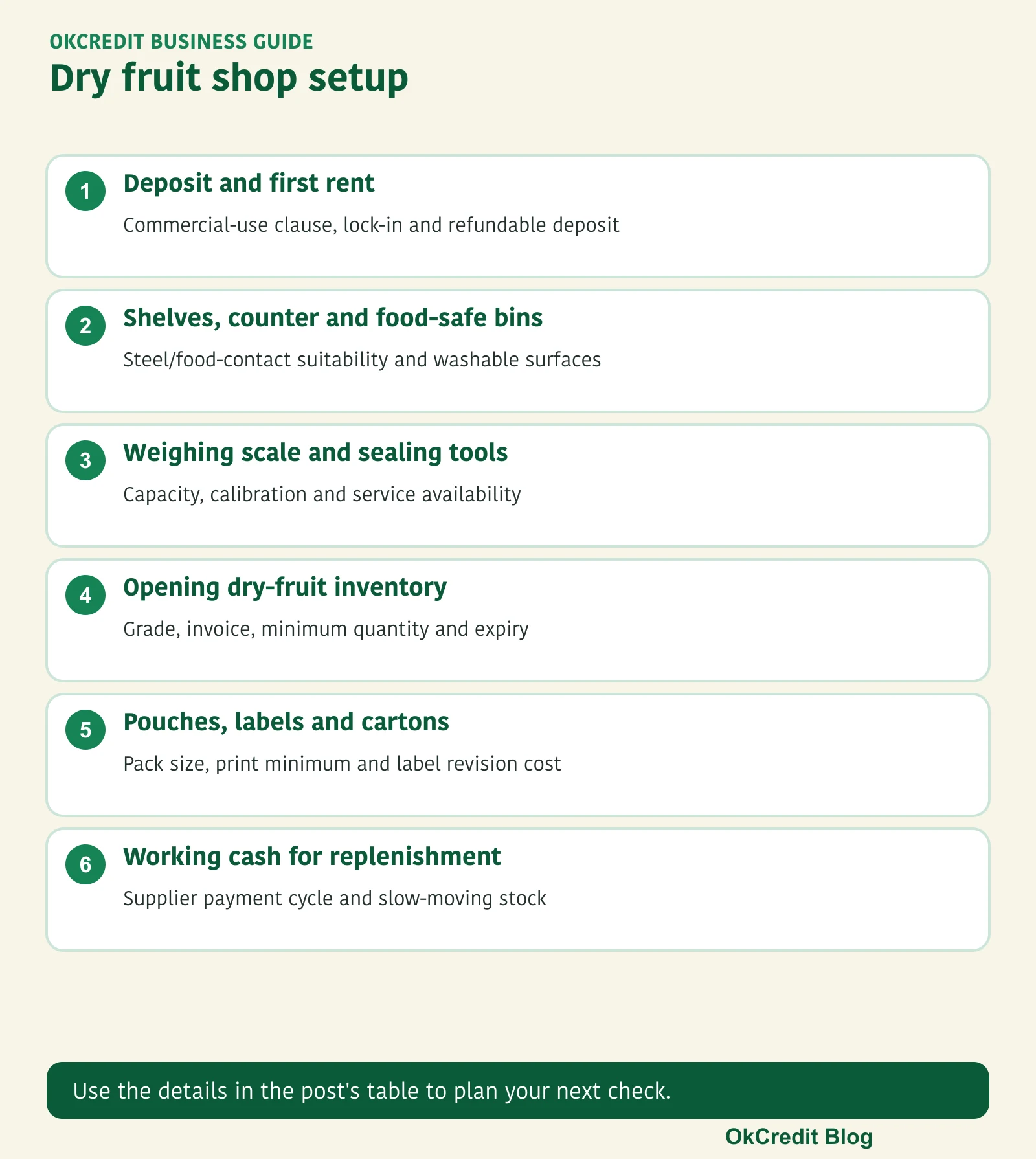
Compare grade, invoice, packaging and replenishment terms.
A packing setup carries additional compliance responsibility and may need more equipment, a suitable workspace and a food-safety plan. A retailer buying intact packs has less packaging work but may have a weaker per-unit margin. Do not assume that a home kitchen, residential room or shared godown is allowed for food packing. Check premises use and the exact activity on FoSCoS before signing.
What monthly costs should you put into the cash plan?
Add rent, staff, electricity, delivery, packaging replenishment, pest control, weighing-scale verification, payment fees, damaged stock and owner drawings. Dry fruit ties up cash because you pay the supplier before the final pack or retail sale has been collected. A sale on customer credit adds another delay. Keep replenishment money separate from the amount you expect to take home.
A high gross margin on a small premium pack can be misleading if it sells once a month. Track gross contribution by SKU and the days stock remains on your shelf. If almonds turn weekly but a speciality date pack turns quarterly, the second item may produce less cash even when its margin percentage looks attractive. Remove products that repeatedly expire, soften or require discounting.
For planning, put rent and wages in fixed cost, and nut purchase, pouch, label, delivery per order and payment charge in variable cost. Spoilage is not “miscellaneous”; estimate it from your own count each month. Keep returned or damaged food segregated and follow applicable food-safety disposal procedures rather than putting it back into saleable stock.
How do you price a pack and calculate contribution?
Use landed cost per saleable kilogram. If a 10 kg lot costs ₹8,000 and freight is ₹400, the cost before packaging is ₹840 per kg. If cleaning, breakage or moisture loss leaves only 9.7 kg saleable, landed cost is about ₹866 per saleable kg. This is arithmetic using stated assumptions, not a current market price. Enter your actual invoice, freight and measured saleable weight into the same formula.
For a 250 g pouch, the assumed product cost at ₹866/kg is about ₹217. Add the actual pouch and label cost, card or platform fee and any delivery subsidy. If you sell that pack at ₹300 and direct pack cost is ₹12 with ₹6 selling/payment cost, contribution before rent is about ₹65. A different grade or wholesale quote changes the answer immediately.
If monthly fixed cost is ₹75,000, the example needs roughly 1,154 such packs to cover fixed cost: ₹75,000 divided by ₹65. That is around 39 packs a day over 30 days, before owner salary, tax and loan repayment. Do not describe this as guaranteed profit. A mixed basket with loose sales and gift boxes has different contribution, so calculate each SKU separately.
Which licences and label checks matter in 2026?
FSSAI announced revised turnover thresholds effective 1 April 2026: food businesses with turnover up to ₹1.5 crore fall within the registration band, above ₹1.5 crore and up to ₹50 crore within the State licence band, and above ₹50 crore within the Central licence band, subject to activity-based eligibility. Confirm the category and premises conditions using FoSCoS. Turnover thresholds do not replace product-specific or activity-specific conditions.
If you pack, relabel, import, store or sell through an online marketplace, your applicable food business category may differ from a simple retail counter. The label for a pre-packaged food must follow the current FSSAI Labelling and Display requirements and Legal Metrology declarations. Check product name, ingredient declaration, net quantity, lot/batch, date marking, nutrition information where required, FSSAI licence number, manufacturer/packer details, customer-care information and MRP. Which declarations apply depends on the exact pack and product.
GST treatment varies by product classification and transaction. Use the current CBIC rate schedule and ask a tax professional to confirm HSN and registration obligations. Udyam registration is an MSME registration; it is not a substitute for FSSAI, local trade permission or tax registration. Save purchase invoices and batch details so you can trace a complaint to a specific supplier lot.
How can you test sales before committing to a shop?
Take a small assortment to a permitted pop-up or accept preorders from known buyers. State the net weight and price clearly. Ask buyers which pack they would reorder, not which one looks attractive. A gift box should list its contents and net quantities; a buyer should not discover that the box is mostly filler after opening. Photograph the packed assortment and record its final weight before selling.
For a retail counter, observe nearby household shopping patterns and competitor pack sizes. Visit during weekday evenings and weekend mornings. Ask a bakery or sweet shop whether it buys nuts by grade, and whether it needs a weekly or monthly delivery. Buyers may ask for a credit period; offer one only after checking the supplier-payment cycle and setting a limit.
A useful first-month sheet has columns for date, SKU, batch, purchase quantity, sale quantity, sale value, payment received, discount, damage and closing stock. Reconcile physical stock weekly. If book stock says 12 kg but the shelf has 10.8 kg, investigate weighing, sampling, household use and recording errors before ordering more. This simple routine protects margin better than a decorative storefront.
What mistakes make a dry-fruit shop lose money?
Buying a wide premium range before testing local price tolerance is a common trap. So is using transparent jars in direct sun, leaving lids open during rush hours or placing a scale where customers cannot see the tare weight. A customer dispute over 50 g can damage trust and invite complaints. Put a visible verified scale on the counter and show the tare deduction.
Do not mix old and new lots just to clear stock. Keep batch identity visible until the older lot is sold. Avoid relabelling the original best-before date or copying another packer’s label. Never make a medicinal or disease-prevention claim for nuts. Marketing language must match the food rules and the product evidence.
Online selling adds commissions, packaging protection, returns, courier damage and payout timing. A list price that works at the counter may lose money after marketplace deductions. Use a small zone-based delivery test and read the platform’s current fee schedule before publishing a price. Compare net settlement with the order report, not the gross cart value.
How do you keep payment and stock records together?
A stock ledger and bank statement answer different questions. The stock sheet tells you what is left; the bank statement shows cleared receipts and payments. A customer may have taken a 500 g pack and paid later. Record the sale and the outstanding amount on the same day, then reconcile when payment arrives. This is why a clean customer ledger can sit beside the purchase register. See how to choose a digital bahi khata for customer-credit records, and review the GST invoice guide for a separate invoice question.
If you extend credit to a café or office buyer, write the invoice date, due date, contact person and disputed quantity. Do not rely on a WhatsApp “paid” message without verifying the bank settlement. Pause new credit if old invoices remain unpaid. A shop that sells well but cannot replenish supplier stock can run out of its fastest-moving item even while its sales notebook looks busy.
Frequently asked questions
Can I start this business from home?
Possibly, if the premises and activity are allowed and food-safety requirements are met. Check FoSCoS category, local land-use conditions, storage, pest control and customer access before accepting orders.
Which dry fruits should I stock first?
Choose a small number of lines after speaking with local buyers and comparing supplier grades. Track repeat sales and stock age; do not use a national “best seller” list as a local demand guarantee.
Do I need FSSAI registration if I only sell?
Food businesses must check the applicable registration or licence for their activity. Revised turnover thresholds began on 1 April 2026, but FoSCoS activity eligibility and premises rules still matter.
Is packing dry fruit more profitable than retailing?
Not automatically. Packing adds packaging, label control, batch traceability, equipment and food-safety work. Compare contribution after all direct costs with the simpler resale model.
How should I handle rancid or damaged stock?
Remove it from sale, identify the supplier batch, photograph the condition and follow the supplier’s documented claim process. Never blend questionable stock into a fresh lot.