A home artificial jewellery business starts at the cost of one stock lot: 100 to 150 pieces at ₹28 to ₹150 wholesale, boxes at ₹11 to ₹70, and a courier float. Tens of thousands, not lakhs. GST is 3%, Udyam registration is free, and Amazon's referral fee on fashion jewellery priced up to ₹1,000 is 0% (2026 rates).
How much money do you need to start an artificial jewellery business from home?
The honest minimum is one stock lot plus packaging plus enough cash to pay couriers for a month. Nobody publishes a startup cost for this business, so the only useful number is one you build from live prices, and those prices are all small.
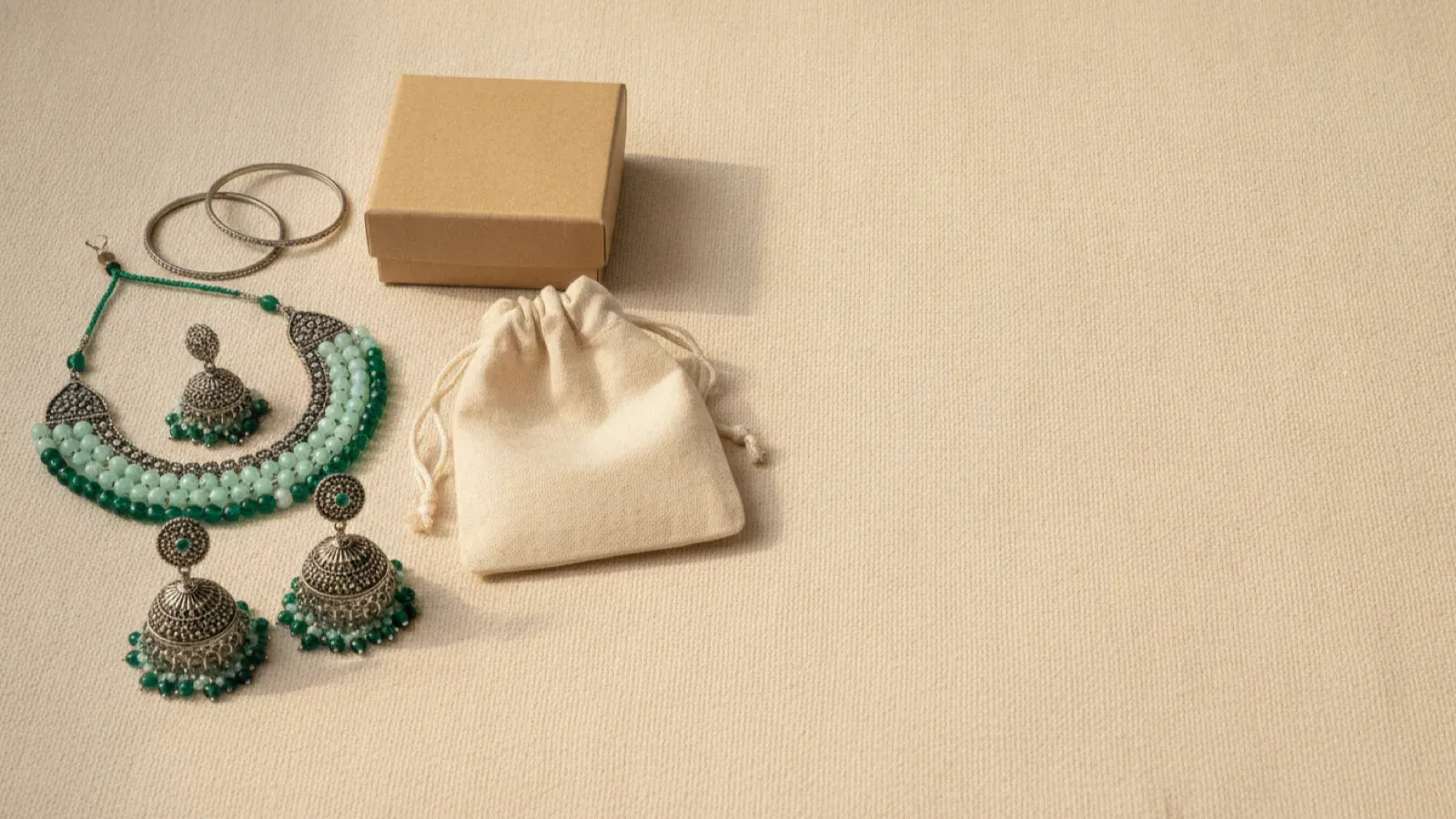
Here is what each line actually costs in 2026. Bulk imitation pieces quote at ₹28 to ₹150 each on B2B listings, jewellery boxes and pouches at ₹11 to ₹70 apiece, and an aggregator courier averages ₹36 to ₹45 per shipment across Shiprocket's plan tiers (their plans run from free to ₹799 a month). Udyam registration costs nothing. GST registration costs nothing. A trade mark is ₹4,500 per class if and when you want one. A Shopify store, if you ever open one, is ₹1,499 a month on the Basic plan billed yearly.
| Model | One-time spend to open | Monthly working capital | What locks up your money |
|---|---|---|---|
| Reseller on catalogue apps, no stock | Almost nil; a phone and a bank account | Only what you choose to spend on promotion | Nothing, and that is also the problem |
| Home boutique: small lot, sold on Instagram and WhatsApp | ₹2,800 to ₹15,000 for a 100-piece lot, or ₹4,200 to ₹22,500 if you buy 150 pieces, plus ₹1,100 to ₹7,000 for 100 boxes | Restock plus ₹36 to ₹45 per shipment | Unsold designs from the first lot |
| Marketplace seller (Amazon and similar) | Same stock and packaging spend, plus a courier float | Per-order fees, deducted at settlement | Stock, plus parcels that come back |
| Buying wholesale to supply other sellers | Set by the supplier's minimum lot, not by any rule of thumb | Storage and larger restocks | Everything; this is the capital-heavy end |
Two cautions on that table. The per-piece and per-box prices are live B2B aggregator quotes, so treat them as ranges rather than a rate card, and ask any supplier for their real minimum order quantity in writing before you plan a budget. Photography is the line where beginners overspend: a phone, a window and a plain cloth do the job, and nothing needs buying on day one.
If you need money to scale rather than to start, two government routes exist. Mudra loans under PMMY run Shishu up to ₹50,000, Kishor ₹50,000 to ₹5 lakh, Tarun ₹5 lakh to ₹10 lakh, and the newer Tarun Plus ₹10 lakh to ₹20 lakh for borrowers who have already repaid a Tarun loan. If you make pieces by hand, check whether you qualify under PM Vishwakarma, where goldsmith is one of the 18 covered trades: it carries a ₹15,000 toolkit grant, collateral-free credit of ₹1 lakh repayable over 18 months and then ₹2 lakh over 30 months at 5% interest with government subvention, and a ₹500 per day stipend during the 40-hour basic or 120-hour advanced training. Eligibility is trade-based, so verify it on the scheme portal before counting on it. Our guide to business loans in India covers the paperwork side.
Which selling model should you pick: reselling, own stock, marketplace or wholesale?
Pick the model by how much capital you can afford to have sitting in a cupboard for six months. That single question separates the four options more cleanly than margin does.
| Model | Capital needed | Margin | Effort | Main risk |
|---|---|---|---|---|
| Reselling from a catalogue app | Almost none | Thin, fixed by the app | Low; posting and forwarding | You never see the piece before the customer does |
| Own stock, sold direct | Cost of the lot | Highest of the stocked models | Medium; sourcing, photos, packing | Dead stock in trend designs |
| Marketplace seller | Stock plus courier float | Middling after fees | High; listings, ratings, returns | Parcels returned to origin and rating pressure |
| Handmade at home | Raw material and tools | Best per piece | Highest; you are the production line | Volume stays small |
Reselling is where most people start because it costs nothing to test whether your circle actually buys from you. The trade-off is real: the margin is set by someone else, and quality is unverified until the box reaches your customer, which means a complaint you cannot fix. Buying your own stock flips both of those, at the price of capital that is now sitting in a box. Marketplaces buy you reach you cannot get on your own, and charge for it in commission, shipping fees and the cost of goods that travel twice. Making pieces yourself earns the most per unit and caps how many units exist.
Nothing stops you from stacking these. A common, sensible sequence: resell for a month to learn what sells, buy a small lot of the two designs that moved, then list those on a marketplace once you can photograph and pack them properly.
Where do you buy artificial jewellery wholesale in India?
Live B2B supplier data puts the imitation jewellery supply base in Mumbai, which is the largest, followed by Jaipur, Delhi, Surat, Rajkot and Bengaluru. Jaipur listings are especially dense in oxidised and traditional work, which matters if that is your niche.
Indicative wholesale quotes from IndiaMART supplier listings, September 2026:
| Category | Indicative wholesale range (2026) |
|---|---|
| Budget everyday pieces | ₹28 to ₹127 per piece |
| Oxidised pieces | ₹85 to ₹810 per piece |
| Mid-range necklace sets | ₹200 to ₹810 per set |
| Heavier bridal-style sets | ₹2,100 to ₹10,350 per set |
| Boxes and pouches | ₹11 to ₹70 per piece |
These are aggregator quotes from many suppliers, not one price list, and minimum order quantities are usually negotiated supplier by supplier rather than posted. Ask for the MOQ, the per-piece rate at that MOQ and the freight cost in the same message, because a low rate with a 500-piece minimum is not a low rate for you.
Before any bulk order, buy a sample lot and wear the pieces for two weeks. You are checking three things that generate almost all the complaints in this category: how long the plating or polish survives daily use, whether the base metal irritates skin, and how fast colour fades after a sweaty afternoon. A supplier who will not sell a sample lot is telling you something. If you are travelling to a market rather than ordering online, our roundup of wholesale markets in India is a useful starting map.
Making pieces yourself changes the shopping list to beads, findings, base-metal blanks, stones, wire and a basic tool kit, bought from the same clusters. Prices there move by weight and quality, so quote your first few designs after you have actually bought the material, not before.
What registration, GST and legal compliance apply to a home jewellery business?
There is no such thing as a general "business licence" or "business name registration" for a home proprietorship in India. What exists is a short, mostly free list.
Udyam registration. Free, Aadhaar-based, fully online and paperless, with PAN and GST details auto-fetched. Since 1 April 2025 a micro enterprise means investment up to ₹2.5 crore and turnover up to ₹10 crore, so a home jewellery business is comfortably micro. Anyone charging you a fee to "get" Udyam is selling you nothing. If you have registered already and want to confirm it, see how to check MSME registration by name.
GST. Imitation jewellery sits under HSN 7117 at 3%. That rate survived the GST 2.0 reset of 22 September 2025, which moved most goods to 5% and 18% slabs, so imitation jewellery is taxed at the same 3% as gold and silver jewellery under 7113; bangles of lac or shellac remain nil. Registration thresholds are ₹40 lakh turnover for goods, ₹20 lakh for services and ₹10 lakh in special category states, but the threshold is not the whole rule: a supplier selling through an e-commerce operator is required to register, with only limited exceptions. In practice that means the day you open a marketplace seller account, plan for GST. The 3% figure here is read from tax-portal schedules citing Notification 13/2025-Central Tax (Rate); CBIC's own public rate page has not been refreshed since 2023, so confirm the current rate with your CA before you print invoices.
Trade mark. Optional at the start, worth it once a label starts getting repeat buyers. Form TM-A costs ₹4,500 per class on e-filing for an individual, startup or small enterprise, and ₹9,000 per class for everyone else. Jewellery falls in class 14, and your Udyam certificate is what gets you the small-enterprise rate.
Hallmarking. BIS hallmarking is a gold and silver rule. It does not apply to imitation pieces, and no imitation piece should carry a hallmark-style claim. What does apply is honesty: if you write "gold plated" or "92.5 silver look", the description has to be accurate, because a wrong material claim is what turns a return into a complaint.
Shop and Establishment. Needed only if you open a physical counter with a municipal address. A cupboard in your bedroom does not trigger it.
Packaging and labelling. If you print your own retail packs or relabel supplier stock, check the current Legal Metrology packaged-commodity requirements with your CA before the print run, and read your marketplace's mandatory product declaration fields at listing time. Rules here change more often than blog posts get updated.
How do you price the pieces, and what margin is actually left?
Price at ₹1,000 or below on Amazon and your commission is zero. That single fee rule shapes pricing in this category more than any markup formula: Amazon's Fashion Jewellery referral fee is 0.00% for items priced up to ₹1,000 and 22.50% above ₹1,000. Cross that line and the closing fee is ₹72. Below it the published figure is ₹13 to ₹26 for items up to ₹500; Amazon does not publish a rate for the ₹500 to ₹1,000 band, so check your own fee group before pricing there.
Here is one delivered order, built entirely from published fees. A pair of oxidised earrings bought at ₹85, sold at ₹449, shipped Easy Ship at 350g:
| Line | Amount (2026) |
|---|---|
| Selling price | ₹449 |
| Referral fee (0% up to ₹1,000) | ₹0 |
| Closing fee | ₹13 to ₹26 |
| Weight handling, 350g Easy Ship | ₹55 |
| GST at 3%, if the price is inclusive | ₹13 |
| Wholesale cost of the piece | ₹85 |
| Box or pouch | ₹20 |
| Left in the bank | about ₹250 to ₹263 |
On that ₹449 order the closing fee, weight handling and GST take ₹81 to ₹94 before the piece and the box are paid for, which is why ₹149 earrings are a trap and ₹449 earrings are a business. Now run the same set at ₹1,299: 22.5% referral is ₹292, closing is ₹72, and you have given away ₹364 before the courier is paid. Either stay at or below ₹1,000 or price high enough that 22.5% still leaves something.
Two things quietly remove margin after that. Ad spend, if you use it, comes out of the same ₹250. And parcels that come back: on low-ticket jewellery a return to origin costs you the courier both ways plus a piece that may not be resellable. No credible current source publishes a return rate for this category, so do not model it with a borrowed percentage; instead push prepaid orders, describe size and material precisely, and treat every avoided return as pure profit. Combos help on both counts, since weight handling is charged on the parcel, not the price, so a set and a single piece of the same weight ship for the same fee, spread over a bigger sale.
Which selling channels work best, and how do you set them up?
Start on Instagram and WhatsApp, because they cost nothing and tell you within three weeks whether your designs move. A catalogue on WhatsApp Business, reels of pieces being worn, and orders confirmed in chat with prepaid UPI: that is a complete first channel, and plenty of home sellers never need more.
Marketplaces come next, once you can pack properly. On Amazon, Fashion Jewellery is a gated category, so budget time for category approval along with your PAN, GST and bank details. Read the fee page yourself before you price. Flipkart's commission rate card now sits behind a seller login and is not publicly readable as of September 2026, which means no number you find in an article can be trusted for Flipkart: create the account and read the live rate card. The same applies to catalogue reselling apps such as Meesho, where the supplier terms are worth reading in full before you upload a catalogue.
An own store is a later decision with a computable answer. Shopify India is ₹1,499 a month on Basic billed yearly, ₹1,994 billed monthly, ₹5,599 a month for Grow, plus a 2% fee on Basic if you use a third-party payment provider. Against a marketplace that charges 0% referral up to ₹1,000, a store is not saving you commission; it is buying you a direct relationship and your own customer data. That is worth ₹1,499 a month only when repeat buyers are coming back on their own. Etsy is sometimes suggested for handmade work: its published fees are US$0.20 per listing for four months, 6.5% transaction fee on the sale price including shipping, 3% plus US$0.25 payment processing, and 2.5% currency conversion, with no monthly subscription. India does not appear in Etsy's seller-region selector, so check seller eligibility and payout options for your country before planning around it.
Do not skip the offline channels, which for this category are often the most profitable ones. Exhibitions, society stalls, boutique and salon counters, kitty groups and wedding-season pop-ups all sell jewellery with no commission, no courier cost and no returns, and they let a buyer try a piece on. If you are supplying a boutique on consignment or handing stock to resellers, agree the margin split and the settlement date before the stock leaves your house.
How do you pick a niche and decide what to stock first?
Pick one look and go deep, because a hundred assorted pieces read as a clearance table and thirty pieces in one style read as a brand. The workable niches in this category are oxidised, kundan and polki-style bridal, temple jewellery, minimal daily-wear office pieces, kids' sets, handmade terracotta or fabric work, and anti-tarnish everyday metal.
Read demand before you buy. Marketplace bestseller lists in fashion jewellery tell you what is actually shipping this month, and the local wedding calendar tells you when. Your first lot should be shallow and wide within one niche: a few designs, several pieces of each, priced at or below ₹1,000 so the fee maths stays in your favour.
The metal price is doing part of your selling for you. On the IBJA benchmark of 1 September 2026, gold 999 stood at ₹1,51,328 per 10g and silver 999 at ₹2,28,360 per kg, before 3% GST and making charges; gold traded near ₹48,000 to ₹50,000 per 10g in 2021. A full imitation set now costs a wedding guest less than a gram of gold, and that gap is the reason the category keeps growing. For scale, IBEF sized the whole gems and jewellery sector, precious metals included, at ₹7,31,255 crore in January 2026; imitation jewellery is a small slice of that and nobody publishes its size separately, so be sceptical of any article that quotes one.
Resist the bridal sets on your first purchase. At ₹2,100 to ₹10,350 per set in wholesale quotes, six of them can absorb the entire budget of a home boutique and sell once a season. Buy those only after you have wedding-season demand you can already name, and stock ahead of the peak months rather than during them, because that is when suppliers quote highest and ship slowest.
How do you photograph, pack and ship jewellery from home?
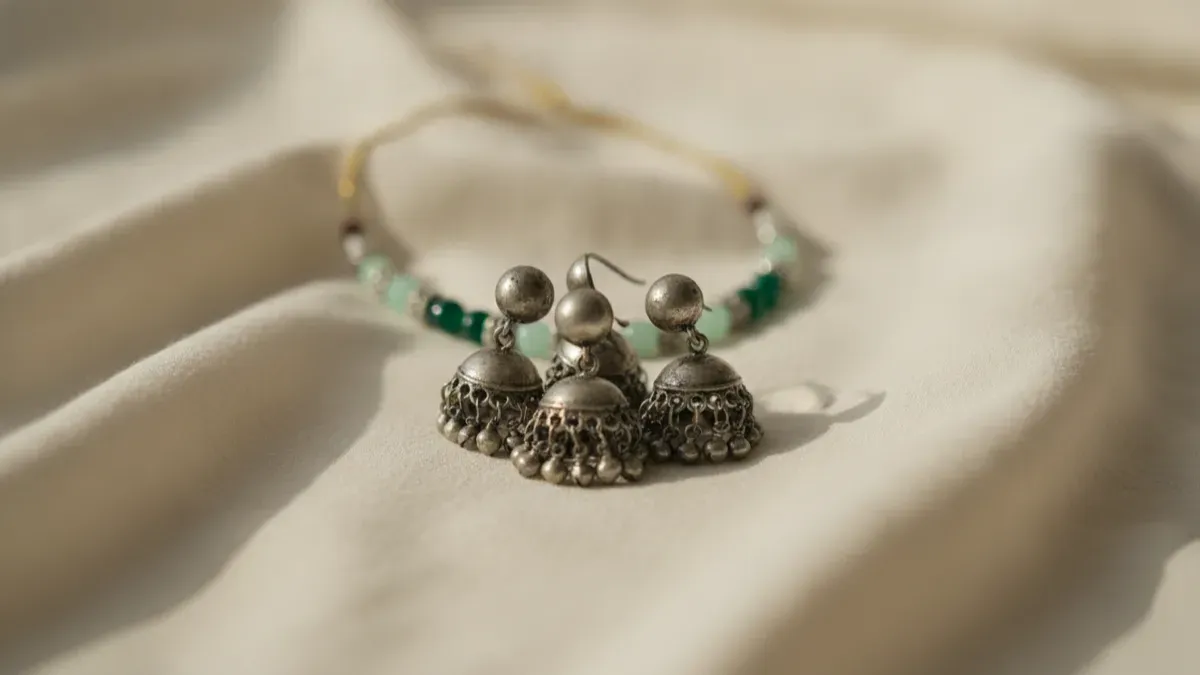
Your phone is enough; light is what you are actually buying. Shoot near a window in the first half of the day, put the piece on plain cloth in a neutral shade, and take three frames per product: the full piece flat, a close-up of the clasp or plating, and one worn shot so buyers can judge size. Add a coin or a ruler in one frame for scale, since "big jhumkas" means different things to different people.
Write the listing the way a returns-averse seller would. Material, plating, length in centimetres, weight in grams, stone type if any, and one line of care instructions. Every specific detail you add removes one reason for a parcel to come back.
Pack for a courier that will drop it. Pouch inside a box, box wrapped, void space filled, tape on all seams. Keep the parcel under 500g if you can: Amazon Easy Ship regional weight handling starts at ₹51 for the first 500g and adds ₹17 per additional 500g, so a heavier box costs you real money on every order. An aggregator courier averages ₹36 to ₹45 per shipment, and prepaid orders are worth a small discount because they come back far less often than COD. Space needs at home are modest: one lockable cupboard for stock sorted by design code, a table for packing, and a printed exchange and return policy you can quote verbatim when a customer asks.
How do you get your first 100 customers?
Reels of pieces being worn are the engine in this category, because jewellery sells on movement and scale, both of which a still photo hides. Post the same piece on a hand, on an ear, against a kurta, and let the caption carry the price and the size.
Beyond that, four things do the work. A WhatsApp broadcast list of everyone who has ever bought from you, messaged before each festival and wedding stretch, is the cheapest sales channel you will ever own. A referral discount that pays your existing buyer, not a stranger. A free Google Business Profile if you take local pickup or deliver in your city, which Google now lets you manage directly from Search and Maps since the old Google My Business app was retired. And small collaborations: a local boutique owner or a creator with two thousand engaged followers will do more for you than a paid campaign at this stage.
Time your offers to the local calendar, not the national one. Then focus on the part everyone skips: a customer who bought earrings in April is the easiest necklace sale you will make in October. Repeat purchase, not new reach, is what turns this into an income.
How do you keep the money side straight?
Keep a stock register from the first lot, because dead stock stays invisible until you count it. One row per design code with the date, quantity, per-piece landed cost and quantity sold tells you at a glance which designs are earning and which are furniture.
Record UPI and cash sales the same day. In a home business the two accounts that matter are separate: open a current account or a second savings account and route every business rupee through it, so household spending never quietly eats your restock money. Track what resellers and boutiques still owe you along with the date it was due, since consignment stock and pending payments are where home sellers lose the most money without noticing. To keep that credit trail straight, a free khata app like OkCredit records every entry with automatic backup and sends payment reminders on outstanding balances (Android).
Once you are GST registered, invoice properly and file on schedule, and keep purchase bills from suppliers so input credit stays claimable. Then spend thirty minutes at the end of every month on three questions: what actually sold, what is still sitting, and what margin you really made after fees and returns. That review is the difference between a hobby and a business.
FAQs
What is the minimum investment to start an artificial jewellery business at home?
The realistic floor is one stock lot plus packaging plus a courier float. At 2026 wholesale quotes of ₹28 to ₹150 per piece and ₹11 to ₹70 per box, a 100 to 150 piece start lands in the low tens of thousands of rupees. Reselling from a catalogue app costs close to nothing but pays a thinner margin.
Is GST registration compulsory for selling artificial jewellery from home?
Not automatically. Thresholds are ₹40 lakh turnover for goods, ₹20 lakh for services and ₹10 lakh in special category states. But a supplier selling through an e-commerce operator is required to register with only limited exceptions, so plan for GST the day you open a marketplace seller account. Confirm your position with a CA.
What GST rate applies to imitation jewellery in 2026?
3% under HSN 7117. The GST 2.0 reset of 22 September 2025 moved most goods to 5% and 18% slabs but left jewellery at 3%; bangles of lac or shellac remain nil. Verify the current rate with your CA before invoicing.
How much profit is actually left on one order?
On a ₹449 pair of earrings bought at ₹85 and shipped at 350g through a marketplace, roughly ₹250 to ₹263 lands in the bank after the closing fee, weight handling, GST and packaging, with the referral fee at 0% up to ₹1,000. Ad spend and returned parcels come out of that.
Do I need a course, qualification or hallmarking to sell imitation jewellery?
No qualification or course is required, and BIS hallmarking applies to gold and silver, not imitation pieces. What you do need is accurate description: a "gold plated" claim must be true, because material claims are what turn returns into complaints.
For more low-capital options to compare against this one, see our list of business ideas.