An organic or unusual business is worth starting only when a specific customer will pay for it repeatedly. In 2026, a useful low-risk route is to test one product or service in a narrow neighbourhood, document the source of every claim, and expand after repeat orders. A home-based organic grocery curation service may need roughly ₹25,000 to ₹80,000 for samples, insulated storage, labels and delivery trials; a small packaged food unit can need several lakh rupees once equipment and compliance are included. These are planning ranges, not a promise of sales. The right budget depends on whether you grow, process, resell or provide a service.
“Organic” is a regulated food claim in India. FSSAI recognises the Participatory Guarantee System for India and the National Programme for Organic Production. A seller cannot simply print “organic” because a supplier says the produce is chemical-free. By contrast, “unique” can describe a distinctive offer, but it should still be accurate and not imply a certification, medical benefit or origin that you cannot prove.
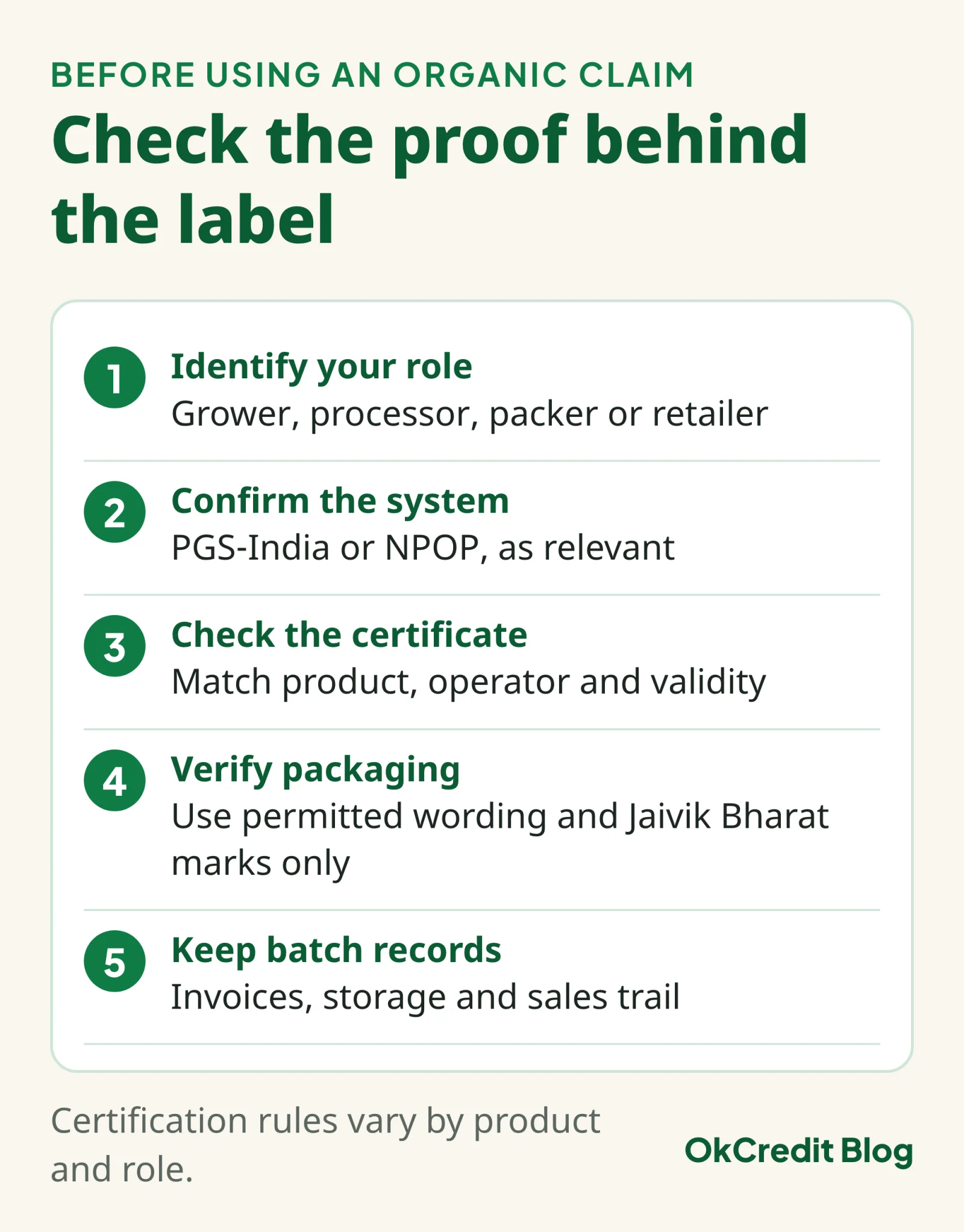
Check the product and your own role before printing a claim.
What makes an organic or unique idea a business?
Start with the buyer’s problem, not with a product trend. A customer may need traceable grains, a refill option, a local seasonal basket, a repair service, or a gift made by nearby artisans. The offer becomes a business when you can source it consistently, explain what makes it different, and leave enough margin after packaging, delivery, spoilage, payment fees and your own time.
Use a simple three-part check before buying equipment. First, interview ten likely buyers and ask what they bought the last time, from whom, and at what price. Second, ask two suppliers for invoices, minimum order quantity, delivery timing and proof behind product claims. Third, sell a small batch or service trial to real customers and record who paid, who returned, and why. Compliments and social media likes are not the same as paid demand.
Which small organic and differentiated ideas can be tested?
The ranges below are lean trial budgets, not all-in factory costs. They assume existing space or a home kitchen where lawful, owner labour, limited inventory and no vehicle purchase. Replace each input with local quotations before borrowing money.
| Idea | Lean trial budget | Why it can stand out |
|---|---|---|
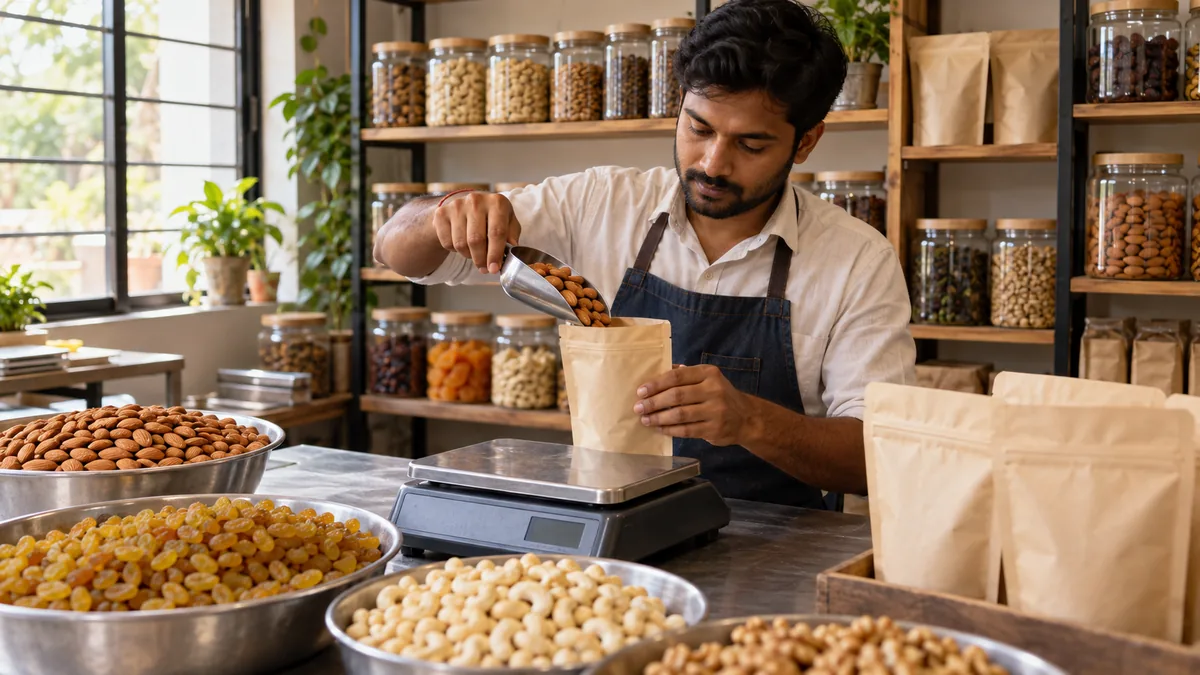
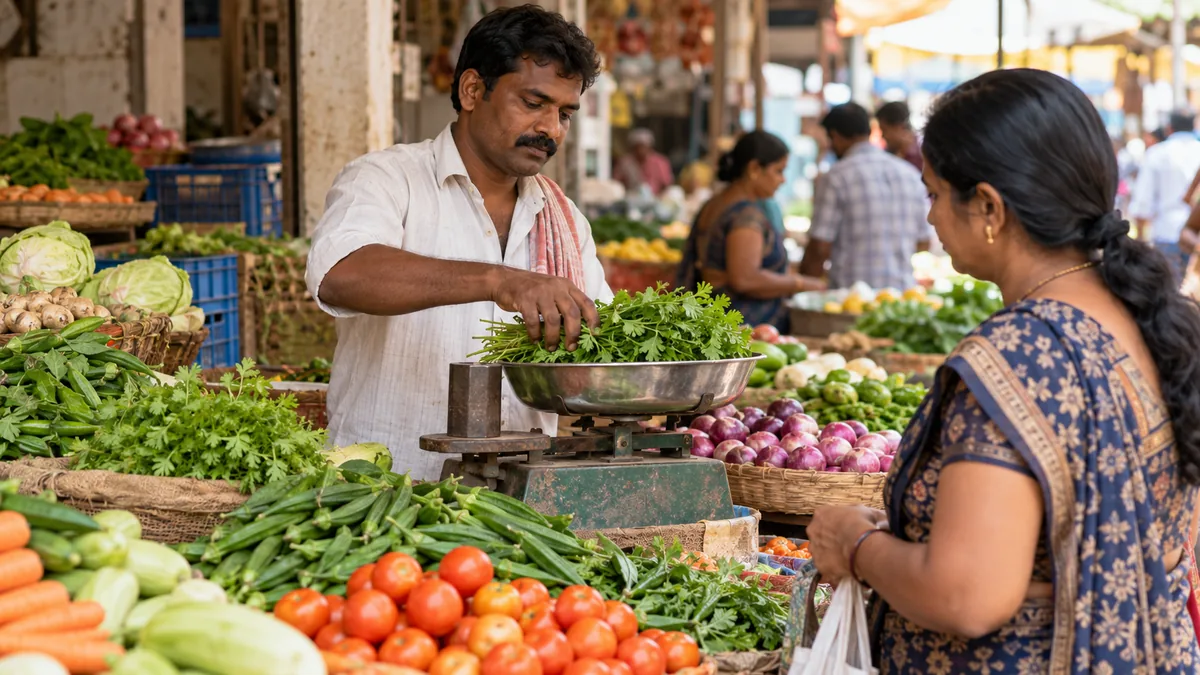
| Seasonal organic produce box | ₹25,000-₹80,000 | Planned weekly basket, verified source and predictable pickup |
| Millet or pulse flour micro-batch | ₹60,000-₹2 lakh | Local grain, small pack sizes and clear milling date |
| Spice blends from a regional recipe | ₹40,000-₹1.5 lakh | Narrow range, traceable ingredients and repeat kitchen use |
| Refill station for staples | ₹50,000-₹2 lakh | Customers bring containers, reducing packaging per refill |
| Compost and garden starter kits | ₹20,000-₹70,000 | Bundled compost, seed and instructions for balconies |
| Native plant nursery | ₹40,000-₹1.5 lakh | Species selected for local climate and water conditions |
| Repair and reuse workshop | ₹30,000-₹1.2 lakh | Extends use of clothes, appliances or furniture |
| Low-waste event supplies | ₹40,000-₹1.5 lakh | Reusable serving pieces and collection service for small events |
| Natural dye or artisan gift boxes | ₹50,000-₹2 lakh | Small-batch craft with maker and material details |
| Farm-to-café ingredient route | ₹75,000-₹2.5 lakh | Scheduled sourcing for a few cafés rather than open-ended delivery |
The figures are operational planning assumptions for trials. They exclude rent deposits, tax, certification, major machinery and working capital beyond the initial cycle. A food product with processing, storage or labelling will need a separate cost plan. Do not present the table as a vendor quotation or as a government-approved investment estimate.
How do you choose between growing, processing and reselling?
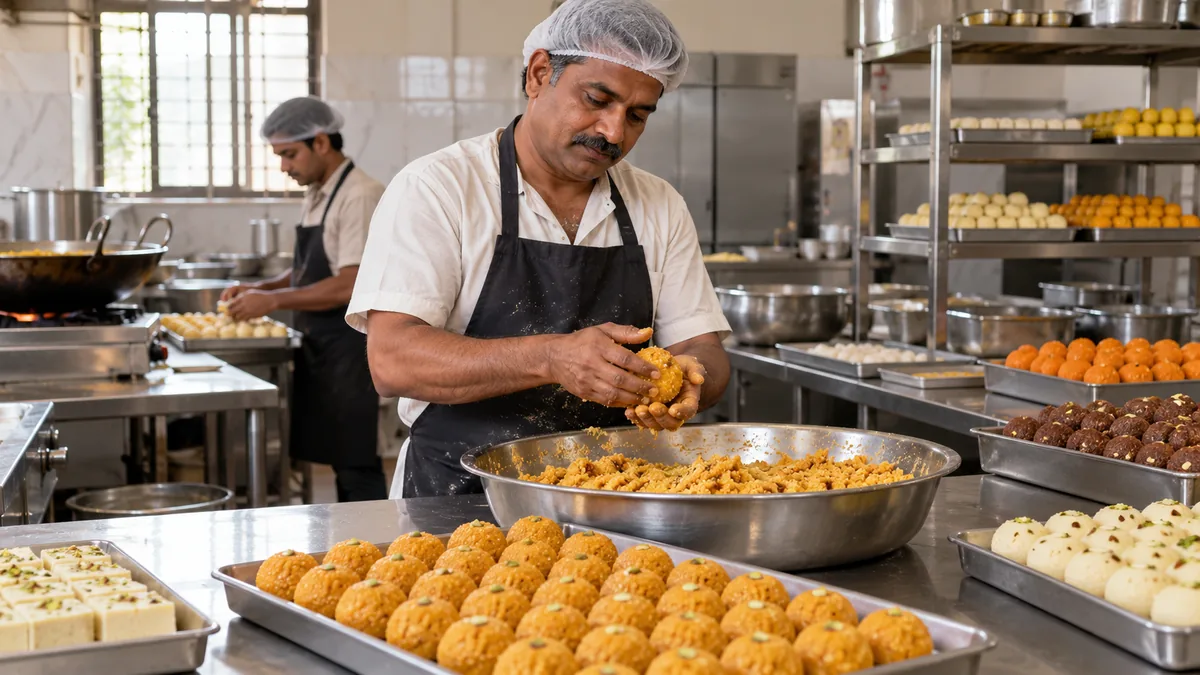
Growing gives you more control over cultivation, but requires land access, season planning, water, labour and a route to buyers. Processing makes the offer easier to store and package, yet adds equipment, hygiene, packaging and licensing decisions. Reselling can start with less machinery, but you need reliable suppliers and evidence that each item meets the claim on its label. A service such as repair, refill delivery or event reuse may avoid food certification, but still requires safe handling, clear pricing and any local business registration.
For a first test, choose the smallest version that still demonstrates the customer value. A farmer can offer a limited harvest box through a pickup point rather than promise year-round variety. A spice maker can test one blend in a permitted kitchen before buying a commercial grinder. A refill seller can start with two fast-moving staples rather than build a broad bulk store. A repair service can book a fixed number of jobs each week and track time, parts and repeat requests.
What does “organic” legally mean on a food label?
FSSAI’s Organic Foods Regulations recognise two certification systems: PGS-India and NPOP. PGS is designed for domestic and local markets, while APEDA implements NPOP, including its export certification framework. Check which scheme applies to your role and product before ordering packaging. Under NPOP labelling, a multi-ingredient product with at least 95% certified organic origin may be labelled “Organic”; products with at least 70% but less than 95% may use “Made with organic ingredients” (Jaivik Bharat guidance). PGS processed products have separate certification and group-identification requirements.
The word “natural” does not replace organic certification. Do not use the Jaivik Bharat or India Organic marks unless the business and product qualify under the rules. Keep supplier certificates, invoices, batch details and storage records. Separate certified and conventional stock so that an unverified product cannot be mixed into a certified lot. If you are only a retailer, still verify the supplier’s FSSAI details and the product label instead of repeating a sales claim that is not supported by records.
For food businesses, the 2026 FSSAI turnover categories changed from 1 April: registration applies up to ₹1.5 crore annual turnover, a State Licence above ₹1.5 crore up to ₹50 crore, and a Central Licence above ₹50 crore for the relevant business categories. Fees and activity categories also matter. A grower, processor, storage operator, repacker and retailer may have different FoSCoS selections. Confirm your exact kind of business on the official portal before launch; a threshold alone does not settle every licensing question.
How should you price a small-batch product?
Calculate landed cost per saleable unit. Include ingredient or wholesale cost, transport, cleaning or processing loss, packaging, label, payment charge, delivery support and a realistic allowance for returns or spoilage. Then compare the result with what customers already pay. An organic premium is not automatic. If a jar costs ₹68 in ingredients, ₹14 in packaging, ₹8 in local delivery allocation and ₹5 in processing loss, its direct cost is ₹95. Selling at ₹140 leaves ₹45 before rent, marketing, compliance, tax and owner wages. Treat that as contribution, not net profit.
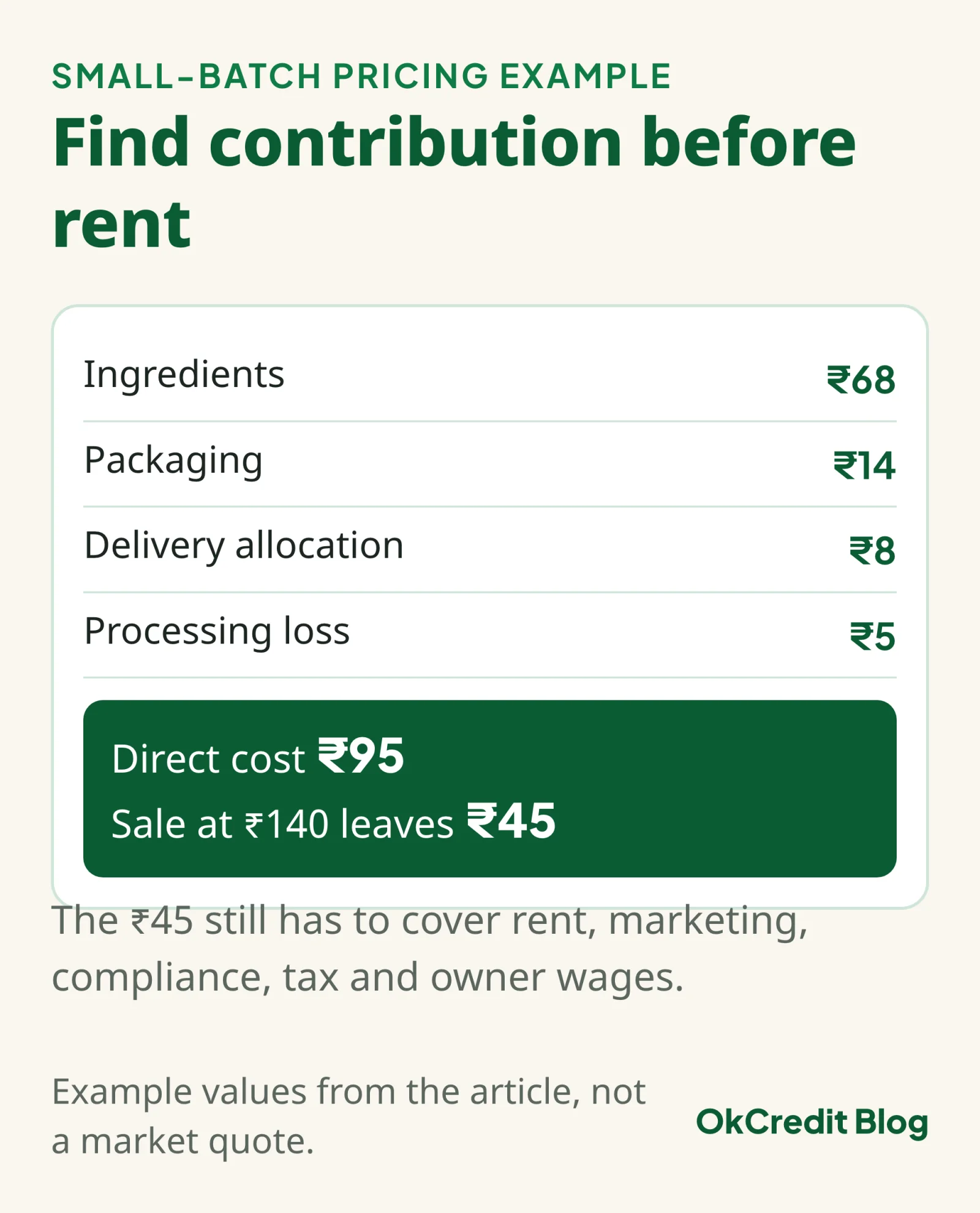
The remaining contribution still pays for operating costs and owner time.
Track each batch by date, quantity made, quantity sold, units discarded and customer feedback. If the first twenty units sell but the next batch sits for a month, the issue may be price, repeat frequency, shelf life, or the wrong buying channel. A café order can look large while creating a long payment delay. A direct-to-consumer basket may collect payment sooner but add delivery time and customer support.
Can government support reduce the initial cost?
The Ministry of Food Processing Industries describes PMFME credit-linked support for eligible individual micro food-processing units: 35% of eligible project cost, capped at ₹10 lakh, with at least 10% beneficiary contribution and the balance through bank credit. The listed support is conditional. It is not a cash discount at purchase, not automatic approval, and not an open-ended grant for every new idea. Check the current scheme window, state nodal office, eligible project costs and bank process before including it in your financing plan. The government page also identifies training around business operations, bookkeeping, food safety and product-specific processing.
If a project is not food processing, do not force it into PMFME. Ask your District Industries Centre or state startup and livelihood departments about schemes that currently apply. Write down the notification date and get eligibility confirmation from the implementing office. Prepare a small-business loan plan with a monthly cash-flow table before approaching a lender. Keep the expected subsidy separate from the base-case budget until it is sanctioned.
What should the first month of a pilot measure?
Set a fixed pilot period and a simple ledger. Record date, product or service, units offered, paid units, selling price, direct cost, delivery or travel cost, customer source, complaint and whether the buyer returned. For perishable food, include unsold quantity and temperature or storage notes where relevant. For repair or reuse, include labour minutes and parts. The objective is to learn which part of the offer creates repeat demand, not to produce an attractive launch post.
A small test should also check supplier reliability. Ask for a second delivery date before committing to a larger order. Verify the name on a certificate against the actual producer or processor. If a supplier cannot provide traceable paperwork, do not use their material for an organic claim. If an artisan product is sold as handmade or made in a particular district, keep a maker invoice or agreement that supports that description.
Choose one or two channels. A weekly pickup can reduce failed deliveries. A local café or retailer can test repeat bulk demand. A market stall can reveal how customers compare size, price and label. Do not launch on five platforms at once if you cannot update stock and answer customer questions promptly. Measure the money collected, not only the orders placed.
When the pilot works, expand one variable at a time: quantity, product variety, delivery radius or opening hours. If sales fall after adding a new item, you can identify the cause. Keep enough cash for the next supplier payment and returns. For a food line, test shelf life and label compliance before enlarging the batch. For a service, document the steps so that quality does not depend entirely on memory.
See how small local retailers plan stock and daily collection. A simple ledger helps compare purchase and customer dues, but it does not replace food-safety records, certification or tax filings.
Frequently asked questions
Can I call a food product organic if I buy it from an organic farmer?
Only if the product and your role meet the applicable FSSAI organic-food requirements and the certification or permitted exemption applies. Keep proof and check the current Jaivik Bharat guidance before printing the claim.
Which organic certification system should a small producer use?
FSSAI recognises PGS-India and NPOP. Their suitability depends on the product, market and sales route. Contact the relevant scheme or accredited certification body before production and labelling.
How much money is enough to test one idea?
A lean pilot may fit within the ranges in the table, but equipment, rent, certification and working capital can change the budget sharply. Get local written quotes and test actual paid demand first.
Does PMFME give every new food business a 35% subsidy?
No. The published support is credit-linked, eligibility-based, capped and depends on eligible project costs, bank credit and the current scheme process. Confirm an open application window before relying on it.
Is a unique product automatically profitable?
No. Differentiation may earn attention, but repeat purchases, contribution after delivery and steady supply determine whether the offer can sustain the business.