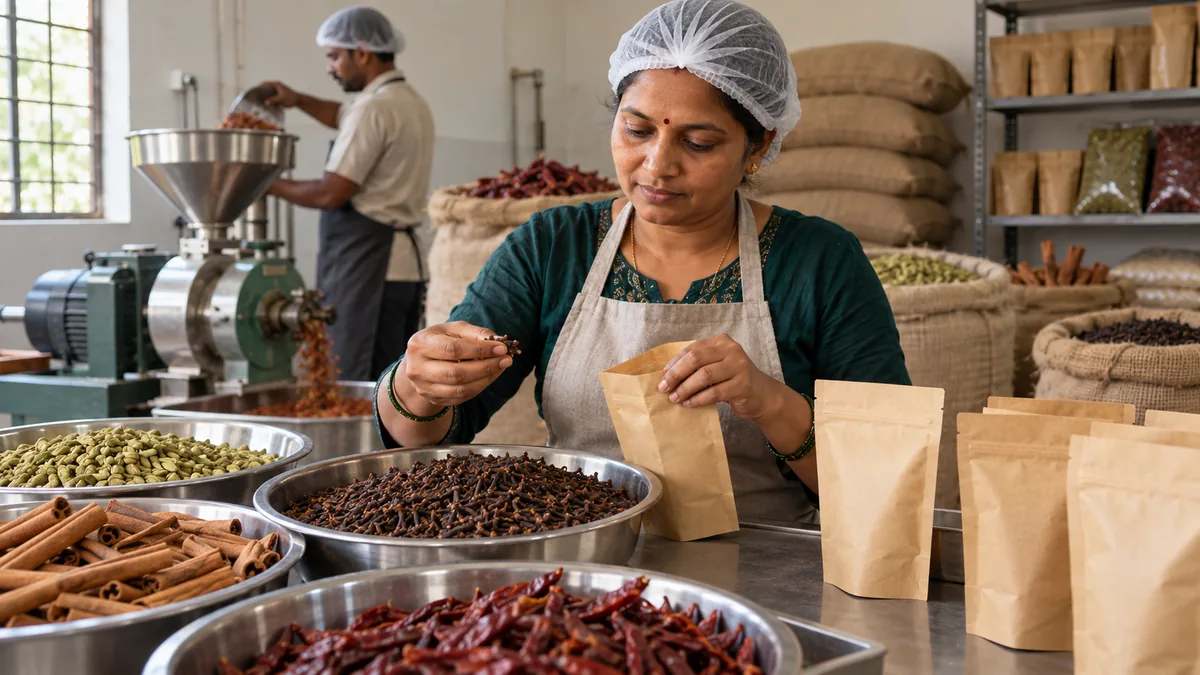
India’s spice suppliers range from whole-spice processors to exporters of sterilised powders, blends, oleoresins and customised food ingredients. Choose by end use and required testing, not by a broad “best manufacturer” claim. The Spices Board reports exports of 17.99 lakh tonnes valued at ₹39,994.48 crore in FY 2024–25; its current FY 2025–26 comparison is 17.34 lakh tonnes valued at ₹39,140.11 crore (Spices Board export statistics). That scale does not make every domestic supplier export-ready or every export certificate relevant to a local retail pack.
Which established spice manufacturers should buyers compare?
| Company | Publicly described base or scope | Ask procurement for |
|---|---|---|
| Synthite Industries | Kerala-based spice extracts and oleoresins, with multiple manufacturing sites | Extraction format, solvent/residue specification, allergen and batch documents |
| Symega Food Ingredients | Kerala operations including Taste Park; seasonings and food ingredient solutions | Blend composition, sample, application support, allergen statement and MOQ |
| Catch / DS Group | Consumer spice brand with broad retail spice and seasoning range | Whether the enquiry is for branded distribution, private label or bulk ingredient supply |
| Everest Food Products | National packaged-spice brand and blends | Current authorized channel, pack/lot traceability and product-specific label details |
| Aachi Masala Foods | Consumer spice powders and blended masalas | Current product catalogue, territory policy and applicable food licence |
| MTR Foods | Packaged spices and prepared mixes within a broader foods portfolio | Confirm product category, appointed distributor and storage requirements |
| Regional processors/exporters | Clusters vary by crop and processing need | Facility, cleaning/sterilisation steps, tests, residue limits and export credentials |
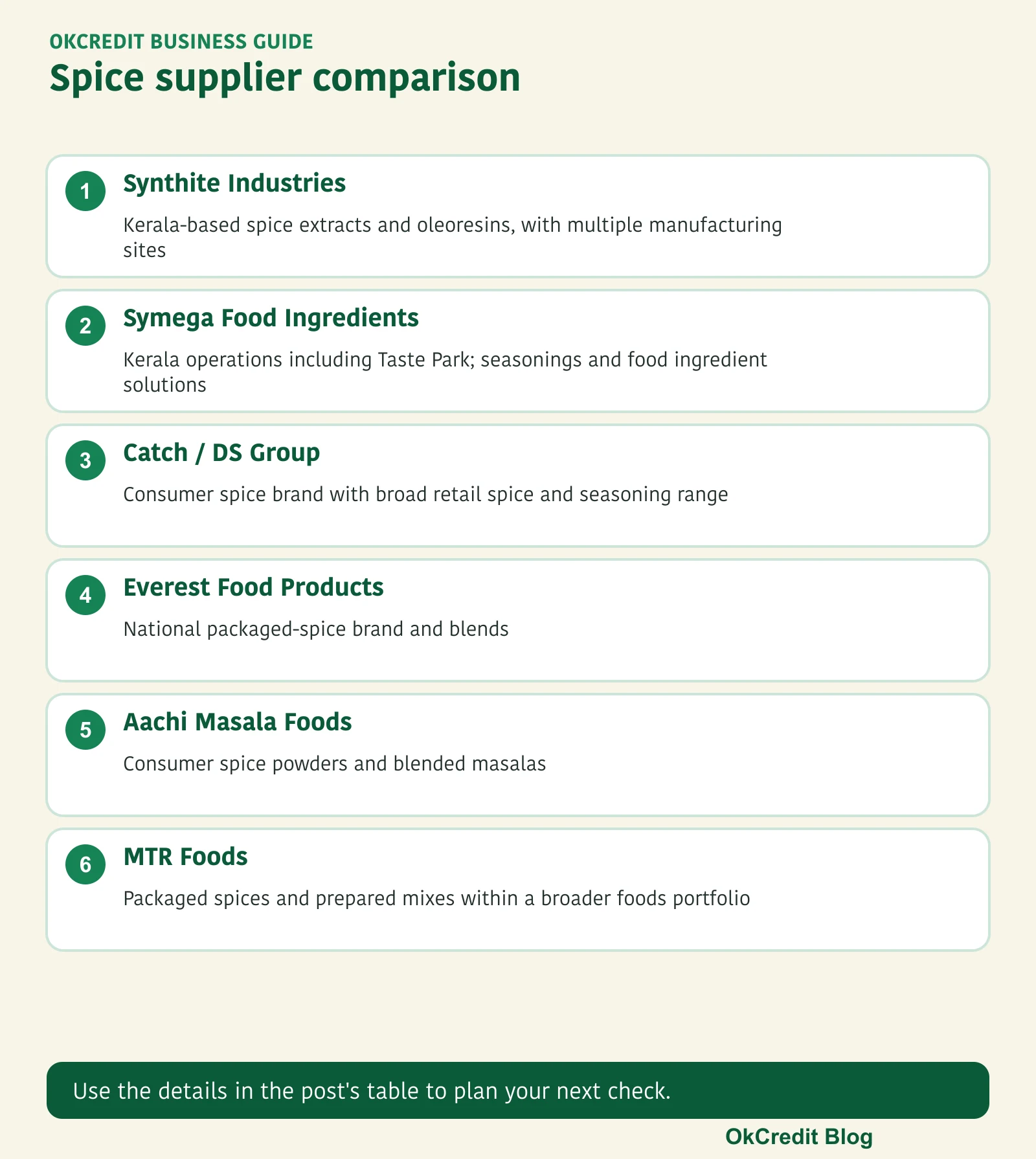
Established companies and supplier categories in the table.
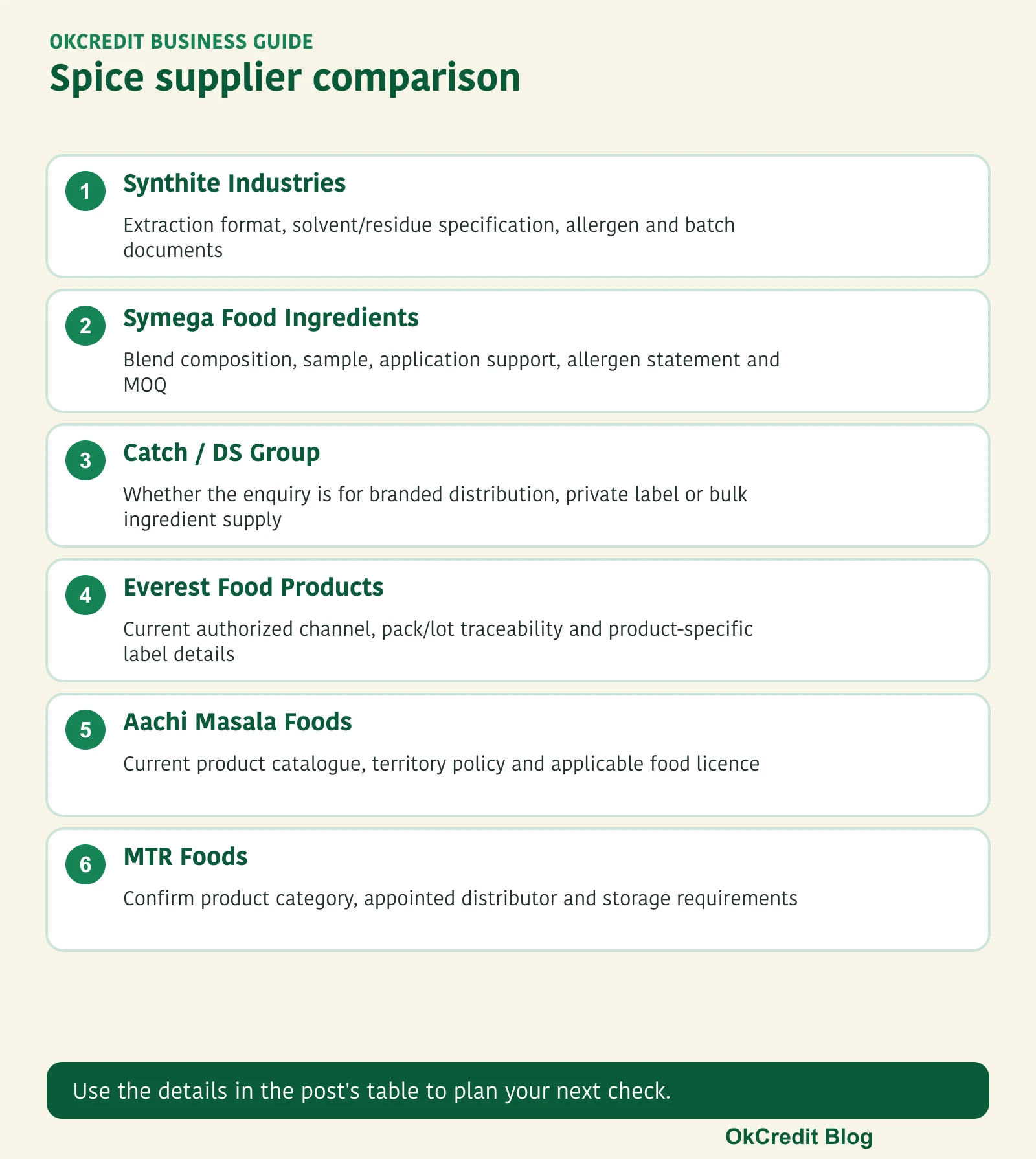
Check batch, food licence, tests and buyer specification.
The list is a shortlist for enquiry, not a claim that every named company accepts small contract orders. Consumer brands may sell only through appointed channels. Ingredients firms may need a technical brief and commercial-volume discussion before quoting. Ask the official company contact for the appropriate department, then confirm the response through the published switchboard.
What product should a buyer specify?
For whole spices, state variety, origin if material, crop/harvest period if known, moisture, foreign matter, broken percentage, size and packaging. For ground powders, specify mesh size, colour range, volatile oil or other quality parameters where relevant, microbial limits, pesticide-residue expectations, heavy metals and packaging barrier. For a masala blend, provide the recipe or target flavour profile, permitted ingredients, allergen controls and intended use. A supplier cannot quote a reproducible product from a generic request for “chilli powder.”
Ask for a representative sample and a batch-specific certificate of analysis. Agree which laboratory methods and limits apply before buying. If the product will be used in a food factory, provide the customer’s technical specification and ask the manufacturer to confirm each clause in writing. Certifications such as FSSC 22000, ISO 22000, HACCP or GMP are meaningful only when the certificate is current and its scope includes the actual site and activity. Verify certification with the issuing body.
How do you check food and export compliance?
A spice processor or packer must have the appropriate FSSAI registration or licence for its activity and premises. Check the licence on FoSCoS rather than relying on a logo on a brochure. Retail packs also require compliant declarations, including ingredient, allergen, net quantity, batch, date, manufacturer/packer details and other applicable statements. Legal Metrology requirements apply to packaged commodities. The exact duties depend on whether you are a manufacturer, brand owner, importer or reseller.
For export, the Spices Board states that an exporter must obtain the Certificate of Registration as Exporter of Spices (CRES). Destination-country limits can differ from domestic rules. Confirm the buyer’s residue limits, certificate and testing protocol for the destination; an Indian food licence alone does not meet every import requirement abroad. Check current Spices Board notifications and the importer’s written specification before booking a shipment.
How should a first lot be evaluated?
For a small business, compare landed price per usable kilogram. Include cleaning loss, processing loss, rejected material, freight, packaging, tax treatment and quality testing. A lower quote may be poor value if the lot has more stems, dust, moisture or inconsistent colour. Weigh a sample, check the seal and batch code, and retain a sealed counter-sample with the invoice and certificate.
For a retail brand or food-service buyer, trial the ingredient in the actual recipe. Record dose per serving, aroma after cooking, colour, heat, flavour balance and any variation across repeat batches. Do not approve only from a sniff test. Specify storage temperature and humidity, container type, use-by period after opening and first-in-first-out handling. Keep strong-smelling spices away from moisture and products that absorb odour.
How can a buyer avoid false agency claims?
Branded spice companies periodically warn customers about unauthorised agents and fake distributorship offers. Do not pay a “territory booking” fee to a person who contacted you on social media. Confirm distributor status directly with the company’s listed office, and verify the GSTIN and bank beneficiary against the named legal business. Ask for an appointment letter and a written price list. A genuine distributor should be able to explain the territory, minimum order, expiry/return policy and invoice process without guaranteeing profit.
Useful references include the Spices Board export page, its exporter FAQ, Synthite’s portfolio, Symega’s company profile, the Catch product range, FoSCoS and the CBIC goods-and-services rate schedule.
Frequently asked questions
Does a spice company’s export volume mean it will sell a small quantity to me?
No. Export presence describes business activity, not a retail minimum order or sales policy. Ask the company’s commercial team for the order channel and MOQ.
Is a lab certificate enough to accept a spice shipment?
It is one piece of evidence. Match its batch number to the delivered goods, review the test methods and limits, inspect the lot, and preserve a sample in case a dispute arises.
Does an FSSAI licence certify that a spice is organic?
No. Food licensing and organic certification are separate matters. For an organic claim, verify the applicable certification, product scope, traceability and label wording.
What is required to export spices from India?
The Spices Board requires CRES registration for spice exporters. Product testing, customs documentation and destination-market requirements also apply.