Britannia Industries and Parle Products are the two largest biscuit manufacturers in India as of 2026, with ITC's Sunfeast a clear third. Britannia reported Rs 18,169 crore revenue in FY2025; privately held Parle last disclosed Rs 17,223 crore for FY2023. Behind them sit Ravi Foods (Dukes), Mrs Bectors (Cremica), Surya Food (Priyagold), Anmol, Bisk Farm and a handful of strong regional makers.
How big is India's biscuit industry and who dominates it?
India is one of the world's largest biscuit markets by volume, and two companies, Parle and Britannia, account for most of what sells at a kirana counter. Older write-ups quote a precise global ranking and percentage shares; none of those figures come from a primary source we could check in 2026, so this post ranks companies by what they publish themselves: revenue, plants, capacity and outlet reach.
What can be said with a source: Kantar's Worldpanel Brand Footprint 2025 named Parle India's most-chosen FMCG brand for the 13th year running, with Britannia right behind it. ITC's Sunfeast is the only other national biscuit brand at that scale. Everyone else is either a strong regional player (Anmol and Bisk Farm in the east, Cremica and Bonn in Punjab, Dukes in the south) or a premium niche (Mondelez's Oreo, Unibic cookies).
The market splits into an organised sector running fully or semi-automated plants, and a large unorganised sector of local bakeries making biscuits by hand for nearby shops. The organised side is where the brands below live.
Which are the largest biscuit manufacturers in India?
Ranked by latest public revenue where it exists (Britannia, Parle), then by declared plant footprint and reach. Treat positions 4 onward as a tier, not a strict order: most of these companies are private and publish no comparable revenue number.
| # | Company | HQ | Founded | Ownership | Plants | Flagship biscuit brands | Scale signal (as of 2026) |
|---|---|---|---|---|---|---|---|
| 1 | Britannia Industries | Bengaluru (corporate); Kolkata (registered) | 1892 | Wadia Group; listed NSE/BSE | - | Good Day, Marie Gold, Tiger, 50-50, Bourbon, NutriChoice, Milk Bikis, Little Hearts, Treat (Jim Jam), Nice Time | Rs 18,169 crore revenue FY25 |
| 2 | Parle Products | Mumbai | 1928 (first factory 1929) | Private | 12 locations | Parle-G, Monaco, Krackjack, Hide & Seek, Milano | Rs 17,223 crore revenue FY23; 40+ brands; India's most-chosen FMCG brand (Kantar 2025) |
| 3 | ITC (Sunfeast) | Kolkata | Sunfeast launched July 2003 | Listed NSE/BSE (ITC Ltd) | ITC food plants | Dark Fantasy, Farmlite, Wowzers, Bourbon | National #3; Dark Fantasy since 2005, Wowzers crackers added 2025 |
| 4 | Ravi Foods (Dukes) | Hyderabad | - | Private | 17 in India | Dukes, Treff, Dynas | 17 plants across India |
| 5 | Mrs Bectors Food Specialities (Cremica) | Ludhiana | - | - | - | Cremica | Exports to 64 countries; co-manufactures Oreo for Mondelez since 2010 |
| 6 | Surya Food & Agro (Priyagold) | Greater Noida | 1994 | Private | Greater Noida plus other Indian sites | Priyagold | Exports to 20+ countries |
| 7 | Anmol Industries | Kolkata | - | Unlisted public company | Eastern India base | Anmol | Among India's top five biscuit makers, by its own account |
| 8 | SAJ Food Products (Bisk Farm) | West Bengal (Aparna Group) | 2000 | Private | 6 (Uluberia, Dhulagarh, Siliguri x2, Nagpur 2018, Bengaluru 2022) | Bisk Farm | Expanding from east into central and south India |
| 9 | Mondelez India (Oreo) | Mumbai | Oreo in India since 2011 | Subsidiary of Mondelez International | Co-manufactured (Cremica since 2010) | Oreo, Prince, Bournvita Biscuits | Premium cream niche; Oreo sold in 100+ countries |
| 10 | Unibic Foods | Bengaluru | 2004 | Private | - | Unibic cookies (incl. Anzac heritage range) | Entered India in 2004 with Anzac and Bradman heritage cookies |
| 11 | Patanjali Ayurved | Haridwar | Biscuits as a later addition to the food range | Private | Own food plants | Aarogya, Marie, Nariyal, Jeera, Creamfeast, Digestive, Ragi Digestive | Range spans marie, cream, crackers and digestive lines (2026) |
| 12 | Sona Biscuits (Sobisco) | Kolkata | 1988 | Private | Plants in 5 states | Sobisco | Regional, eastern India and beyond |
| 13 | Bonn Group (Americana) | Ludhiana | 1985 | Private | Punjab | Americana | Strong in north; pushing quick-commerce listings |
A few corrections to what older lists say. Britannia dates itself to 1892 in Kolkata, not 1918 (that was the year it incorporated as Britannia Biscuit Co.). Anmol was often called India's fourth-largest biscuit maker; the company's own claim today is "top five". Priyagold once got billed as India's top-selling biscuit brand; in 2026 the company itself says only that it is one of the industry's top players, and the brand with the strongest claim to that title is Parle-G, which Nielsen declared the world's largest-selling biscuit brand (Parle cites the 2003 survey; a 2011 Nielsen survey said the same). Ravi Foods' plant count has grown from 15 to 17. And Pillsbury, Nature Valley and McVitie's are not Indian manufacturers; McVitie's (founded 1830 by Robert McVitie, owned by pladis) shows up here only as a digestive-segment import. Haldiram's sells cookies, but it is a namkeen company, not a biscuit maker of scale.
Company profiles in brief:
Britannia Industries dates itself to 1892 in Kolkata and is now a Wadia Group company, listed on NSE and BSE, with corporate headquarters in Bengaluru and its registered office in Kolkata. It reported Rs 18,169 crore revenue in FY2025.
Parle Products is the House of Parle, founded by Mohanlal Dayal in 1928 with the first factory in 1929 and Parle-G (then Parle Gluco) launched in 1939. Monaco followed in 1942, Krackjack in 1972, Hide & Seek in 1996 and Milano in 2006. Parle is privately held, so its last audited public revenue is the FY2023 Rs 17,223 crore figure. Plants sit in Mumbai, Kanpur, Neemrana, Bengaluru, Hyderabad, Kutch, Khopoli, Indore, Pantnagar, Sitarganj, Bahadurgarh and Muzaffarpur.
ITC Sunfeast launched in July 2003 as ITC's entry into biscuits. Dark Fantasy (2005) built the premium cream-cookie segment in India; Farmlite (2014) covers oats and digestive; Wowzers crackers arrived in 2025.
Ravi Foods makes Dukes in Hyderabad and runs 17 plants across India, with Treff and Dynas as sister brands.
Mrs Bectors Food Specialities, the Ludhiana company behind Cremica, exports to 64 countries and has co-manufactured Oreo for Mondelez India since 2010.
Surya Food & Agro launched Priyagold in 1994 from Greater Noida and exports to more than 20 countries.
Anmol Industries, headquartered in Kolkata, is an unlisted public company that positions itself among India's top five biscuit makers.
SAJ Food Products (Bisk Farm), part of the Aparna Group, began in 2000 in West Bengal and has added plants in Nagpur (2018) and Bengaluru (2022), taking it to six.
Mondelez India sells Oreo (introduced by Nabisco in 1912, in India since 2011 via the then Cadbury India) and Prince. Britannia also owns a "Tiger" biscuit, so when you see Tiger on a wholesaler's list, check which company it is from.
Unibic Foods arrived in India in 2004 as an Australian subsidiary carrying Anzac and Bradman heritage cookies, and today sells its cookie range from Bengaluru.
Patanjali Ayurved sells a range that now includes Aarogya, Marie, Nariyal, Jeera, Butter Top, Creamfeast, High Kick crackers and several digestive and grain cookies. Older names like Doodh biscuit and Nutty Delite are no longer on its store.
Sobisco (Sona Biscuits, Kolkata, 1988) and Bonn Group (Ludhiana, 1985, Americana) round out the list as genuine regional manufacturers that older lists skipped while padding with American brands.
Which biscuit segments do these companies compete in?
Glucose biscuits, led by Parle-G, are the mass-market segment of Indian biscuits, and every other category has its own clear leader.
| Segment | What it is | Leading brands (2026) |
|---|---|---|
| Glucose | Small low-price packs, mass market, lowest margin per pack | Parle-G (Nielsen: world's largest-selling biscuit brand), Britannia Tiger, Priyagold, Anmol |
| Marie | Thin, lightly sweet tea biscuit | Britannia Marie Gold, Patanjali Marie, regional marie lines from Bisk Farm and Sobisco |
| Cream / sandwich | Two biscuits with a cream layer; the premium growth segment | Oreo, Parle Hide & Seek, Bourbon (Britannia and Sunfeast both sell one), Patanjali Creamfeast, Dukes, Cremica |
| Crackers / salted | Savoury, usually paired with tea | Parle Monaco, Parle Krackjack, Britannia 50-50, Sunfeast Wowzers, Patanjali High Kick |
| Cookies / premium | Butter, cashew, choco-chip | Britannia Good Day, Sunfeast Dark Fantasy, Parle Milano, Unibic, Patanjali Cashew and Almond cookies |
| Digestive / health-positioned | Oats, ragi, multigrain, fibre | Britannia NutriChoice, Sunfeast Farmlite, McVitie's Digestive, Patanjali Digestive range |
Two things a retailer should note. First, Parle, Britannia and ITC each sell in nearly every row above, which is why they take most of the shelf. Second, regional players win on price in glucose and marie, where a pack from Anmol or Priyagold competes directly with Parle-G in eastern and northern districts. Premium cookies and cream are where newer brands find room, and where quick-commerce listings (Bonn, Unibic, Oreo) matter most.
One caution on the "health" row: the labels are how companies position these products, not a nutrition claim by us. Read the pack.
How does biscuit distribution work for a retailer or distributor?
Biscuits reach a kirana through a four-step chain: company, then a carrying-and-forwarding (C&F) agent or super-stockist for the state, then a district or town distributor, then the retailer. Britannia and Parle both run this model; smaller brands like Bisk Farm or Sobisco often collapse C&F and distributor into one regional partner.
Applying for a distributorship. Neither Parle nor Britannia publishes an online distributor form as of 2026. Parle routes distributorship enquiries through its consumer-care line (1800-209-6929) and the contact page on parleproducts.com; Britannia through its distributors contact number (1-800-4254449). Expect to be asked for your existing FMCG lines, godown size, vehicles, and the towns you can cover daily. Newer brands (Bisk Farm, Bonn, Unibic, Patanjali) are easier to get and more active in appointing distributors outside their home states. The process is similar to getting a soft-drink agency; the walkthrough in how to start a soft drink agency covers the capital and godown questions you'll face.
Margins. Biscuit margins are thin at the retail counter and thinner on glucose packs than on cookies. No company publishes its trade margins, and the percentages you see quoted online are industry talk, not verified figures, so negotiate on actual invoice and scheme terms rather than a number from a blog. As a rule of thumb, distributors make money on volume and scheme accruals, not per-pack margin.
GST after September 2025. GST 2.0 took effect on 22 September 2025, collapsing most goods into 5% and 18% slabs. Biscuits were widely reported as moving from 18% to 5%, which triggered MRP cuts and scheme restructuring in late 2025. Confirm the current biscuit rate on cbic-gst.gov.in or with your CA before repricing old stock; the rate matters for your input credit and for how distributors pass on the cut.
Credit. Distributors supply most kirana stores on short credit, and retailers in turn run udhaar for their own customers. That second khata is where money gets stuck. To track customer credit, a free khata app like OkCredit keeps every entry backed up and sends automatic payment reminders.
If you are scouting the wider FMCG category, the detergent brands in India list works the same way: a few national players, many regional ones, and the regional ones are the easier distributorships to land.
Can a small business start biscuit manufacturing?
Yes, but start with paperwork: every biscuit unit needs an FSSAI licence, applied for online through FoSCoS (foscos.fssai.gov.in). There are three tiers, Basic Registration, State Licence and Central Licence, depending on your turnover and manufacturing capacity; the exact thresholds are on the FoSCoS portal, and an FSSAI consultant or your CA can confirm which tier your planned capacity falls into. You will also need GST registration, a factory licence from the state, and a local trade licence.
Capital. A semi-automatic line costs anywhere from lakhs to low crores depending on capacity; we could not verify a reliable 2026 figure from equipment vendors, so treat any single number you see online as a starting quote and get three written ones. Land, a baking oven and packaging machinery are the big-ticket items.
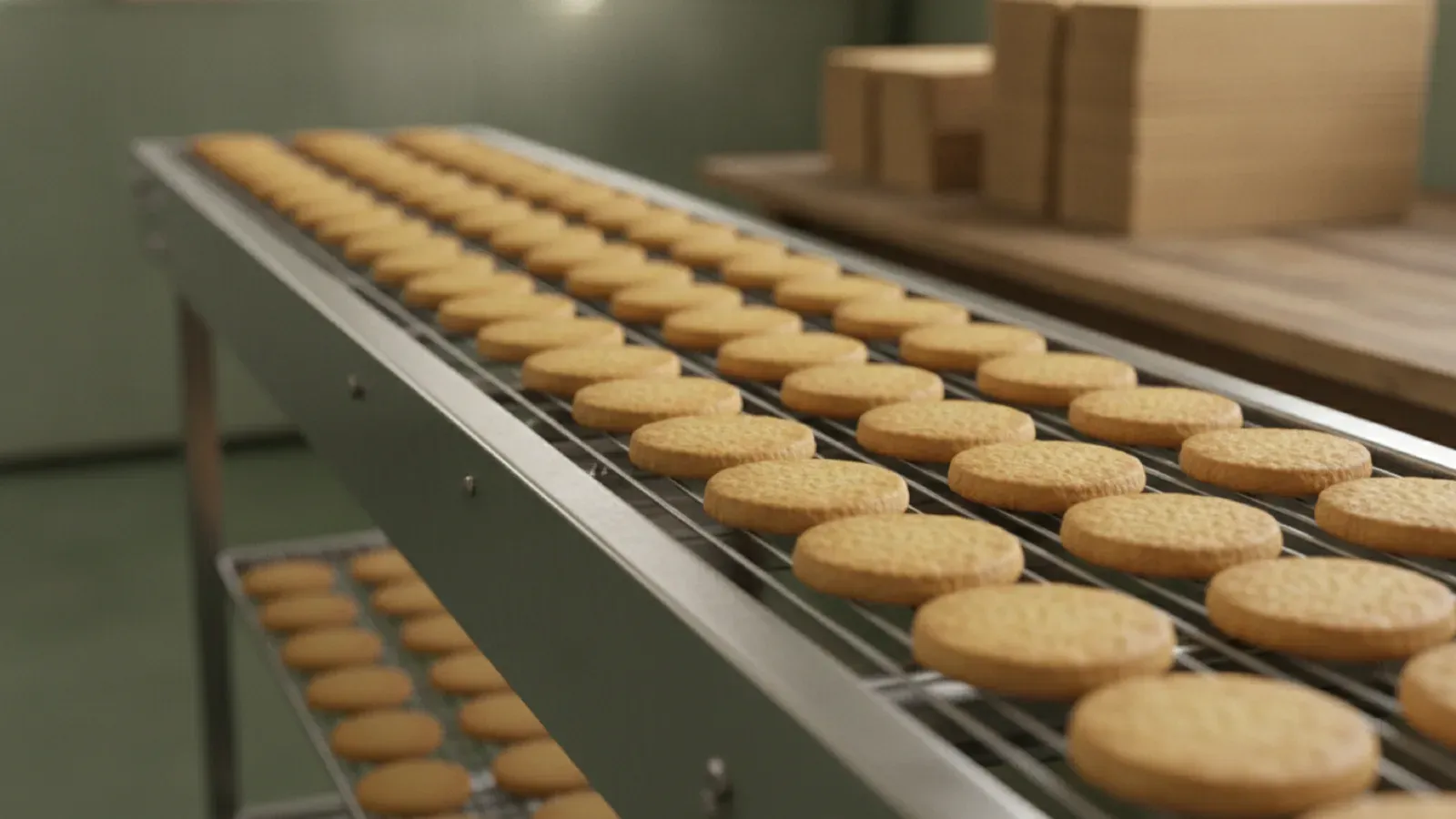
Machinery. A biscuit line is a sequence of machines: a dough mixer; a rotary moulder or cutter for hard biscuits (or a wire-cut depositor for cookies); a tunnel baking oven; a cooling conveyor; a cream sandwiching machine if you plan cream varieties; and a packing machine. Parle, Britannia and the regional players all run the same sequence, just faster and wider.
Contract manufacturing as the entry route. Big brands outsource volume: Cremica has co-manufactured Oreo for Mondelez India since 2010. A small unit with the right FSSAI licence tier and consistent quality can pitch for co-packing work rather than building a brand from zero. If you are locating in the NCR, where Priyagold sits, the list of manufacturing companies in Delhi gives a sense of the industrial clusters.
Earnings vary widely with capacity utilisation and whether you sell under your own brand or as a co-packer. Nobody can promise a monthly number, and anyone who does is selling you the machine.
FAQs
Which is the largest biscuit company in India?
By latest public revenue, Britannia Industries (Rs 18,169 crore in FY2025). Parle Products is privately held; its last disclosed revenue was Rs 17,223 crore for FY2023, and Kantar's 2025 Brand Footprint names Parle India's most-chosen FMCG brand. The two are effectively neck and neck.
Which is the number one selling biscuit brand in India?
Parle-G, going by the only brand-level data ever published: Nielsen declared it the world's largest-selling biscuit brand (Parle cites the 2003 survey; a 2011 Nielsen survey said the same). Claims that Priyagold or another brand is number one are not supported by any current source.
Parle vs Britannia: which is bigger?
Britannia posts higher reported revenue (Rs 18,169 crore FY25 against Parle's Rs 17,223 crore FY23), but the years are not comparable and Parle's brand reach is wider by Kantar's household-choice measure. Britannia is listed and diversified into dairy and bakery; Parle is private and also sells confectionery and snacks.
Which are the most popular biscuit brands in India?
Parle-G, Britannia Good Day, Britannia Marie Gold, Sunfeast Dark Fantasy, Parle Monaco, Hide & Seek, Oreo and Bourbon are the names that show up in almost every kirana in 2026. Which is "healthiest" depends on what you are comparing; check the ingredients panel rather than the front-of-pack wording.
How many biscuit manufacturers are there in India?
There is no official count. Thirteen companies of national or multi-state scale are listed above; beyond them are hundreds of single-plant regional makers and thousands of unorganised bakeries.